What this code means
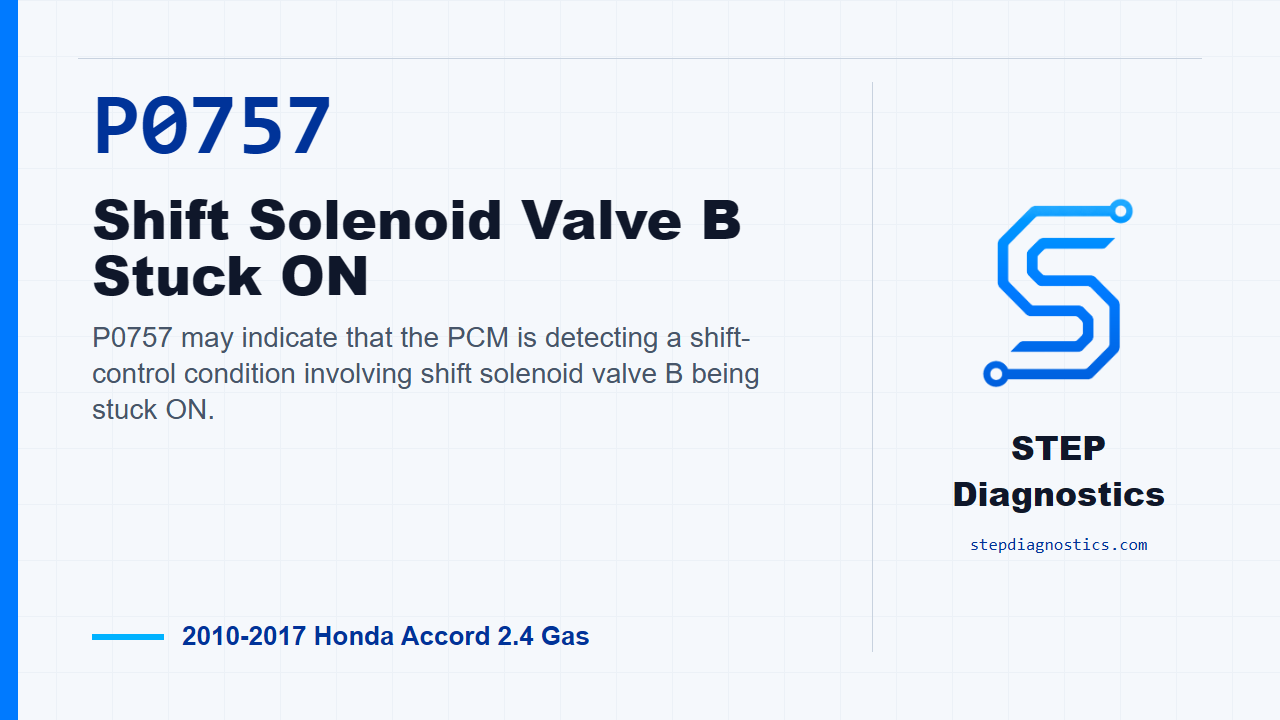
P0757 may indicate that the PCM is detecting a shift-control condition involving shift solenoid valve B being stuck ON.
What the vehicle may do
- The transmission may have wrong or limited gear operation.
- The vehicle can go into a fail-safe strategy and may be limited to 2nd or 4th gear.
- The concern may be intermittent and may only show up under similar operating conditions.
Possible fault areas
- ATF level, condition, or leaks may be involved.
- Internal transmission debris or clutch material can be possible clues.
- Shift solenoid valve B operation may be involved.
- The shift valve B hydraulic path may be involved.
Diagnostic path
Code overview
On this Accord, P0757 is for shift solenoid valve B stuck ON. In plain language, the PCM is seeing a shift-control problem that may show up as wrong gear engagement or limited shifting. When this code is stored, the transmission fail-safe can limit operation so it does not shift to any gear other than 2nd or 4th gear. The broad fault areas may include the ATF condition, internal clutch or metal debris, shift solenoid valve B operation, or the shift valve B hydraulic path. Before going deep, start with the basic system checks so you are not chasing a transmission fault with an obvious setup or system issue still present.
Start with the ATF and debris check
First, warm the engine up to normal operating temperature, to the point where the radiator fan comes on. Make sure the transmission is filled to the proper level, and check for fluid leaks. Then drain the ATF through a strainer and inspect what comes out. You are looking for metal debris or excessive clutch material. If the strainer has metal debris or excessive clutch material, the diagnostic path calls for transmission replacement. If it does not, replace the ATF and continue to the next step.
Duplicate the fault during the 5-6 shift
Next, raise the vehicle on a lift, make sure it is securely supported, and allow all four wheels to rotate freely. Turn the vehicle to the ON mode, clear the DTC with the HDS, start the engine, and disable VSA with the VSA OFF button. Test-drive the vehicle in D position or mode and let the transmission shift slowly to 6th gear. Watch the HDS data during the shift from 5th gear to 6th gear. If vehicle speed goes above 31 mph (50 km/h), enter VSA maintenance mode. If shifts are normal, repeat the check two or three times. What you are trying to prove is whether the 3rd Pressure Switch turns on momentarily in 6th gear, and then whether the 2nd Pressure Switch or the 4th Pressure Switch turns on in 6th gear. If that sequence happens, the failure is duplicated, so move on to the shift solenoid valve B check. If it does not happen, treat it as an intermittent failure and the system is OK at this time. If captured data for this code is available, try to reproduce the failure under the same conditions.
Command shift solenoid valve B
With the failure duplicated, use the HDS miscellaneous test menu and command shift solenoid valve B. Listen for the solenoid operation. If you hear the clicking sound, shift solenoid valve B is considered OK on this path, and the fault is shift valve B. The repair path is replacement of the secondary valve body for shift valve B. If you do not hear the clicking sound, the fault is shift solenoid valve B. The repair path is replacement of the secondary valve body for shift solenoid valve B.
Takeaway
The key is not to jump straight to a solenoid. On P0757, first check ATF condition and debris, then duplicate the 5-6 shift fault, then use the HDS command test to separate a solenoid problem from a shift valve problem. For more diagnostic training, visit stepdiagnostics.com.
Final check
This diagnosis is about proving the hydraulic/mechanical fault path in order: fluid and debris first, fault duplication second, and solenoid command testing last.
For more guided automotive diagnostics, visit STEP Diagnostics.