What this code means
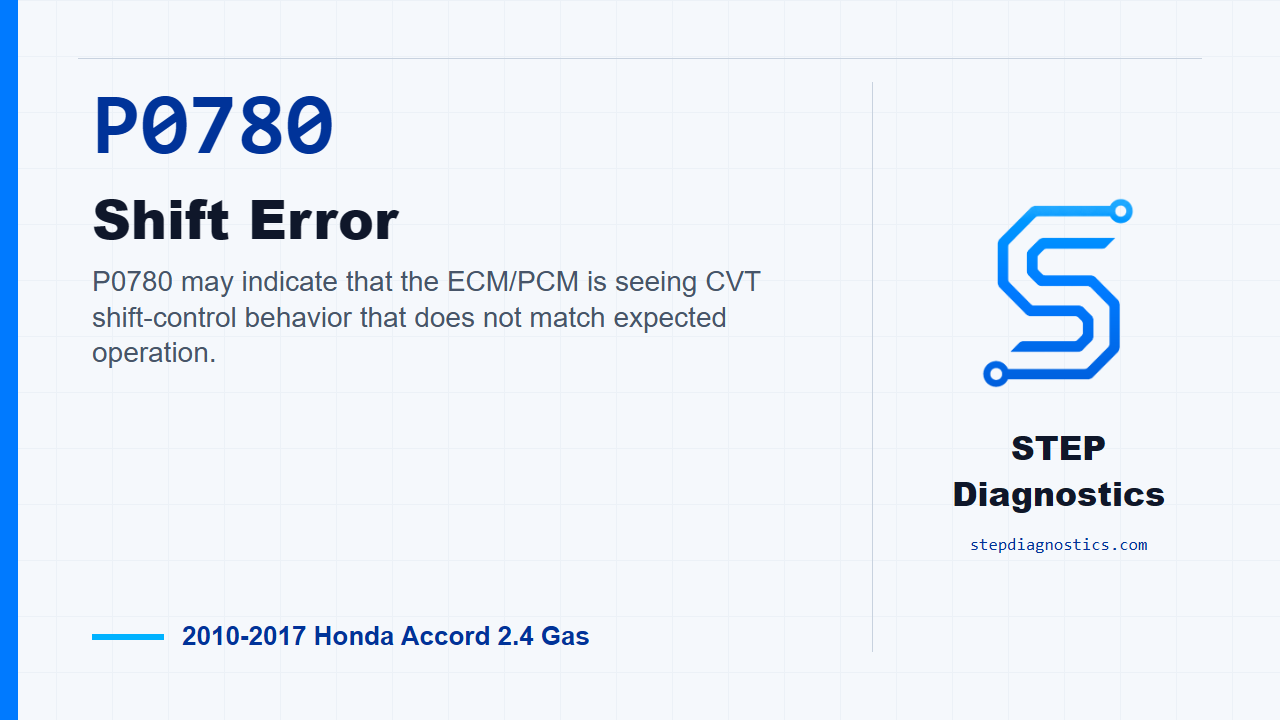
P0780 may indicate that the ECM/PCM is seeing CVT shift-control behavior that does not match expected operation.
What the vehicle may do
- The vehicle may have an abnormal shift feel.
- The vehicle can hesitate or feel inconsistent during acceleration.
- A warning light may be present, or the code may be noticed during a scan.
Possible fault areas
- Possible CVT shift-control monitoring concerns.
- Possible related control-system codes that need to be handled first.
- Possible PCM control or software evaluation after P0780 is isolated.
Diagnostic path
Open and set up the logic
On this 2010 to 2017 Honda Accord with the 2.4 gas engine, P0780 is a shift error in the CVT shift control system. In plain language, the ECM/PCM may be seeing shift-control behavior that does not match what it expects. The driver may notice an abnormal shift feel, hesitation, or a warning light, but it can also show up mainly as a stored code. The broad areas here are possible CVT shift-control faults, related control-system codes, and PCM control or software evaluation after the code is isolated. Before you troubleshoot it, save the freeze data and any on-board snapshot with the HDS, then start with the basic system checks. For P0780, the first move is not to jump into parts. The first move is to see whether P0780 is standing by itself or being set along with another relevant code.
Reproduce the code check
Turn the ignition switch to ON (II), or press the engine start/stop button to select ON mode. Clear the DTC with the HDS, then start the engine. Now test-drive the vehicle in D until vehicle speed reaches 37 mph (60 km/h). Slow down, stop the vehicle, then accelerate from a stop at full throttle in D until vehicle speed reaches 37 mph (60 km/h). After that drive cycle, use the HDS to check for any other Pending or Confirmed DTCs indicated along with P0780.
Decide whether P0780 is alone
If other codes are present, check what they mean first and follow the diagnostic path for the indicated code. Do not treat P0780 as isolated until the related code path has been handled. If there are no other DTCs along with P0780, update the PCM or substitute a known-good PCM, then move into repair verification.
Run repair verification
For verification, turn the ignition switch to ON (II), or press the engine start/stop button to select ON mode. Clear the DTC with the HDS. Start the engine, shift the lever to D while pressing the brake pedal, and wait for at least 5 seconds. Then test-drive the vehicle in D. Accelerate from a stop at over 0.6/8 throttle, using 1.26 V of the APP sensor voltage by monitoring APP Sensor A (V) with the HDS, until vehicle speed reaches 37 mph (60 km/h) on a flat road for at least 12 seconds. Slow down and stop the vehicle, then accelerate from a stop at full throttle in D until vehicle speed reaches 37 mph (60 km/h).
Read the verification result
Now monitor the OBD STATUS for P0780 in the DTCs menu with the HDS. If the status shows PASSED, troubleshooting is complete. If a known-good PCM was substituted, replace the original PCM. After that, check for other DTCs; if any other Pending or Confirmed DTCs are present, follow the diagnostic path for the indicated code. If the status shows FAILED, troubleshooting is incomplete. Go back to the beginning of the P0780 path and recheck it. If the PCM was updated, substitute a known-good PCM and check the OBD STATUS again. If the status shows NOT COMPLETED, the verification drive did not meet the test condition, so meet the test condition and check the OBD STATUS again.
Takeaway and CTA
The key with P0780 on this system is to prove whether it is tied to another CVT shift-control code first. If it is alone, the path moves to PCM update or known-good PCM substitution, followed by a clean verification drive and OBD status check. For more diagnostic training, visit stepdiagnostics.com.
Final check
P0780 often needs to be isolated from any related codes before PCM update or known-good PCM substitution is evaluated through repair verification.
For more guided automotive diagnostics, visit STEP Diagnostics.