What this code means
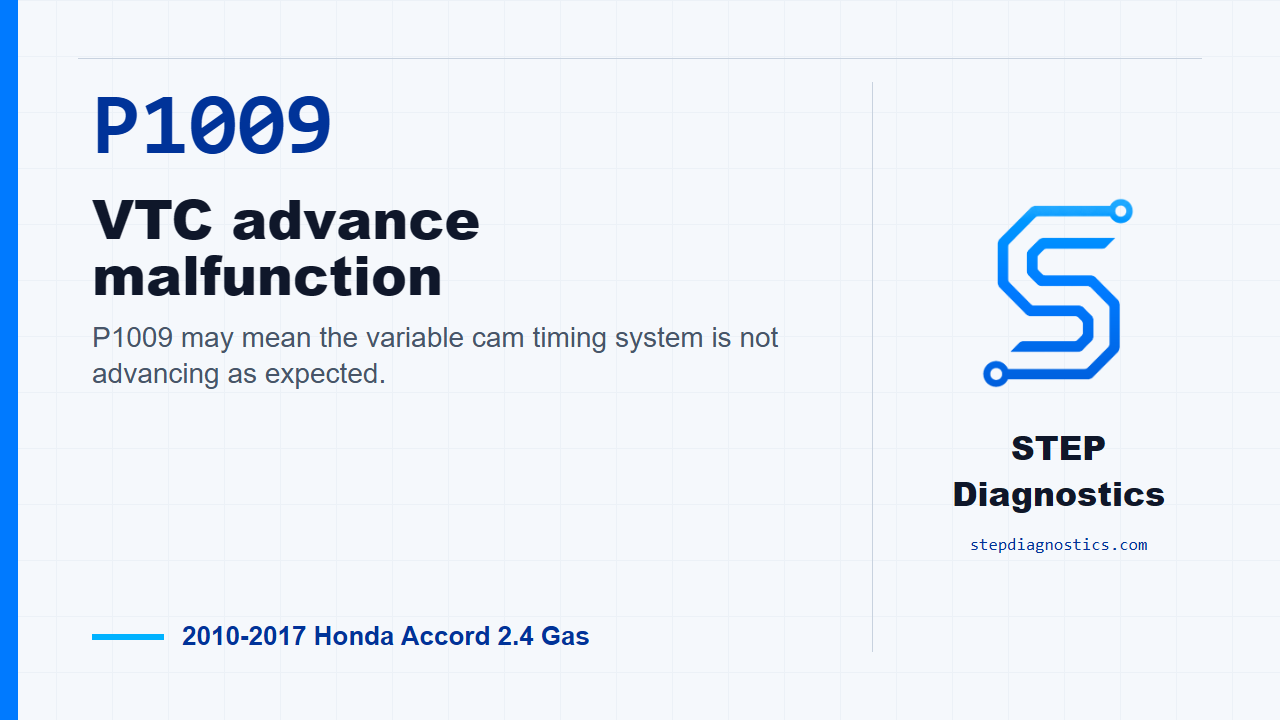
P1009 may mean the variable cam timing system is not advancing as expected.
What the vehicle may do
- The vehicle may have a check engine light.
- The engine may feel rough, hesitant, or down on power.
- The symptom can be intermittent or mild.
Possible fault areas
- Oil flow through the VTC circuit may be restricted.
- The VTC oil control solenoid valve may be involved.
- The VTC actuator may be involved.
- VTC oil passages or mechanical timing-related conditions may be involved.
Diagnostic path
Open and initial context
On this Accord with the 2.4 gas engine, P1009 is a VTC advance malfunction. In plain terms, the PCM may be seeing the variable cam timing system not advance the way it expects. The driver may notice a check engine light, roughness, hesitation, or reduced performance, but the symptom can also be mild. The broad fault areas can include oil flow through the VTC circuit, the VTC oil control solenoid valve, the VTC actuator, or a mechanical timing-related issue. Before you start testing, save the captured data and any on-board snapshot. If a related cam timing signal code is stored at the same time, handle P1009 first, then recheck for that other code afterward.
Confirm the fault before disassembly
Start by verifying the problem. Turn the ignition switch to ON (II), or use the engine start/stop button to select ON mode. Clear the code with the HDS, start the engine, and check Pending or Confirmed codes with the HDS. If P1009 comes back, continue into the VTC oil supply checks. If P1009 is not indicated, treat it as an intermittent failure and the system is OK at this time.
Check the VTC strainer first
Next, shut the vehicle down. Turn the ignition switch to LOCK (0), or select OFF mode with the start/stop button. Remove the VTC strainer and check it for clogging. This path starts with oil delivery because the actuator can only respond correctly if oil flow is getting through. If the strainer is OK, move on to the oil control valve test. If the strainer is not OK, clean the VTC strainer, replace the engine oil filter and the engine oil, then go to repair verification.
Test the VTC oil control solenoid valve
With the strainer ruled out, test the VTC oil control solenoid valve. This is the commanded hydraulic control point for the VTC system, so do not skip it and do not jump straight to the actuator. If the VTC oil control solenoid valve tests OK, continue to the actuator inspection. If it does not test OK, replace the VTC oil control solenoid valve, then go to repair verification.
Inspect the VTC actuator and oil passages
After the solenoid valve checks OK, inspect the VTC actuator. If the actuator is OK, check the VTC system oil passages and clean them if needed, then go to repair verification. If the actuator is not OK, replace the VTC actuator, then go to repair verification. One extra caution: if P1009 set after a VTC actuator replacement, verify that the correct timing marks on the crank pulley were used.
Verify the repair and confirm the code stays gone
Keep verification separate from the component checks. Turn the ignition switch to ON (II), or select ON mode with the start/stop button. Reset the PCM with the HDS. Do the CKP pattern clear, the PCM idle learn, and the CKP pattern learn. Then run the HDS VTC test, and monitor the OBD STATUS for P1009. If the status shows PASSED, troubleshooting is complete. If any other Pending or Confirmed codes are present, check what they mean next. If the status shows FAILED, go back to the beginning and recheck the diagnostic path. If the status shows NOT COMPLETED, retest and check the OBD STATUS again.
Takeaway
The clean way through P1009 is to prove the code first, then work through oil supply, solenoid control, actuator condition, and oil passages in order before final verification. For more diagnostic training, visit stepdiagnostics.com.
Final check
P1009 is best approached as a VTC hydraulic and mechanical response fault: confirm it, check oil flow first, then test the control valve, actuator, passages, and finish with a proper verification.
For more guided automotive diagnostics, visit STEP Diagnostics.