What this code means
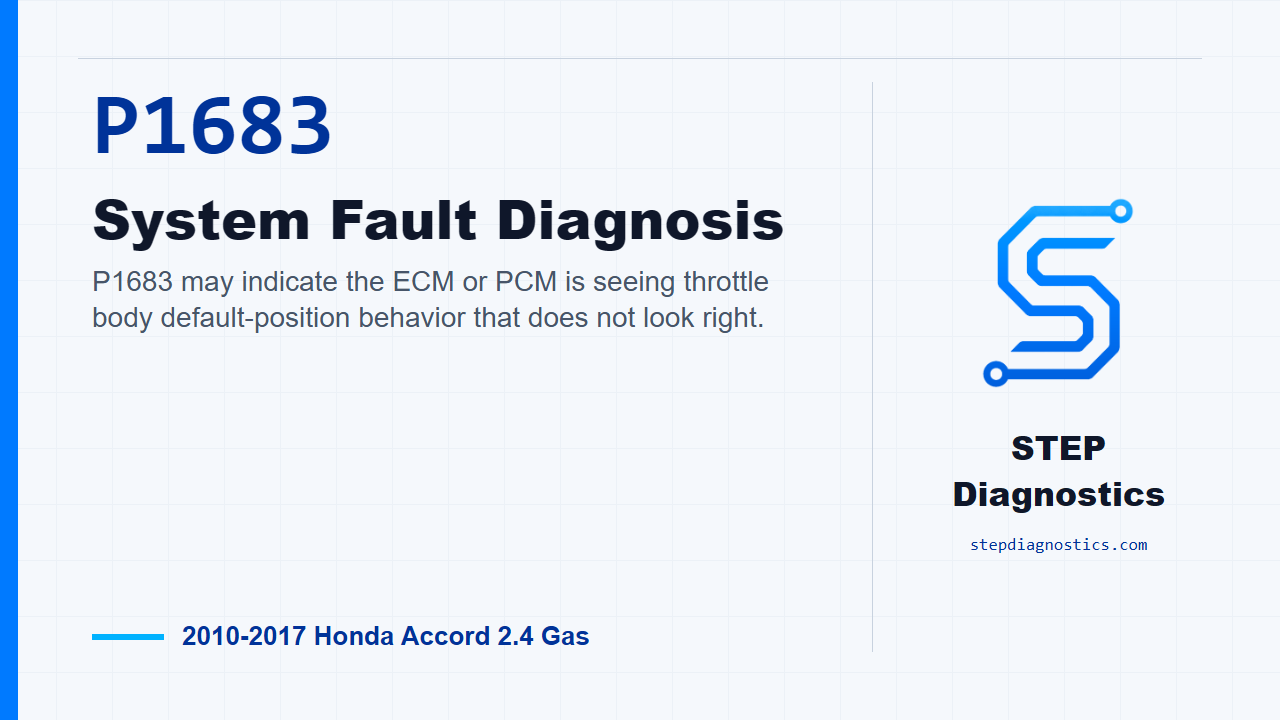
P1683 may indicate the ECM or PCM is seeing throttle body default-position behavior that does not look right.
What the vehicle may do
- The vehicle may turn on a warning light.
- The engine can have idle or throttle response concerns.
- The concern may be intermittent if the code does not return during testing.
Possible fault areas
- A dirty or sticking throttle plate is possible.
- A throttle body default-position return issue is possible.
- Poor connections or loose terminals at the throttle body or PCM can be involved.
Diagnostic path
Open and safety setup
On this 2010 to 2017 Honda Accord with the 2.4 gas engine, P1683 may mean the ECM or PCM is seeing a problem with the throttle body default-position behavior. The driver may notice a warning light, idle concerns, or reduced throttle response. Broadly, this can involve a throttle plate that is dirty or sticking, a default-position return issue inside the throttle body, or poor connections at the throttle body or PCM. Before starting, save the captured data and any on-board snapshot, then start with the basic system checks. Also, keep your fingers out of the installed throttle body any time the ignition is on or the vehicle is in ON mode. If the throttle valve moves, it can seriously injure your fingers.
Duplicate the fault first
Start by turning the ignition switch to ON (II), or press the engine start/stop button to select ON mode. Clear the code with the HDS. Then start the engine and hold it at 3,000 rpm with no load. For an automatic, keep it in P or N. For a manual, keep it in neutral. Hold that until the radiator fan comes on, then let the engine idle. Next, turn the ignition switch to LOCK (0), or select OFF mode, and wait for 10 seconds. Turn it back to ON mode and check Pending or Confirmed DTCs with the HDS. If P1683 comes back, the fault is duplicated and you move into the throttle body default-position spring check. If P1683 does not come back, treat it as intermittent for now. At that point, the system is okay at this time, and the next thing to inspect is poor connections or loose terminals at the throttle body and the PCM.
Check the throttle body return behavior
For the throttle body default-position spring check, turn the ignition switch to LOCK (0), or select OFF mode. Disconnect the intake air duct from the throttle body. Push the throttle valve closed, then release it and watch whether the throttle valve returns. This check depends on the correct throttle-valve push position. If that visual position is not clear, pause, recheck the earlier diagnostic path, and avoid guessing. If the throttle valve returns, clean the throttle body, then go to the repair verification. If P1683 is still indicated after that verification, replace the throttle body and verify again. If the throttle valve does not return, replace the throttle body, then verify the repair.
Verify the repair and confirm the code stays gone
For verification, turn the ignition switch to ON (II), or select ON mode. Reset the PCM with the HDS, then do the PCM idle learn procedure. Turn the ignition switch to LOCK (0), or select OFF mode, and wait for 10 seconds. Turn it back to ON mode and check Pending or Confirmed DTCs with the HDS. If P1683 is indicated, check for poor connections or loose terminals at the throttle body and the PCM, then go back and repeat the diagnostic path from the beginning. If P1683 is not indicated, this troubleshooting is complete. If other Pending or Confirmed DTCs are present, check what they mean next.
Takeaway
The key with P1683 is to prove the fault first, then separate an intermittent connection problem from a throttle body that will not return correctly. Keep the verification step separate, because that is what confirms the code stays gone after cleaning, repair, or replacement. For more diagnostic training, visit stepdiagnostics.com.
Final check
P1683 often comes down to duplicating the fault, checking whether the throttle valve returns correctly, and then verifying the code stays gone.
For more guided automotive diagnostics, visit STEP Diagnostics.