What this code means
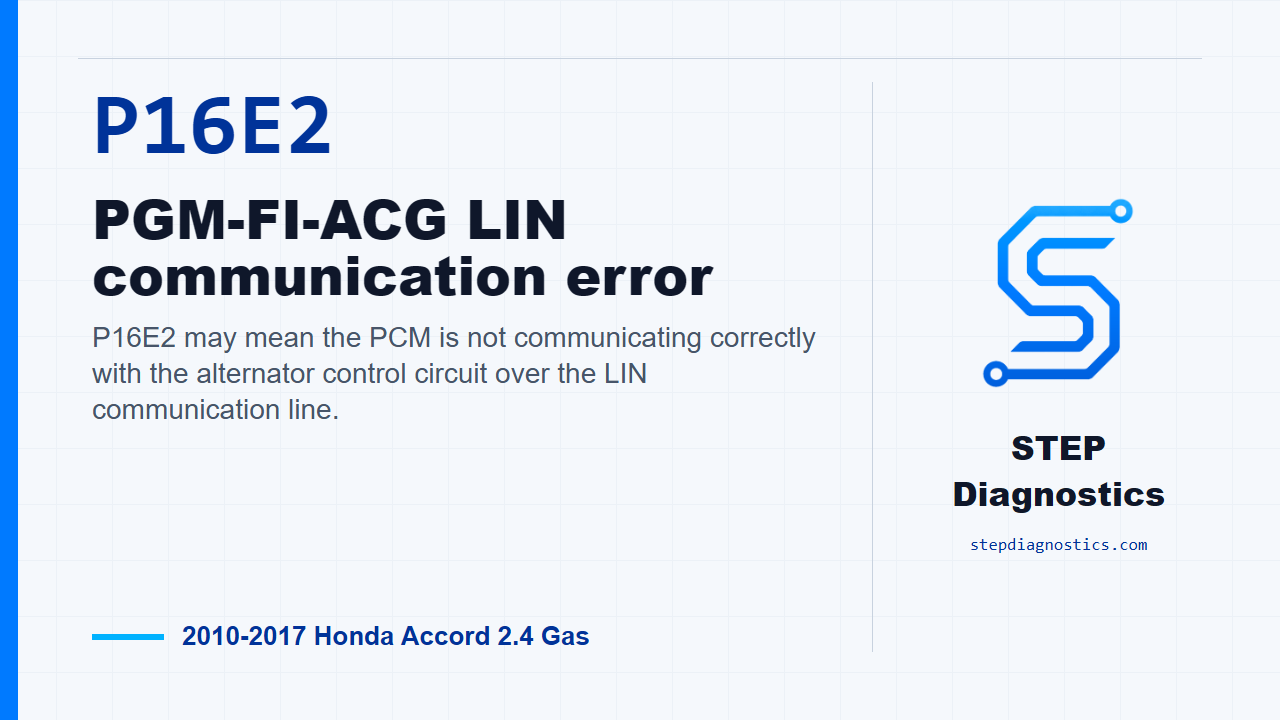
P16E2 may mean the PCM is not communicating correctly with the alternator control circuit over the LIN communication line.
What the vehicle may do
- The vehicle may show charging system concerns.
- The code may be intermittent.
- The vehicle may have no obvious symptom beyond a warning or stored DTC.
Possible fault areas
- Possible alternator connection or terminal fit issue.
- Possible LIN communication wire problem between the alternator and PCM.
- Possible PCM software or PCM-related concern.
Diagnostic path
Open and context
Today we’re diagnosing P16E2 on a 2010 to 2017 Honda Accord with the 2.4 gas engine. In plain terms, this code may point to a communication problem on the LIN line between the PCM and the alternator control side. The vehicle may show charging system concerns, the code may be intermittent, or there may be no obvious symptom besides a warning or stored DTC. The broad possible fault areas are the alternator connection, the LIN wire between the alternator and PCM, terminal fit, PCM software, or the PCM itself. Before getting deep into testing, save the captured data and on-board snapshot, take care of the basic checks, and make sure the alternator +B terminal is not loose. A loose +B terminal can store this code.
Verify the problem first
Start by proving whether the fault is active. Turn the ignition switch to ON (II), or use the engine start/stop button to select ON mode. Clear the DTC with the HDS. Then turn the ignition to LOCK (0), or select OFF mode. Turn it back to ON (II), or ON mode, and check for Pending or Confirmed DTCs with the HDS. If P16E2 comes right back, the failure is duplicated and you move into circuit testing. If it does not come back, treat it as intermittent right now. The system is OK at this time, so concentrate on poor connections or loose terminals at the alternator and the PCM.
Separate alternator from the rest of the path
Next, narrow down whether the problem is at the alternator side or elsewhere in the LIN circuit. Turn the ignition to LOCK (0), or OFF mode, and disconnect the Alternator 1P connector. Turn the ignition back to ON (II), or ON mode. Measure voltage on the LIN circuit between Alternator 1P connector No. 1, the YEL wire, and body ground. With the alternator connector disconnected and ignition on, the decision point is simple: is there 0 V? If there is 0 V, continue to the LIN wire short check. If there is not 0 V, replace the alternator, then verify the repair.
Check the LIN wire for a short to ground
For the short check, turn the ignition to LOCK (0), or OFF mode. Jump the SCS line with the HDS, then disconnect PCM connector B, the 51P connector. With the Alternator 1P connector still disconnected and PCM connector B disconnected, check continuity between Alternator 1P connector No. 1, the YEL wire, and body ground. If there is continuity, repair a short in the LIN wire between the alternator and PCM B40, then verify the repair. If there is no continuity, the LIN wire is not shorted, so move on to the open-wire check.
Check the LIN wire for an open
Now check the same LIN circuit for continuity end to end. Keep the ignition in LOCK (0), or OFF mode, with the Alternator 1P connector disconnected and PCM connector B, the 51P connector, disconnected. Check continuity between Alternator 1P connector No. 1, the YEL wire, and PCM connector B No. 40, also the YEL wire. If there is no continuity, repair an open in the LIN wire between the alternator and PCM B40, then verify the repair. If there is continuity, the LIN wire is OK. At that point, update the PCM if it does not have the latest software, or substitute a known-good PCM, then verify the repair.
Verify the repair
Keep verification separate from the circuit checks. Reconnect all connectors, exit SCS mode with the HDS, then turn the ignition switch to ON (II), or select ON mode. Reset the PCM with the HDS, do the PCM idle learn procedure, and check again for Pending or Confirmed DTCs with the HDS. If P16E2 is still indicated, recheck for poor connections or loose terminals at the alternator and PCM. If the PCM was updated, substitute a known-good PCM and recheck. If the PCM was already substituted, go back to the initial problem verification and avoid guessing. If P16E2 is not indicated, troubleshooting is complete. If a substituted PCM fixed the issue, replace the original PCM. If other Pending or Confirmed DTCs are present, check what they mean next.
Takeaway
The clean path for P16E2 is to confirm the code, check the alternator-side LIN voltage, prove the LIN wire is not shorted or open, then handle the PCM software or known-good PCM path only after the wiring checks pass. For more diagnostic training, visit stepdiagnostics.com.
Final check
Confirm the fault first, test the LIN circuit in order, and verify the repair before calling the diagnosis complete.
For more guided automotive diagnostics, visit STEP Diagnostics.