What this code means
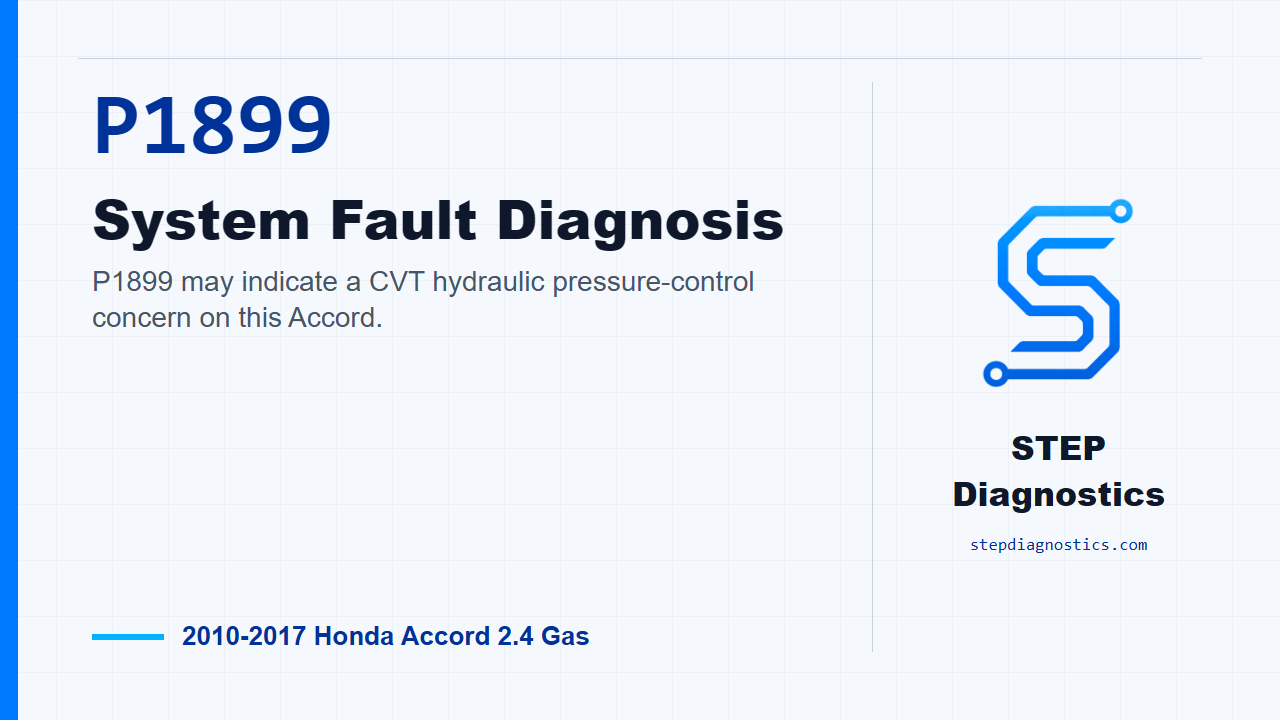
P1899 may indicate a CVT hydraulic pressure-control concern on this Accord.
What the vehicle may do
- The vehicle may feel normal during some driving.
- The vehicle can show abnormal CVT behavior during acceleration.
- The concern may be intermittent.
Possible fault areas
- Possible CVT pulley pressure-control area concern.
- Possible drive or driven pulley pressure control solenoid valve involvement.
- Possible CVT hydraulic control issue.
Diagnostic path
Open on what P1899 means
On this 2010 through 2017 Honda Accord with the 2.4 gas engine, P1899 may point to a CVT hydraulic pressure-control problem. The vehicle may feel normal, or it can act up during acceleration when the transmission is trying to control pulley pressure. Broadly, this code keeps us focused on the CVT pressure-control side of the system, especially the drive and driven pulley pressure control solenoid valves. We’re going to keep the diagnosis narrow: capture the data first, reproduce the conditions, see if P1899 comes back with its companion transmission code, and then verify the result correctly.
Capture data before clearing anything
Before clearing codes or road-testing, save all recorded data and any on-board snapshot with the HDS. Also start with the basic system checks so you are not chasing a code with missing background information. That first data capture matters, because once the code is cleared, the original operating snapshot may be gone.
Verify the problem
For the problem verification, turn the ignition ON, either with the ignition switch in ON (II), or by selecting ON mode with the engine start/stop button. Clear the DTC with the HDS, then start the engine.
Run the road test conditions
Now road-test the vehicle in D. Drive until vehicle speed reaches 37 mph (60 km/h). Then slow down, stop the vehicle, and accelerate from a stop at full throttle in D until vehicle speed reaches 37 mph (60 km/h) again. After that, check for Pending or Confirmed DTCs with the HDS.
Make the problem-verification decision
At this point, the decision is simple. If P1899 is indicated along with its companion transmission code, replace the CVT drive pulley pressure control solenoid valve and/or the CVT driven pulley pressure control solenoid valve, then move to verification. If the codes are not indicated, treat it as an intermittent failure and the system is OK at this time.
Verify the repair separately
For verification, turn the ignition ON again, either to ON (II), or ON mode with the engine start/stop button. Clear the DTC with the HDS, then start the engine. Road-test in D and accelerate from a stop at over 0.6/8 throttle, with 1.26 V of APP sensor voltage while monitoring APP Sensor A (V) on the HDS. Do this on a flat road until vehicle speed reaches 37 mph (60 km/h) for at least 12 seconds. Then slow down, stop, and accelerate from a stop at full throttle in D until vehicle speed reaches 37 mph (60 km/h).
Read the OBD status result
After the verification drive, monitor the OBD status for P1899 and its companion code in the HDS DTC menu. If the status shows PASSED, troubleshooting is complete. If a PCM had been substituted, reinstall the original PCM, then check for any other Pending or Confirmed DTCs and follow those diagnostic paths if needed. If the status shows FAILED, the troubleshooting is incomplete: go back to the beginning and recheck the path. If the PCM was updated, substitute a known-good PCM and check the OBD status again. If the status shows NOT COMPLETED, the verification did not run to completion, so meet the test conditions and check the OBD status again.
Close
The key is not to guess from P1899 alone. Save the data, reproduce the CVT operating conditions, make the decision from the HDS result, and keep verification separate from the repair path. For more diagnostic training, visit stepdiagnostics.com.
Final check
Use the scan-tool result and the verification drive to confirm whether the code is current, intermittent, or resolved.
For more guided automotive diagnostics, visit STEP Diagnostics.