What this code means
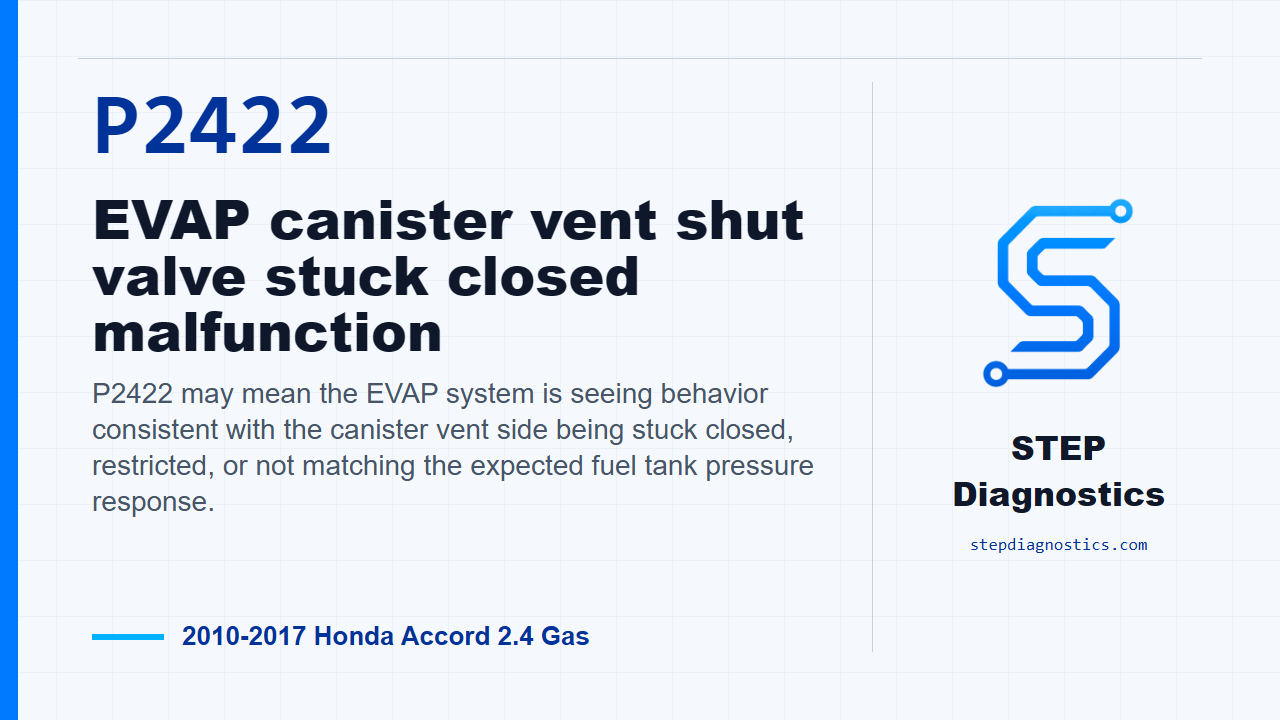
P2422 may mean the EVAP system is seeing behavior consistent with the canister vent side being stuck closed, restricted, or not matching the expected fuel tank pressure response.
What the vehicle may do
- The check engine light may be on.
- The vehicle may drive normally while the EVAP monitor stores the fault.
- The EVAP monitor can be difficult to complete if the condition is intermittent.
Possible fault areas
- The EVAP canister vent shut valve may be involved.
- A vent hose, vent port, drain joint, or canister passage may be restricted.
- The FTP sensor signal or its connector path may be involved.
- The canister may have an internal restriction.
Diagnostic path
Opening and setup
On this Accord, P2422 is pointing at the EVAP canister vent shut valve circuit behavior, basically the system thinks the canister vent side may be stuck closed or the tank pressure signal may not be returning the way it should. The driver may only notice a check engine light, and sometimes the EVAP monitor can be difficult to complete. Broadly, keep your mind on the vent shut valve, restrictions in the EVAP vent paths, the canister, the FTP sensor, and the wiring or terminal condition around that signal. Before you clear anything, save the captured data and any on-board snapshot so you can compare the test conditions later.
Initial EVAP system check
Start with the basic system checks. Turn the ignition ON, clear the code with the HDS, then turn the ignition OFF. Remove the fuel fill cap and wait 1 minute. Turn the ignition back ON and look at the FTP SENSOR parameter on the HDS. The decision point here is whether the FTP SENSOR reading is within the threshold of -0.67-0.67 kPa. If it matches that range, move into duplicating the failure. If it does not, skip ahead to the FTP sensor vent hose side of the diagnosis.
Duplicate the P2422 failure
Install the fuel fill cap, clear the code again, start the engine, and let it idle with no load until the radiator fan comes on. Then watch EVAP PC DUTY in the HDS data list while holding engine speed at 3,000 rpm with EVAP PC DUTY at 20 % or more for at least 4 minutes. After that, let the engine idle and check the OBD STATUS for P2422. If the HDS shows FAILED, the failure is duplicated and you continue with the vent line check. If it shows PASSED, treat it as an intermittent at this time: compare the on-board snapshot conditions, including fuel level, engine speed, vehicle speed, and outside temperature, then check for loose connections or terminal problems between the FTP sensor and the PCM, and look for blockage in the FTP sensor vent port, FTP sensor vent hose, EVAP canister vent hose, and drain joint. If the status is NOT COMPLETED, keep it idling until the test gives a result.
Vent line and vent shut valve checks
With the failure duplicated, clear the code, turn the ignition OFF, and disconnect the EVAP canister vent hose from the canister. Turn the ignition ON and check the FTP SENSOR reading again against -0.67-0.67 kPa. If the reading now matches the threshold, the path points to a blockage in the EVAP canister vent hose or the drain tube joint before you verify the repair. If the reading does not match, move to the vent shut valve. Turn the ignition OFF, remove the EVAP canister vent shut valve from the canister, connect its 2P connector, turn the ignition ON, and use the HDS EVAP test to command EVAP CVS ON in the single-solenoid test. Watch the valve operation. If the valve is free of corrosion and operates properly, keep going because the valve is considered OK. If it is corroded or does not operate properly, replace the EVAP canister vent shut valve and then verify the repair.
FTP sensor vent hose, port, and canister path
Next, disconnect the vent hose from the FTP sensor and check the FTP SENSOR parameter with the HDS against -0.67-0.67 kPa. If it matches that threshold, the diagnostic path points to a blockage in the FTP sensor vent hose before repair verification. If it does not, turn the ignition OFF, remove the FTP sensor from the EVAP canister while leaving the connector connected, and check the FTP SENSOR parameter again. If that final reading matches -0.67-0.67 kPa, the FTP sensor port is OK and the path identifies an internal blockage in the EVAP canister; replace the EVAP canister and verify the repair. If that final reading does not match the threshold, replace the FTP sensor and verify the repair.
Verify the repair
Keep verification separate from the testing. Turn the ignition OFF and reinstall the removed parts in reverse order. Turn the ignition ON, reset the PCM with the HDS, and perform the PCM idle learn procedure. Then monitor the OBD STATUS for P2422. If the HDS shows PASSED, this code is complete. If other pending or confirmed codes are present, check what they mean after P2422 passes. If P2422 shows FAILED, go back to the first check and recheck the path instead of guessing. If it shows NOT COMPLETED, hold engine speed at 3,000 rpm with EVAP PC DUTY at 20% or more until the HDS gives a result.
Takeaway
The clean way through P2422 is to prove the tank pressure signal first, duplicate the monitor result, then separate a blocked vent path from a bad vent shut valve, canister issue, or FTP sensor issue. Verify the repair with the OBD status before calling it fixed. For more diagnostic training, visit stepdiagnostics.com.
Final check
P2422 is often handled by proving the FTP signal response, duplicating the monitor result, then isolating whether the issue is in the vent path, valve operation, canister, or FTP sensor side.
For more guided automotive diagnostics, visit STEP Diagnostics.