What this code means
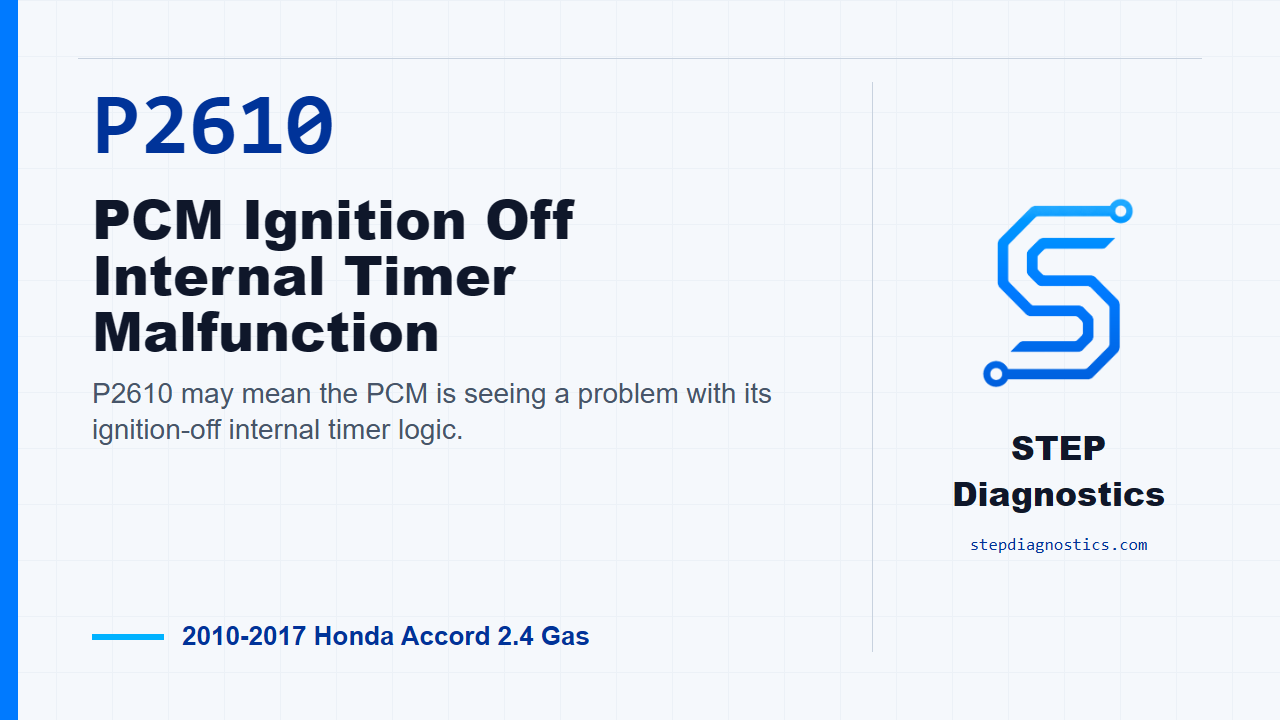
P2610 may mean the PCM is seeing a problem with its ignition-off internal timer logic.
What the vehicle may do
- The vehicle may turn on the malfunction indicator light.
- The code may be intermittent.
- The vehicle may seem to operate normally even with the code stored.
Possible fault areas
- PCM software status may be involved.
- An internal PCM fault may be possible.
- Other stored codes may provide context if they are present.
Diagnostic path
Opening context
For this Accord, P2610 points to a PCM ignition-off internal timer malfunction. In plain language, the PCM may not be judging its key-off timing logic the way it expects to. The vehicle may turn the light on, may store the code intermittently, and often may not give you an obvious driveability complaint. Keep the thinking broad at the start: possible areas can include PCM software status, the PCM itself, and whether the fault is actually repeatable or only showing up intermittently.
Start with captured data
Before clearing anything, save all freeze data and any on-board snapshot. Then start with the basic system checks. That snapshot matters here because this is a plausibility-style fault inside the PCM’s own timing logic, so you want to know the conditions that were captured before the memory gets wiped.
Verify whether P2610 repeats
Next, turn the ignition switch to ON (II), or press the engine start/stop button to select the ON mode. Clear the DTC with the HDS. After that, check Pending or Confirmed DTCs with the HDS and see whether P2610 is indicated again.
If the fault is duplicated
If P2610 is indicated after that check, the failure is duplicated. At that point, update the PCM if it does not have the latest software, or substitute a known-good PCM. Then keep the verification step separate and confirm what the system does after that action.
If the fault is not duplicated
If P2610 is not indicated, treat it as an intermittent failure and the system is OK at this time. If other Pending or Confirmed codes are present, do not chase P2610 in isolation; handle those other code paths separately.
Verify the repair
For repair verification, check Pending or Confirmed DTCs with the HDS again. If P2610 is still indicated and the PCM was updated, substitute a known-good PCM and recheck. If a known-good PCM had already been substituted and P2610 is still indicated, pause, recheck the earlier diagnostic path from the beginning, and avoid guessing.
When P2610 stays gone
If P2610 is not indicated during verification, troubleshooting for this code is complete. If a known-good PCM was substituted, replace the original PCM. If other Pending or Confirmed codes are present, handle those separately rather than folding them into this P2610 decision.
Takeaway
The key with P2610 is to prove whether the PCM timer fault repeats after clearing, then separate the software or known-good PCM decision from the final verification. Do not overcomplicate it with unrelated codes. For more diagnostic training, visit stepdiagnostics.com.
Final check
P2610 is often approached by saving captured data, proving whether the fault repeats, then verifying the result after the PCM software or known-good PCM decision.
For more guided automotive diagnostics, visit STEP Diagnostics.