What this code means
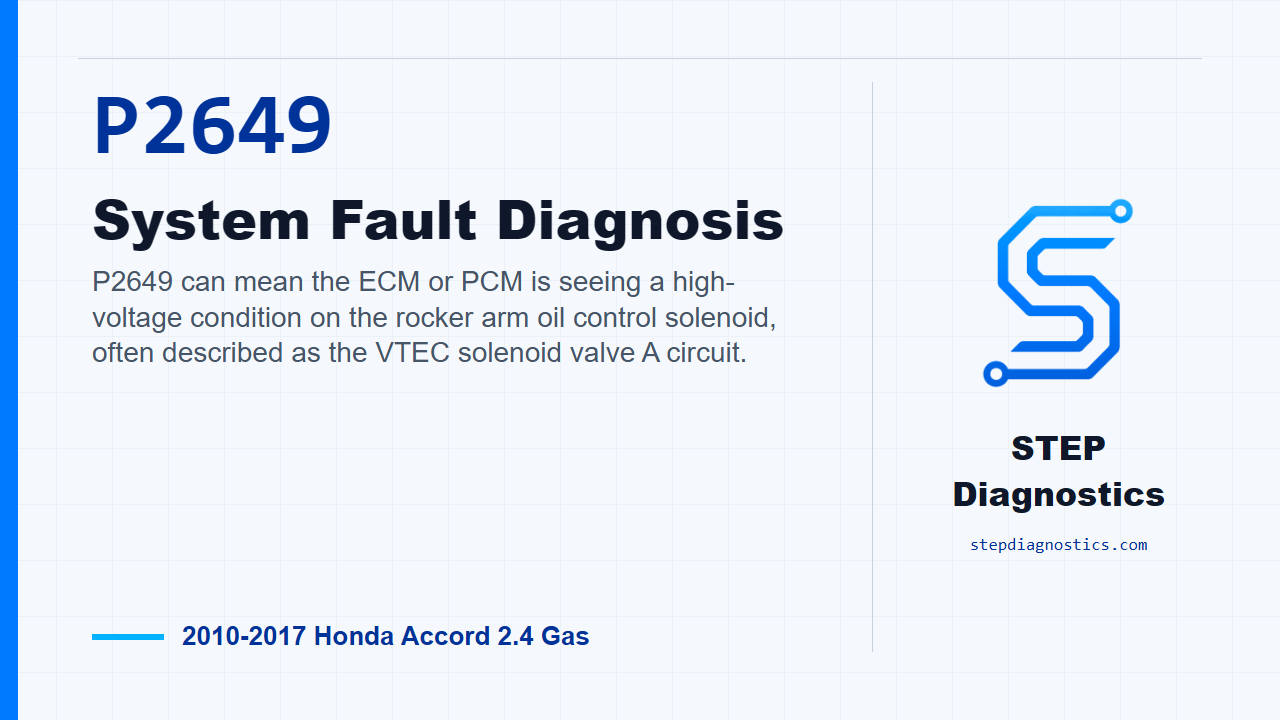
P2649 can mean the ECM or PCM is seeing a high-voltage condition on the rocker arm oil control solenoid, often described as the VTEC solenoid valve A circuit.
What the vehicle may do
- The vehicle may turn on a warning light.
- The vehicle may limit VTEC operation.
- The vehicle can show drivability symptoms depending on when the fault occurs.
Possible fault areas
- A possible issue with the rocker arm oil control solenoid circuit.
- A possible ground-side or control-wire problem.
- Possible connector or terminal concerns at the solenoid or PCM.
- PCM software or PCM-related checks may be involved after the circuit tests pass.
Diagnostic path
Opening context and setup
On this Accord, P2649 means the ECM or PCM is seeing a high-voltage condition on the rocker arm oil control solenoid circuit, the VTEC solenoid valve A circuit. The car may have a warning light, may limit VTEC operation, or can show drivability complaints depending on when the fault shows up. Broadly, possible fault areas include the solenoid itself, the ground side, the control wire back to the PCM, connector issues, or PCM software and PCM-related checks. Before troubleshooting, save the captured scan data and any onboard snapshot, then start with the basic system checks so you are not chasing a code without context.
Duplicate the fault first
Start by verifying the problem. Turn the ignition ON, or select ON mode, clear the code with the HDS, then start the engine. Hold engine speed at 3,000 rpm with no load, with an automatic in P or N, or a manual in neutral, until the radiator fan comes on. Then let it idle and check the HDS for pending or confirmed P2649. If P2649 comes right back, the failure is duplicated and you move into circuit testing. If it does not come back, treat it as intermittent for now. The system is okay at that moment, so concentrate on poor connections or loose terminals at the rocker arm oil control solenoid and the PCM.
Check the solenoid internal resistance
With the fault duplicated, turn the ignition OFF, or select OFF mode. Disconnect the rocker arm oil control solenoid 2P connector. Measure resistance on the solenoid side between terminal No. 1 and terminal No. 2, checking the VTS and PG side of the solenoid circuit. At room temperature, the solenoid should measure 14-30 Ω. If it is in that range, keep going to the ground-side check. If it is not in that range, replace the rocker arm oil control valve, then go to repair verification.
Check the PG ground path
Next, check the PG line for an open. Keep the ignition OFF, or in OFF mode, and keep the rocker arm oil control solenoid 2P connector disconnected. Check continuity between the solenoid connector No. 2 black wire and body ground. If there is continuity, the PG line is okay and you move to the VTS control wire. If there is no continuity, repair the open in the PG wire between the rocker arm oil control solenoid and G101, then verify the repair.
Check the VTS control wire back to the PCM
Now check the VTS line for an open. Jump the SCS line with the HDS, disconnect PCM connector B, the 51-pin connector, and leave the solenoid connector disconnected. With the ignition OFF, check continuity between the rocker arm oil control solenoid connector No. 1 pink wire and PCM connector B terminal No. 18, also pink. If continuity is good, the VTS wire is okay. At that point, update the PCM if it does not have the latest software, or substitute a known-good PCM, then verify the repair. If there is no continuity, repair the open in the VTS wire between the solenoid and PCM terminal B18, then verify the repair.
Verify the repair
For verification, reconnect all connectors, exit SCS mode with the HDS, turn the ignition ON or select ON mode, reset the PCM with the HDS, and do the PCM idle learn procedure. Start the engine and repeat the same warm-up check: hold 3,000 rpm with no load, automatic in P or N, or manual in neutral, until the radiator fan comes on, then let it idle. Check again for pending or confirmed P2649. If P2649 is still indicated, recheck for poor connections or loose terminals at the rocker arm oil control solenoid and the PCM. If the PCM was updated, substitute a known-good PCM and recheck. If the PCM was substituted, go back and repeat the diagnostic path from the beginning. If P2649 is not indicated, troubleshooting is complete. If a substituted PCM was used, replace the original PCM. If other pending or confirmed codes are present, check what they mean next.
Closing takeaway
The key on P2649 is not to guess at the VTEC solenoid circuit. First duplicate the code, then prove the solenoid resistance, prove the ground path, prove the VTS wire back to the PCM, and keep verification separate from the testing. For more diagnostic training, visit stepdiagnostics.com.
Final check
A careful diagnosis may separate a solenoid problem from wiring, connection, or PCM-related possibilities.
For more guided automotive diagnostics, visit STEP Diagnostics.