What this code means
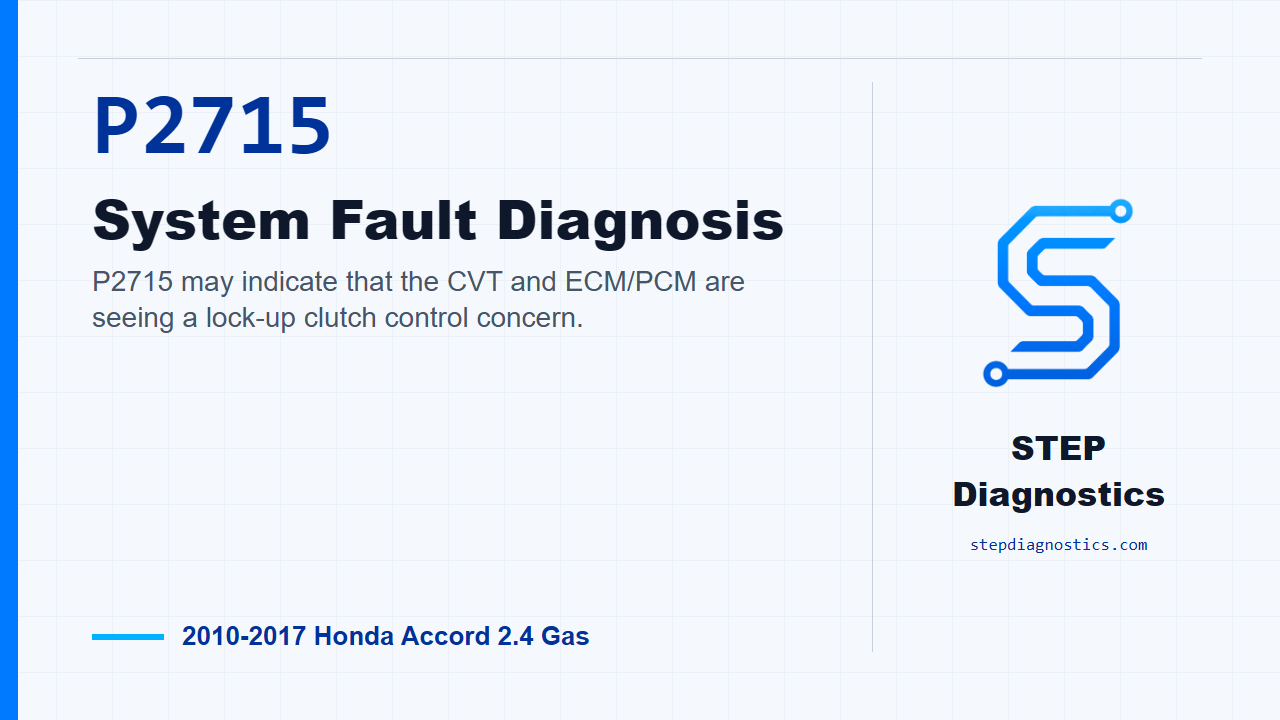
P2715 may indicate that the CVT and ECM/PCM are seeing a lock-up clutch control concern.
What the vehicle may do
- The vehicle may have abnormal low-speed CVT engagement or driveability complaints.
- The transmission can feel like it is not applying smoothly in some conditions.
- The code may only reset when the correct operating conditions are reproduced.
Possible fault areas
- Possible CVT hydraulic control concerns.
- Possible lock-up clutch control solenoid valve or circuit concerns.
- Possible intermittent operating-condition related concerns.
Diagnostic path
Open and setup
Today we’re working through P2715 on a 2010 to 2017 Honda Accord with the 2.4 gas engine and CVT. In plain terms, this code may point to a CVT lock-up clutch control issue being seen by the ECM or PCM. The driver may notice abnormal engagement, low-speed driveability complaints, or the transmission may feel like it is not applying smoothly. Broadly, possible fault areas can include the CVT hydraulic control side, the lock-up clutch control solenoid circuit or valve, and the operating conditions the module needs to see before it will judge the fault. Before you start, capture the stored scan-tool data and any on-board snapshot with the HDS, then look over the basic troubleshooting information so you know what the vehicle was doing when the fault was recorded.
Problem verification
Start with problem verification. Turn the ignition switch to ON (II), or use the engine start/stop button to select ON mode. Clear the DTC with the HDS. Then start the engine and warm it up to normal operating temperature, which is when the radiator fan comes on twice.
Run the monitor conditions
Now reproduce the operating conditions for the code. With the brake pedal pressed, shift to N, then to D, and wait for at least 1 second. Release the brake pedal and test-drive the vehicle in D on a flat road at speeds 12 mph (20 km/h) or below for at least 10 seconds. Then turn the ignition switch to LOCK (0), or select OFF mode with the engine start/stop button. Restart the engine, press the brake, shift to N, then to D, and again wait for at least 1 second. Release the brake pedal and repeat the drive in D on a flat road at speeds 12 mph (20 km/h) or below for at least 10 seconds.
Decision after problem verification
After that, check for Pending or Confirmed DTCs with the HDS. If P2715 is indicated, the diagnostic path calls for replacing the CVT lock-up clutch control solenoid valve, then moving into repair verification. If P2715 is not indicated, treat it as an intermittent failure and the system is OK at this time.
Repair verification setup
Keep repair verification separate from the initial problem check. Turn the ignition switch to ON (II), or select ON mode with the engine start/stop button. Clear the DTC with the HDS. Start the engine and warm it up to normal operating temperature, with the radiator fan coming on twice.
Repair verification drive cycle
Now repeat the same operating pattern for the verification. With the brake pedal pressed, shift to N, then to D, and wait for at least 1 second. Release the brake pedal and test-drive in D on a flat road at speeds 12 mph (20 km/h) or below for at least 10 seconds. Then turn the ignition switch to LOCK (0), or select OFF mode. Restart the engine, press the brake, shift to N, then to D, and wait for at least 1 second. Release the brake pedal and retest-drive in D on a flat road at speeds 12 mph (20 km/h) or below for at least 10 seconds.
Confirm the result
To finish, monitor the OBD status for P2715 in the DTCs menu with the HDS. If the status shows PASSED, troubleshooting for P2715 is complete. If other pending or confirmed codes are present after this, check what they mean first and follow the diagnostic path for those codes. If the status shows FAILED, the troubleshooting is incomplete, so go back to the beginning of the P2715 check and recheck it. If the status shows NOT COMPLETED, the verification did not finish, so meet the test conditions and check the OBD status again.
Takeaway and CTA
The key on P2715 is not to guess from the code alone. Clear it, reproduce the low-speed D-range conditions exactly, make the decision from the HDS result, and then verify the repair with the OBD status. For more diagnostic training, visit stepdiagnostics.com.
Final check
Follow the scan-tool result and verification status before calling the diagnosis complete.
For more guided automotive diagnostics, visit STEP Diagnostics.