What this code means
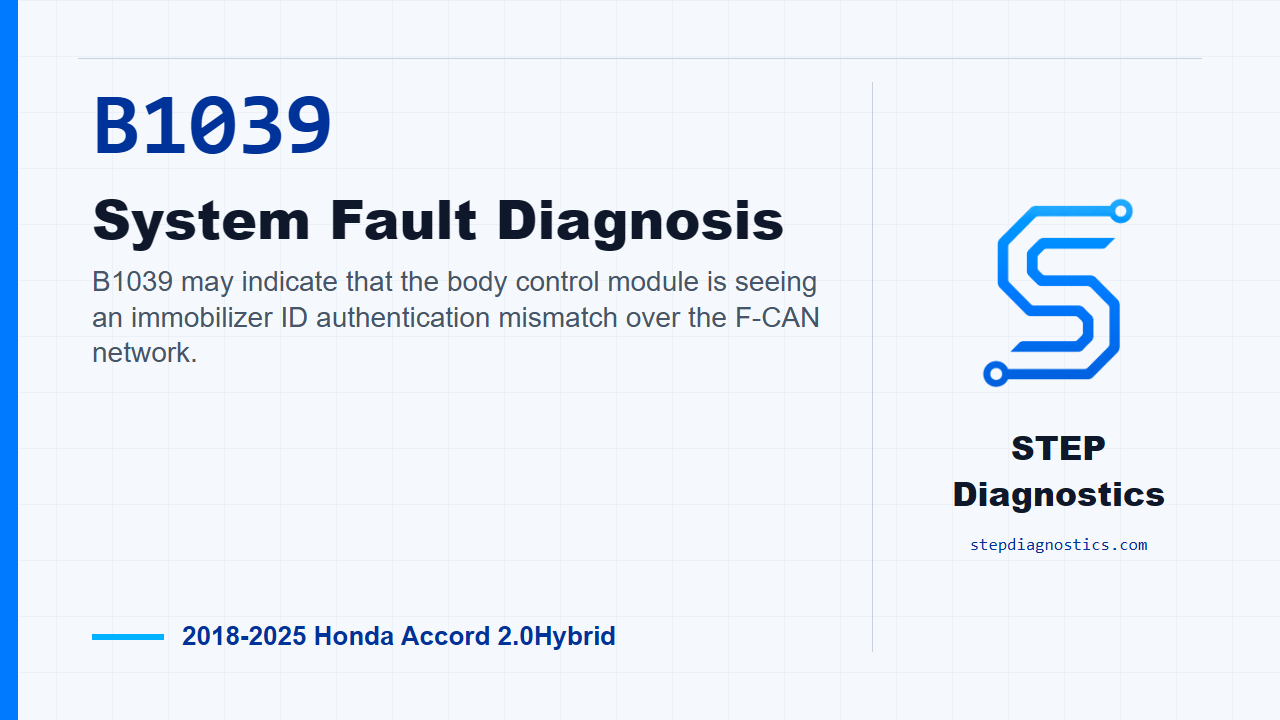
B1039 may indicate that the body control module is seeing an immobilizer ID authentication mismatch over the F-CAN network.
What the vehicle may do
- The vehicle may show security or start-authorization symptoms.
- The code can appear during a body control, immobilizer, or network scan.
- Some vehicles may have limited visible symptoms depending on when the mismatch is detected.
Possible fault areas
- Possible immobilizer authentication signal mismatch.
- Possible body control module communication concern.
- Possible F-CAN network communication concern.
- Possible connector or wiring condition in the related signal path.
Diagnostic path
Open on what B1039 means
On this 2018 to 2025 Honda Accord Hybrid, B1039 is tied to body control module and immobilizer authentication over the F-CAN network. In plain terms, the body control module may be seeing an immobilizer ID signal that does not match what it expects. Depending on the situation, the vehicle may have security or start-authorization symptoms, or the code may show up during a network or body-system scan. The broad fault areas can include the immobilizer authentication signal path, body control module communication, F-CAN network communication, or related connector and wiring conditions.
Start with the setup checks
Before chasing B1039 directly, start with the basic system checks and follow a structured diagnostic approach. If other codes are present, handle the body network diagnostic path first so you are not diagnosing this authentication code while another communication issue is still active.
Understand the setting logic
The key logic for B1039 is a mismatch. If the body control module detects that the immobilizer ID signals coming across F-CAN do not agree, it treats that as an abnormal condition and stores the code. So the diagnosis should stay focused on why that ID information is not lining up, rather than jumping straight to parts.
Run the check in order
For the actual check, turn the vehicle to the ON mode. That puts the system in the state needed for the module to evaluate the immobilizer ID information over the network. From there, continue with the scan-tool and network checks that apply to the earlier basic diagnostic path, and do not guess past an unclear result.
Close and takeaway
The takeaway for B1039 is simple: this is an immobilizer ID plausibility problem as seen by the body control module over F-CAN. Confirm the vehicle is in the correct operating state, resolve any broader body-network issues first, and keep the testing centered on the authentication signal path. For more diagnostic training, visit stepdiagnostics.com.
Final check
B1039 should be approached as an authentication plausibility concern: verify the operating state, address broader network issues first, and keep the diagnosis focused on why the immobilizer ID signal,
For more guided automotive diagnostics, visit STEP Diagnostics.