What this code means
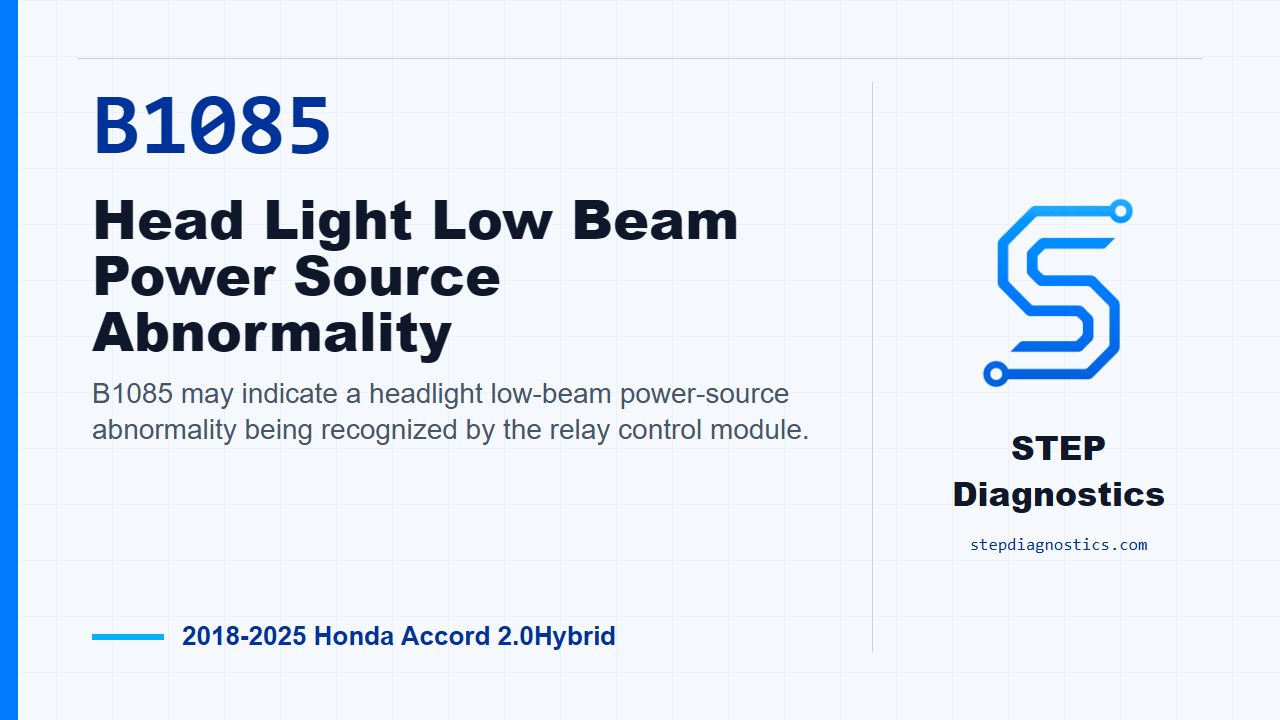
B1085 may indicate a headlight low-beam power-source abnormality being recognized by the relay control module.
What the vehicle may do
- The low beams may not operate normally.
- The lighting behavior may be intermittent or unexpected.
- A lighting-related warning or stored body electrical code may be present.
Possible fault areas
- Relay control module involvement is possible.
- A headlight-side abnormality signal may be involved.
- Related front lighting control faults can affect the diagnostic direction.
- Body electrical communication context may matter when multiple codes are stored.
Diagnostic path
Opening context
Today we’re diagnosing B1085 on a 2018 to 2025 Honda Accord 2.0 Hybrid. In plain language, this code may mean the relay control module is seeing an abnormal low-beam power-source condition reported from the headlight side. The vehicle may have low-beam operation that is missing, intermittent, or not behaving as expected. Broadly, the possible fault areas can involve the relay control module, the headlight-side abnormality signal, or related front lighting control issues. The key is to handle the setup checks first, then confirm the code under the correct lighting conditions.
Start with the basic checks
Before getting into B1085, start with the basic troubleshooting checks. If there are multiple codes stored, do not chase this one by itself. Follow the B-CAN multiple-code diagnostic approach first. And if other related front lighting control faults are present, check what they mean first before judging the relay control module path for B1085.
Understand what sets B1085
The logic here is straightforward: if a unit abnormality signal comes in from the headlight to the relay control module, the relay control module determines there is an abnormality and stores B1085. So treat this as a reported abnormal condition in the low-beam power-source control path, not as a random lighting complaint.
Follow the B1085 repair path
Once the preliminary checks are handled and the related lighting faults are not leading the diagnosis somewhere else, the B1085 path identifies the relay control module as the repair work item. Do not skip the earlier checks, because those decide whether B1085 is the code you should be acting on.
Verify the repair separately
Keep verification separate from the diagnostic decision. To confirm the condition, turn the vehicle to the ON mode, turn the combination light switch to the ON position, and wait for at least 6 seconds. Those are the monitor gates for checking whether B1085 sets again under the intended operating condition.
Takeaway
The takeaway: for B1085, do the basic checks first, handle multiple-code and related lighting-control issues before this path, then verify the low-beam command condition with the vehicle ON, the light switch ON, and at least 6 seconds of run time. For more diagnostic training, visit stepdiagnostics.com.
Final check
B1085 is best approached by confirming the setup conditions, handling related lighting faults first, and then verifying whether the code returns under the low-beam command condition.
For more guided automotive diagnostics, visit STEP Diagnostics.