What this code means
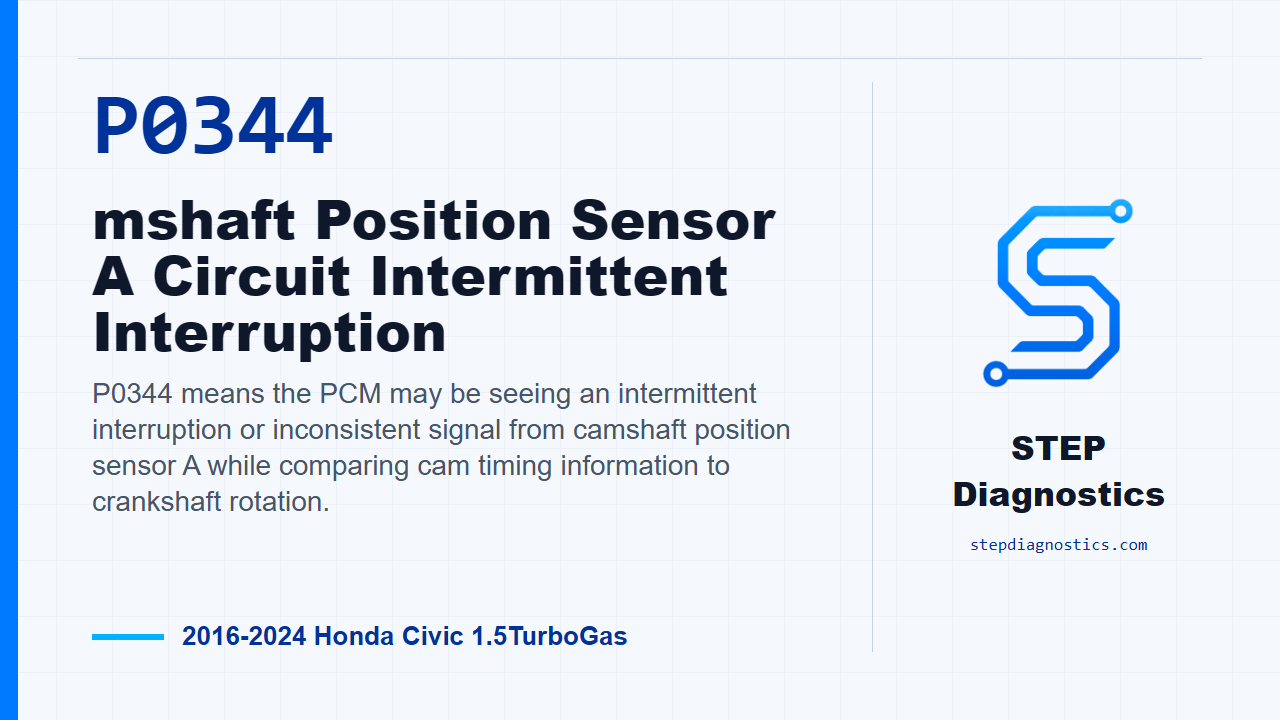
P0344 means the PCM may be seeing an intermittent interruption or inconsistent signal from camshaft position sensor A while comparing cam timing information to crankshaft rotation.
What the vehicle may do
- The vehicle may run normally when the fault is not active.
- The concern may only show up under the same operating conditions where the code originally set.
- The engine may have intermittent running or starting symptoms when the cam signal is unstable.
Possible fault areas
- Possible CMP sensor A circuit connection or terminal concern.
- Possible PCM-side connector or terminal concern.
- Possible engine ground or body ground terminal concern.
- Possible CMP pulse plate A looseness or damage.
- Possible CMP sensor A fault after the earlier checks are normal.
Diagnostic path
Opening context
On this Honda Civic 1.5 turbo, P0344 is for an intermittent interruption in the camshaft position sensor A circuit. In plain terms, the PCM may be losing or questioning the cam signal it uses to compare cam timing against crankshaft rotation. The car may run normally during a quick check, or it may act up only under the same conditions where the code set. Broadly, this can involve the CMP sensor A circuit, connector or terminal contact, engine and body grounds, the CMP pulse plate A, or the sensor itself. Before getting into pinpoint checks, start with the basic system checks and follow a structured diagnostic approach. Do not jump straight to a part.
Duplicate the fault first
The confirmation routine comes first, and it needs to be done in order. Start the engine and let it idle for 10 seconds or more. Then watch HDS OBD STATUS under PGM-FI for P0344. If the failure duplicates there, the confirmation is complete. If it does not duplicate at idle, move to the second confirmation path: test-drive the vehicle for several minutes in the same range as the captured Engine Speed and Vehicle Speed. Then monitor HDS OBD STATUS under PGM-FI for P0344 again. If the failure duplicates, the confirmation is complete.
Check the CMP sensor A and PCM connections
Once the fault path is confirmed, start with the CMP sensor A circuit connector inspection. Check for secure connection and loose terminals at CMP sensor A and at the PCM. The normal result is that the connections and terminals are OK. If anything is abnormal here, the problem is in the connections or terminals, and that needs to be handled before moving deeper into the diagnosis.
Check the ground-side terminal condition
Next, check the connectors for secure connection and loose terminals at the engine ground and body ground. Again, the normal condition is that the connections and terminals are OK. If this inspection is abnormal, stay with the connection or terminal problem instead of moving on to the mechanical inspection.
Inspect the CMP pulse plate A
If the connector and terminal checks are normal, prepare for the CMP pulse plate A visual inspection by removing the cylinder head cover. With access open, visually inspect CMP pulse plate A for looseness or damages. The normal finding is no looseness or damages. If the pulse plate inspection is abnormal, this diagnostic path points to a problem with CMP pulse plate A.
Last remaining fault area
If all the earlier inspection items are normal, then this diagnostic path identifies the remaining CMP sensor A as the cause. That conclusion comes after duplicating the failure and after the connector, terminal, ground, and pulse plate checks have all passed.
Takeaway
The key with P0344 is to separate an intermittent signal problem from a connection issue or a mechanical pulse plate issue. Duplicate it first, inspect in order, and only call the sensor after the earlier checks are normal. For more diagnostic training, visit stepdiagnostics.com.
Final check
P0344 is often approached by first duplicating the intermittent fault, then checking the signal path and related mechanical reference parts in order.
For more guided automotive diagnostics, visit STEP Diagnostics.