What this code means
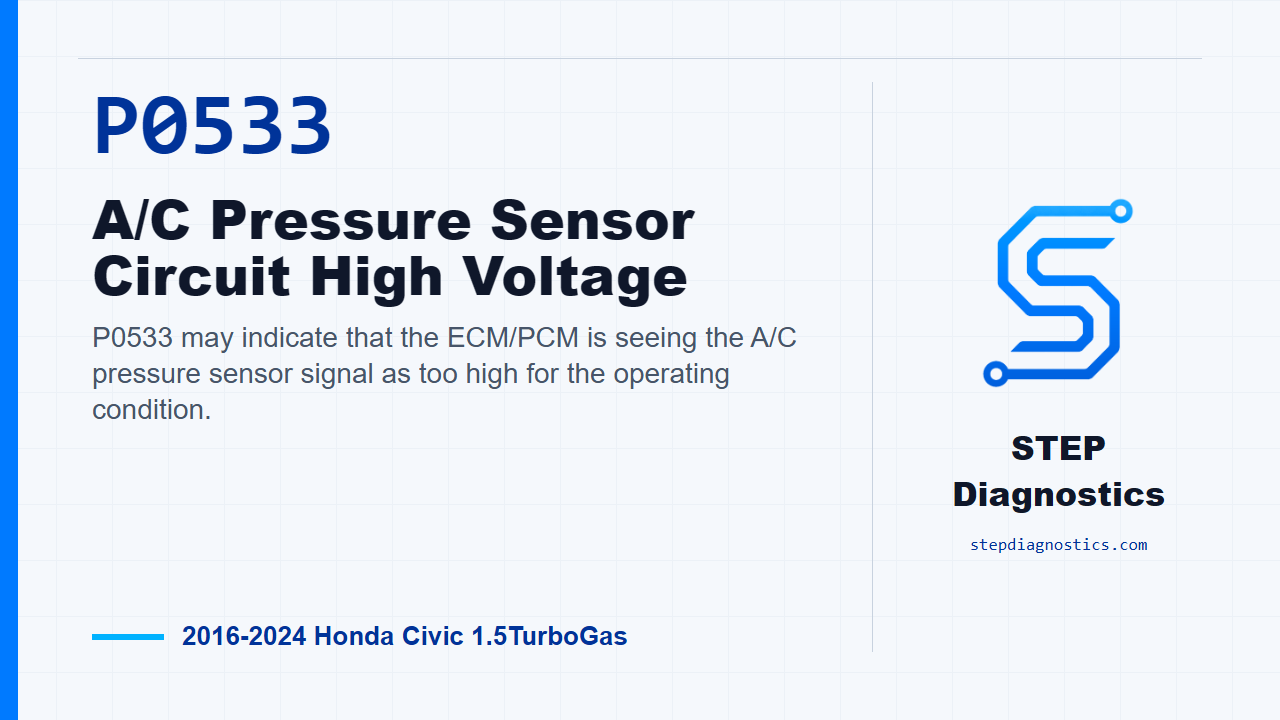
P0533 may indicate that the ECM/PCM is seeing the A/C pressure sensor signal as too high for the operating condition.
What the vehicle may do
- The A/C may cool poorly or may be disabled by the control system.
- The vehicle may store the code with few noticeable drivability symptoms.
- A warning light or scan-tool fault information may be present depending on the vehicle state.
Possible fault areas
- A possible A/C pressure sensor signal issue
- Possible connector or wiring concerns in the sensor circuit
- Possible ECM/PCM-side circuit evaluation after the earlier checks pass
Diagnostic path
Open and set the diagnostic frame
On this 2016 through 2024 Honda Civic with the 1.5 turbo engine, P0533 means the ECM/PCM is seeing the A/C pressure sensor circuit higher than expected. In plain terms, the pressure signal may be stuck high, the A/C may not operate normally, and the fault area can be the sensor, the sensor wiring, connector condition, or, after the other checks pass, the PCM side of the circuit. Before chasing the code, start with the basic system checks and follow a structured diagnostic approach so you are not testing around a basic power, ground, connector, or scan-tool issue.
Duplicate the high-voltage condition
Start by putting the vehicle in ON mode. Turn the blower switch on, then turn the A/C switch on. Now look at the HDS data for A/C Pressure Sensor Voltage. If that value is more than 4.75 V, the failure is duplicated and the diagnostic path continues from there.
Check whether the sensor-side test responds normally
There is no direct component test given for the pressure sensor itself, so the diagnosis works through the related components. Disconnect the A/C pressure sensor 3P connector. Jump terminals No. 1 and No. 2 of that connector with a jumper wire, then turn the vehicle back to ON mode. Watch the HDS A/C Pressure Sensor Voltage again. For this check, normal is less than 4.75 V. If the value is normal with the jumper in place, the problem is with the A/C pressure sensor. If it is still abnormal, move on and treat it as a related circuit or component problem.
Protect the PCM before connector work
Before disconnecting the PCM connector, jump the SCS line with the HDS and wait more than 1 minute. After that, disconnect the A/C pressure sensor 3P connector, PCM connector A, which is the 50P connector, and PCM connector E, which is the 80P connector.
Check the PD_SENSOR and SG6 circuits open
With the connectors disconnected, perform the PD_SENSOR open-wire inspection with the circuit OFF. The normal condition is less than 1 Ω. Then perform the SG6 open-wire inspection with the circuit OFF. That normal condition is also less than 1 Ω. These checks depend on the exact connector terminal identification, so pause and verify the test points before measuring; do not guess at terminals. If either open-wire inspection is abnormal, the problem is in the circuit.
Final decision
If the A/C pressure sensor inspection and the circuit inspections all indicate normal, then the remaining fault area is the PCM. The key is not to jump to that conclusion early. For P0533, duplicate the high sensor voltage first, check the sensor response path, then prove the PD_SENSOR and SG6 circuits before calling the PCM. For more diagnostic training, visit stepdiagnostics.com.
Final check
This diagnosis is often about proving whether the high reading follows the sensor-side check, the wiring checks, or the remaining PCM decision point.
For more guided automotive diagnostics, visit STEP Diagnostics.