What this code means
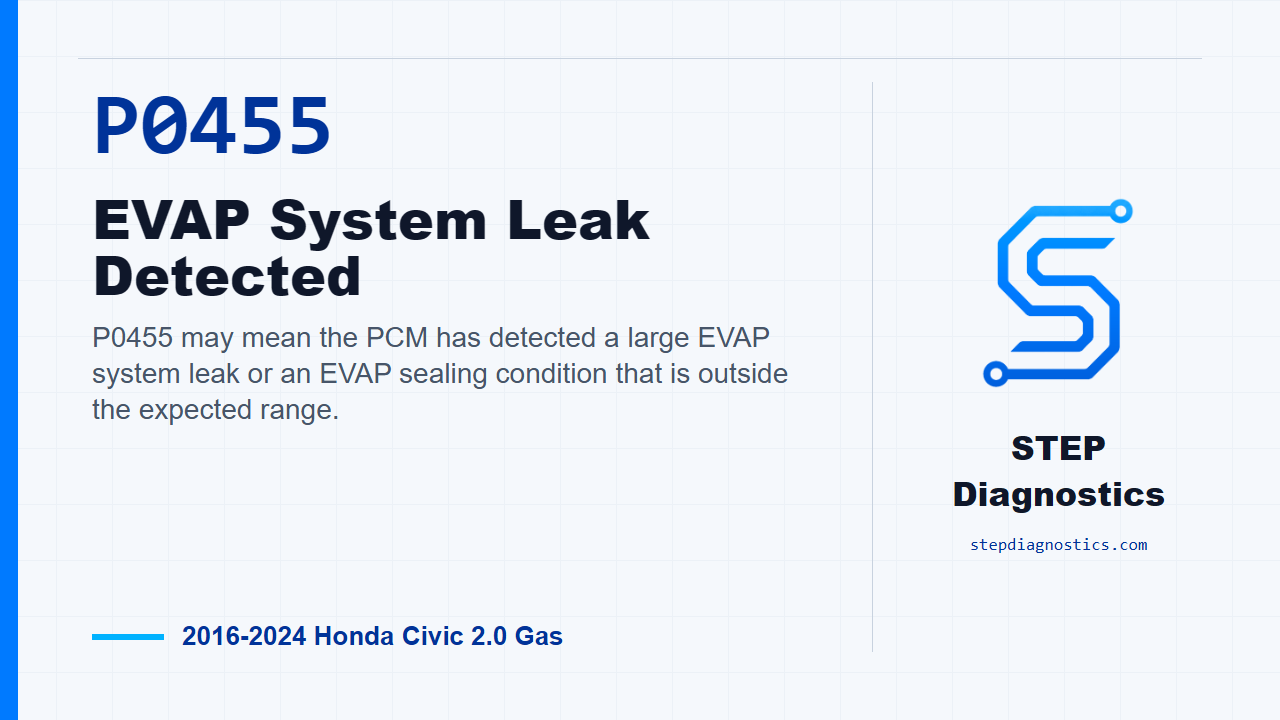
P0455 may mean the PCM has detected a large EVAP system leak or an EVAP sealing condition that is outside the expected range.
What the vehicle may do
- The vehicle may drive normally.
- The malfunction indicator may be the main symptom.
- Fuel odor can sometimes be possible on EVAP-related faults, depending on where the leak is.
Possible fault areas
- Possible EVAP hose or line leakage, blockage, or restriction may be involved.
- Purge valve or vent shut valve sealing may be involved.
- The EVAP canister area, FTP sensor area, or O-rings may be involved.
- The fuel fill pipe, vapor recirculation tube, shut-off valve area, or fuel tank sealing may be involved.
Diagnostic path
Opening context
On this Civic 2.0L, P0455 is an EVAP system leak detected code. In plain language, the PCM may be seeing fuel tank pressure after engine shutoff that does not match what it expects. The car may still drive normally, and the warning light may be the main complaint. Possible fault areas can include EVAP hoses and lines, purge or vent sealing, the canister area, the FTP sensor area, the fill pipe and vapor recirculation tube, the shut-off valve sealing area, or the tank itself. Start with the basic system checks and follow a structured diagnostic approach. If other codes are present, check what they mean first, but keep this diagnostic path focused on P0455.
Test setup and safety
Before applying vacuum or pressure, stay inside the test method. This fuel system is only designed for specified vacuum and pressure conditions, and excessive vacuum or pressure can damage EVAP components or eventually damage the fuel tank. For leak detection, fresh fuel helps because it has higher volatility. The best condition is less than a full tank of fresh fuel. If possible, add 1 gallon of fresh fuel to the tank just before testing, as long as that will not fill the tank. The listed tools for these checks include a vacuum pump/gauge, 0-30 inHg, and a vacuum/pressure gauge, 0-4 inHg.
Confirm the failure
To confirm the failure, turn the vehicle to ON mode and run the HDS FUNCTION TEST. If that test result is not OK, the failure has been duplicated. From there, work through the EVAP checks in order instead of jumping to the end of the system.
EVAP canister vent hose check
Start at the EVAP canister vent hose. With the vent hose disconnected, check it for blockage or restriction. The expected result is no blockage and no restriction. If that check is abnormal, the problem is in the EVAP canister vent hose area.
EVAP canister purge valve check
Next, check the purge valve side. In the engine compartment, disconnect the vacuum hose, or purge line, from the EVAP canister purge valve. Connect the T-fitting, the vacuum/pressure gauge, 0-4 inHg, and the vacuum pump/gauge, 0-30 inHg, to the vacuum hose. Slowly apply about 2 kPa (0.6 inHg, 15 mmHg) of vacuum to the hose. The EVAP canister purge valve should hold vacuum for 1 minute. If it does not, the problem is in the EVAP canister purge valve.
Purge line and canister area visual check
After that, visually inspect the EVAP canister purge line between the purge valve and the EVAP canister. Look for poor connections or damage. Also check the EVAP canister area, FTP sensor area, EVAP canister vent shut valve area, and O-rings for damage. The expected result is that the connections are OK and there is no damage. If this visual check is abnormal, the problem is with parts on the EVAP canister purge line side.
EVAP canister purge line leak check
Now test the purge line sealing. Disconnect the EVAP canister vent hose and the fuel vent tube from the EVAP canister, then plug each port. In the engine compartment, disconnect the vacuum hose, or purge line, from the EVAP canister purge valve, and connect the vacuum pump/gauge, 0-30 inHg, to that hose. Turn the vehicle to ON mode. Apply vacuum until the HDS FTP Sensor Voltage reads 1.90 V (-0.59 inHg, -15.1 mmHg). Be careful not to exceed the vacuum, because the FTP sensor can be damaged. Hold the check for 1 minute. The HDS FTP Sensor Voltage should not increase more than 0.2 V (0.1 inHg, 2.5 mmHg). If that result is abnormal, the problem is with parts on the EVAP canister purge line side.
EVAP canister vent shut valve check
Only move to the vent shut valve check after the purge line checks normal. Disconnect the fuel vent tube from the EVAP canister and plug the port. In the engine compartment, disconnect the vacuum hose, or purge line, from the EVAP canister purge valve, and connect the vacuum pump/gauge, 0-30 inHg, to the hose. Turn the vehicle to ON mode, then command HDS CVS ON. Apply vacuum until the HDS FTP Sensor Voltage reads 1.90 V (-0.59 inHg, -15.1 mmHg). Again, do not exceed the vacuum because the FTP sensor can be damaged. Watch the HDS FTP Sensor Voltage for 1 minute. It should not increase more than 0.2 V (0.1 inHg, 2.5 mmHg). If this check is abnormal, the problem is in the EVAP canister vent shut valve.
Fuel fill pipe, recirculation tube, and shut-off valve checks
Next, visually inspect the fuel fill pipe and the fuel tank vapor recirculation tube for poor connections or damage. The expected result is good connections and no damage. If this check is abnormal, the problem is in the fuel fill pipe or the fuel tank vapor recirculation tube. Then, with the mis-fuel inhibit device removed, inspect the shut-off valve and make sure it is closed. If it is not closed, the problem is in the main flap unit. With the mis-fuel inhibit device still removed, inspect the shut-off valve flap seal and its mating surface for missing or damaged seals. If that seal check is abnormal, the problem is also in the main flap unit.
Fuel tank determination
The fuel tank is the last call in this path. If the other inspection items have all indicated a normal condition, then the remaining determination is that there is a problem with the fuel tank. Do not make that call at the beginning of the diagnosis; it comes after the vent hose, purge side, vent shut valve, fill pipe, vapor recirculation tube, and shut-off valve sealing checks have been worked through.
Verification and takeaway
Keep verification separate from component testing. After the fault is corrected, use the confirmation check again with the vehicle in ON mode and the HDS FUNCTION TEST, and confirm the failure is no longer duplicated and P0455 stays gone. The takeaway is simple: this code is a sealing and leak-isolation diagnosis, so confirm the failure, protect the EVAP system from excessive vacuum or pressure, and isolate the leak path in order before condemning the tank. For more diagnostic training, visit stepdiagnostics.com.
Final check
P0455 is often approached as an EVAP leak-isolation diagnosis: confirm the fault, protect the system during vacuum testing, and work through the sealing checks in order.
For more guided automotive diagnostics, visit STEP Diagnostics.