What this code means
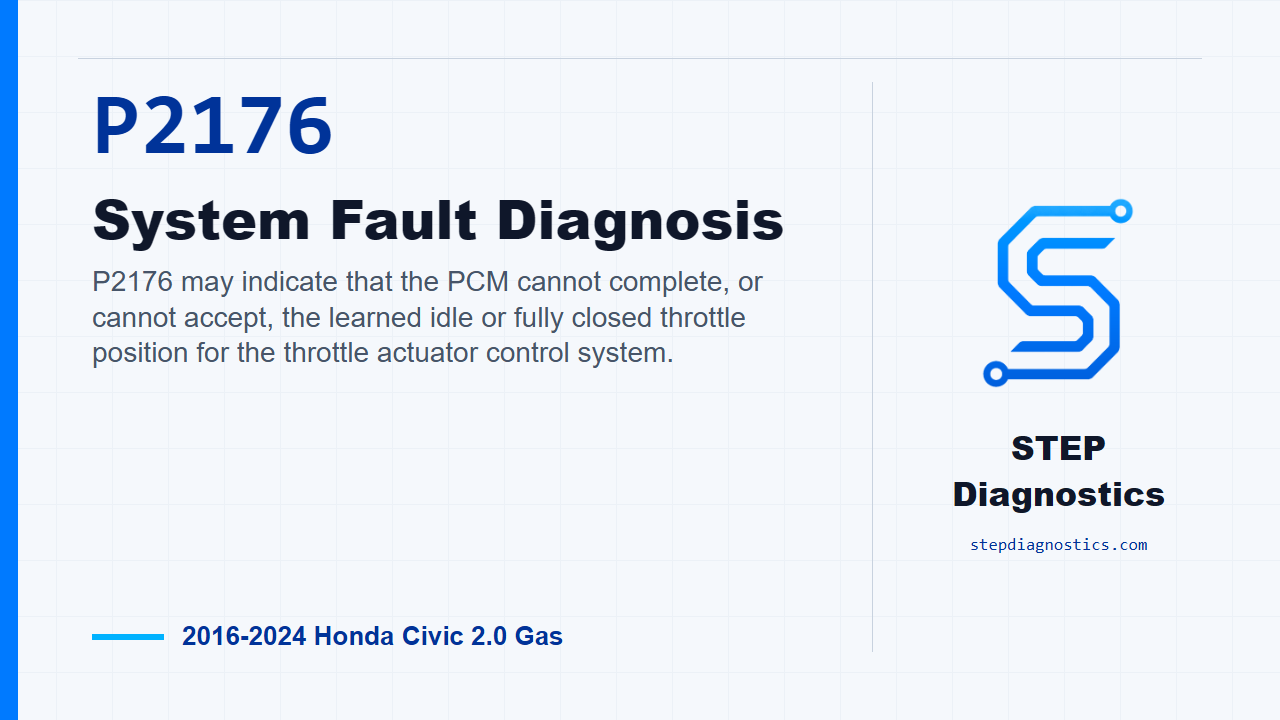
P2176 may indicate that the PCM cannot complete, or cannot accept, the learned idle or fully closed throttle position for the throttle actuator control system.
What the vehicle may do
- The vehicle may have idle quality complaints.
- Throttle response may feel abnormal.
- A warning light may be present.
Possible fault areas
- Possible broad fault areas can include throttle body condition.
- Possible broad fault areas can include throttle actuator motor circuits, wiring, or connectors.
- Possible broad fault areas can include related throttle position sensor faults.
- Possible broad fault areas can include PCM-related decision making after other checks are normal.
Diagnostic path
Opening and diagnostic direction
On this 2016 to 2024 Honda Civic with the 2.0 gas engine, P2176 means the throttle actuator control system has not learned the idle, or fully closed, throttle position the way the PCM expects. In plain terms, the PCM may be commanding and watching throttle position, but the learned closed position may not be completing or may be outside the range it expects. The vehicle may have idle complaints, throttle response issues, or a warning light, and the possible fault areas can include throttle body condition, throttle motor control circuits, connector or wiring problems, related throttle position faults, and, after those checks pass, the PCM. Start with the basic system checks and follow a structured diagnostic approach before getting into the pinpoint work.
Handle related faults first
Before chasing P2176 by itself, look at any other stored faults. If a related throttle position sensor fault is present, diagnose that first. A throttle position issue can affect what the PCM sees during throttle learning, so clearing that path first keeps this diagnosis from going in circles.
Understand what sets the code
The logic for this code is based on whether the fully closed throttle position can be learned correctly. If that learning does not complete within the expected time, or if the learned fully closed position lands outside the specified range, the PCM stores P2176. So the diagnostic direction is simple: confirm the condition, check the throttle motor circuits for opens, inspect and clean the throttle body, and only then move to substitution testing and PCM judgment.
Confirm the condition safely
For the confirmation procedure, turn the vehicle to OFF, or LOCK mode, and wait 10 seconds. Then turn the vehicle to ON mode. Keep your fingers out of the installed throttle body any time the vehicle is being turned ON or is already in ON mode. If the throttle valve is activated, it can seriously injure your fingers.
Prepare for the throttle motor open-circuit check
Next, prepare for the MTR1 and MTR2 open-wire inspection. Disconnect the throttle body 6-pin connector. Before disconnecting the PCM connector, jump the SCS line with the HDS and wait more than 1 minute. Then disconnect PCM connector E, the 80-pin connector. The terminal callouts for the connector-to-PCM measurement need to be confirmed before probing; do not guess at terminals if the callouts are not clear.
Check MTR1 and MTR2 for opens
With the throttle body 6-pin connector and PCM connector E disconnected, perform the MTR1 and MTR2 open-wire inspection. With IG Mode OFF, the normal condition for the MTR1 circuit is less than 1 Ω, and the normal condition for the MTR2 circuit is also less than 1 Ω. If either check is abnormal, the problem is in the circuit. If both checks are normal, move on to the throttle body inspection path.
Inspect and clean the throttle body
Now disconnect the intake air duct from the throttle body and perform the throttle body cleaning. After cleaning, check the throttle valve for sludge or carbon. The normal condition is no sludge or carbon on the throttle valve. If that inspection is abnormal, the problem is with the throttle body condition.
Use a known-good throttle body when direct testing is not available
For the throttle body inspection, there is no direct method given to test that inspection item, so the diagnostic path uses a known-good component. Install a known-good throttle body and try to reproduce the failure. If the symptom or DTC goes away, the original throttle body is faulty. If the failure is reproduced even with the known-good throttle body, the problem is with other related components, so pause and recheck the earlier diagnostic path instead of guessing.
PCM judgment after the other checks pass
Only after the other inspection items have indicated normal should the remaining PCM be judged as the cause. That is the end of this diagnostic path: related throttle faults first, then confirmation, throttle motor circuit integrity, throttle body condition, known-good throttle body comparison, and finally PCM judgment if everything else checks normal.
Close
The key takeaway for P2176 is to treat it as a throttle closed-position learning problem, not as a reason to jump straight to parts. Prove the related faults, wiring, throttle body condition, and known-good comparison before making the final call. For more diagnostic training, visit stepdiagnostics.com.
Final check
P2176 is often approached by confirming the learning concern, checking related throttle faults and circuits, inspecting throttle body condition, and only considering control-module judgment after the前
For more guided automotive diagnostics, visit STEP Diagnostics.