What this code means
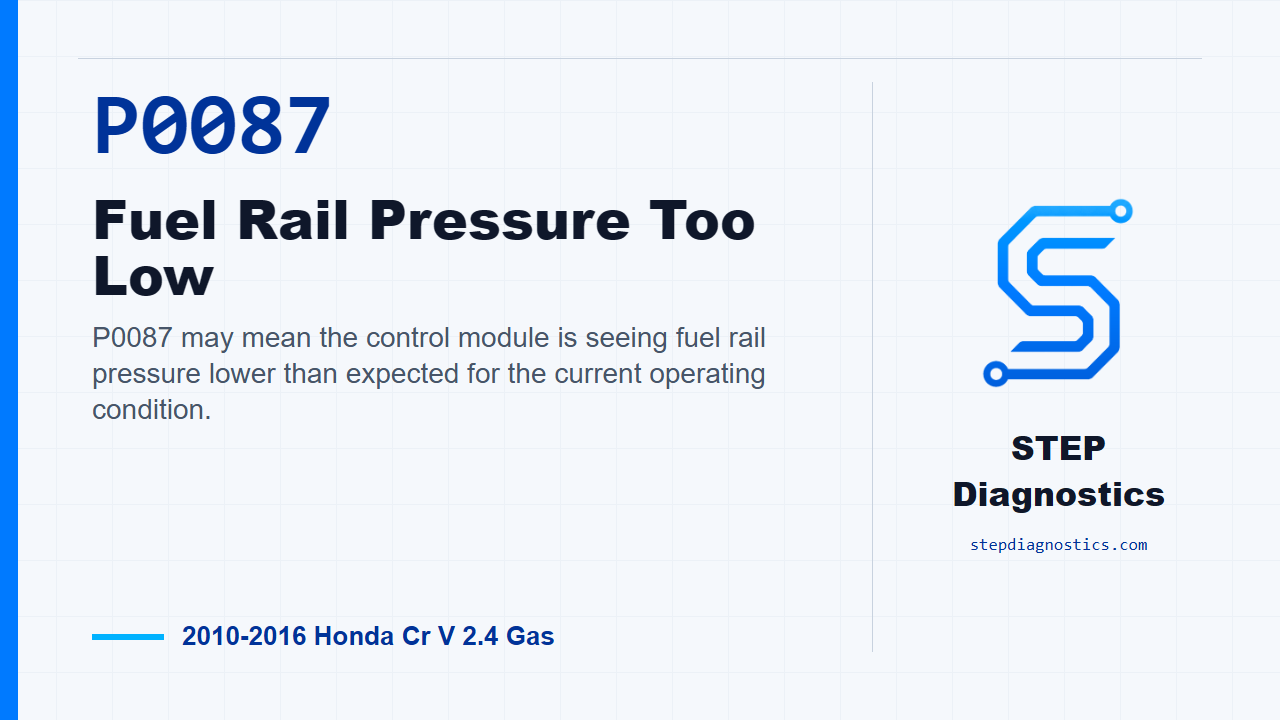
P0087 may mean the control module is seeing fuel rail pressure lower than expected for the current operating condition.
What the vehicle may do
- The vehicle may have hard starting.
- The engine may hesitate, stumble, stall, or feel low on power.
- The warning light may come on, and the problem can be intermittent.
Possible fault areas
- Possible fuel supply issues
- Possible pressure control issues
- Possible fuel rail pressure sensor signal or connector issues
- Possible high-pressure fuel pump or pump drive concerns
- Possible wiring or terminal issues
- Possible fuel leakage
Diagnostic path
Opening and pre-checks
P0087 on this Honda CR-V is a fuel rail pressure too low code. In plain language, the PCM may be seeing direct-injection fuel rail pressure lower than expected. The vehicle may show hard starting, hesitation, reduced power, stalling, or just a warning light. The possible fault areas can include fuel supply, pressure control, the rail pressure signal, high-pressure pump operation, wiring or terminal issues, and actual fuel leakage. Before chasing the code, start with the basic system checks. If the vehicle was out of fuel and stalled before the code set, refuel it and clear the code with the HDS. If there is a fuel leak, repair that leak before continuing. And if other related fuel pressure, injector, misfire, ignition, or throttle-related codes are stored with P0087, handle those first, then come back and recheck P0087.
Verify the fault at idle
Start by recording all freeze data and on-board snapshots with the HDS. Turn the vehicle to ON mode, clear the DTC, then start the engine. Hold the engine at 3,000 rpm with no load, in P or N, until the radiator fan comes on, then let it idle. From there, run the DI FUEL PRESSURE TEST in the HDS inspection menu. If that test result is OK, move into a road verification. If it is not OK, go straight to checking high-pressure pump spill valve operation.
Road verification and intermittent result
For the road verification, test-drive the vehicle for several minutes under the same kind of captured operating conditions: engine speed, road speed, load, throttle input, temperature, intake air, and the fuel pressure data that was recorded when the fault occurred. Then check the HDS for pending or confirmed codes. If P0087 is indicated, the failure is duplicated, so continue to the spill valve check. If P0087 is not indicated, treat it as intermittent and the system is OK at this time. Test PGM-FI main relay 2. If the relay checks OK, inspect for poor connections or terminal problems at the fuel rail pressure sensor, the high pressure fuel pump, and the PCM. If captured data is available, try to reproduce the failure under those same conditions instead of guessing.
Check spill valve operation
Next, start the engine and let it idle. Check for noise or vibration from the spill valve on the high pressure fuel pump. Some spill valve noise is expected when the high pressure fuel pump is running, so the point here is to confirm that the valve is active. If you do have noise or vibration, continue to the fuel rail pressure sensor checks. If there is no noise or vibration, the diagnostic path supports replacing the high pressure fuel pump.
Fuel rail pressure sensor check 1
For the first fuel rail pressure sensor check, turn the vehicle to OFF, remove PGM-FI main relay 2 from the under-dash fuse and relay box, then start the engine and let it idle until it stalls. After it stalls, crank the engine several times. Now look at FUEL PRESSURE CONVERTED FROM PF SENSOR on the HDS. The listed threshold for this check is Less than 1,000 kPa. A reading of several hundred kPa is normal here. If the current condition matches the threshold, continue to the second sensor comparison. If it does not match the threshold, the diagnostic path supports replacing the fuel rail, which includes the fuel rail pressure sensor.
Fuel rail pressure sensor check 2
For the second sensor check, turn the vehicle OFF and reinstall PGM-FI main relay 2. Start the engine again. Hold the engine at 3,000 rpm with no load, in P or N, until the radiator fan comes on, then let it idle. With the brake pedal held firmly, shift to D position or mode, then press the accelerator pedal. Do not shift the transmission or take your foot off the brake while raising engine speed. On the HDS, compare FUEL PRESSURE CONVERTED FROM PF SENSOR against FUEL PRESSURE DIRECT INJECTION SYSTEM. If the two values are almost the same, the fuel rail pressure sensor is OK, and you move to the low-pressure side fuel pressure check. If they are not almost the same, the diagnostic path supports replacing the fuel rail, including the fuel rail pressure sensor.
Low-pressure side and mechanical pump drive check
Now check fuel pressure on the low-pressure side. If fuel pressure is OK, the low-pressure side is considered OK and the next step is the high-pressure pump visual inspection. If fuel pressure is not OK, check the fuel pump, fuel pressure regulator, fuel filter, and fuel lines. If the low-pressure side passes, remove the high pressure fuel pump and visually inspect the cam that drives it, along with the pump roller, for wear or damage. If those parts are OK, the diagnostic path supports replacing the high pressure fuel pump. If the cam or roller is not OK, stop and handle the mechanical damage carefully. Recheck the earlier diagnostic path and avoid guessing at the repair.
Takeaway
The clean path on P0087 is to prove whether the fault is present, separate an intermittent condition from a duplicated one, compare the rail pressure signal to the direct-injection pressure value, confirm low-side fuel supply, and only then make the call on the high-pressure pump or mechanical drive area. For more diagnostic training, visit stepdiagnostics.com.
Final check
P0087 is best approached by verifying the fault, checking whether the pressure signal makes sense, confirming low-side supply, and then inspecting high-pressure pump operation and mechanical drive.
For more guided automotive diagnostics, visit STEP Diagnostics.