What this code means
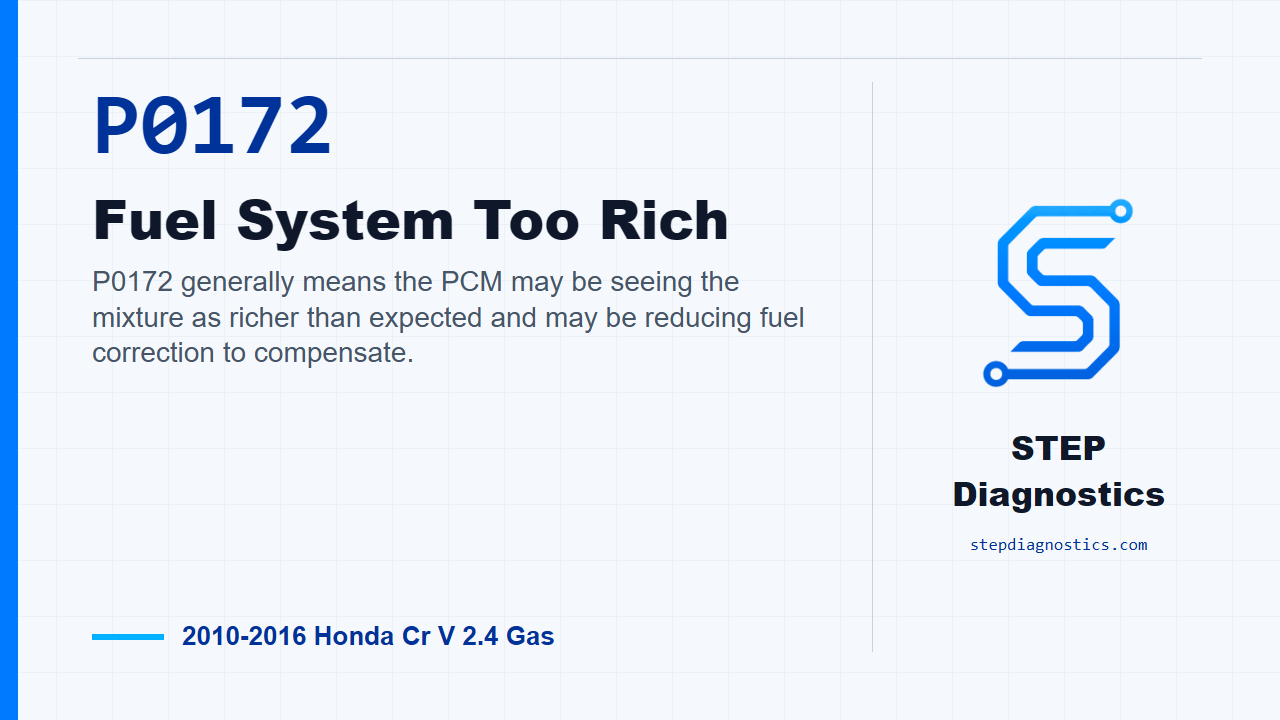
P0172 generally means the PCM may be seeing the mixture as richer than expected and may be reducing fuel correction to compensate.
What the vehicle may do
- The vehicle may run rough or feel loaded up.
- Fuel economy may be worse than normal.
- There may be hesitation, poor drivability, or a fuel smell in some cases.
- The engine can stall in some situations if excess vapor enters the intake.
Possible fault areas
- Possible fuel pressure or fuel quality issues.
- Possible airflow measurement issues.
- Possible crankcase oil contamination influence.
- Possible EVAP purge flow influence.
- Possible A/F sensor, injector, or control-side issues.
Diagnostic path
Opening context
On this 2010 to 2016 Honda CR-V with the 2.4 gas engine, P0172 means the fuel system is being seen as too rich. In plain terms, the PCM may be pulling fuel back because the mixture looks heavier on fuel than expected. The vehicle may run rough, may have poor fuel economy, may hesitate, or in some cases may stall if excess fuel vapor is getting into the intake. Broadly, this kind of fault can involve fuel pressure, fuel quality, airflow measurement, crankcase contamination, purge flow, the air-fuel sensor, injectors, or the control side of the system. Before chasing P0172, start with the basic system checks. Do not clear the code or reset the PCM until the test specifically tells you to, because that can erase useful captured information. Also look for aftermarket fuel system or engine parts, and if other powertrain codes are present, check what they mean first, then come back and recheck P0172.
Confirm the rich condition
Start by proving the problem. Start the engine and let it idle with no load, in Park or Neutral. Watch AF FB, or short-term fuel trim, on the HDS. The question here is simple: is AF FB less than 0.79 at idle? If it is, the rich condition is active right now, so move into fuel pressure testing. If it is not low at idle, use the captured operating data instead. Record engine speed, vehicle speed, relative throttle position, and accelerator pedal position from the point where AF FB was at its lowest. Then drive the vehicle under those same conditions and watch AF FB again. If AF FB drops below 0.79 during that replay, continue with the diagnostic path. If it stays normal under the same conditions, the system is normal at this time.
Check low-side and high-side fuel pressure
Once the low AF FB value is confirmed, check the low-pressure side first. Start the engine, let it idle, and check fuel pressure under the same conditions where AF FB is 0.79 or less. The low side should be between 390-440 kPa (3.98-4.49 kgf/cm 2, 56.6-63.8 psi). If it is not in that range, the fuel tank unit is the repair path given for this check. If the low side is in range, it is not the cause of the low AF FB value, so move to the high-pressure side. Turn the vehicle OFF, turn it ON, clear the DTC with the HDS, start the engine, and hold 3,000 rpm with no load in Park or Neutral until the radiator fan comes on. Then let it idle and run the DI fuel pressure test from the HDS inspection menu. If the HDS shows NORMAL, high-side pressure is OK and the next check is fuel quality. If it does not show NORMAL, stop this P0172 path and diagnose the high-pressure fuel system fault first.
Check for fuel quality as the cause
Next, rule out the fuel itself. Turn the vehicle OFF, drain the fuel from the tank, and refill it with known-good fuel. Start the engine, let it idle, then operate the vehicle under the same conditions where AF FB was 0.79 or less, and watch AF FB on the HDS while driving. If AF FB is still less than 0.79, the fuel is not the cause and you keep going. If AF FB is no longer low, the fuel was causing the rich correction. This is especially worth considering if the rich condition showed up shortly after refueling. The MIL distance value, compared with fuel level, can help support that call.
Check MAF input
After fuel quality is ruled out, check the MAF sensor reading under controlled conditions. Keep the engine idling, make sure ECT Sensor 1 is above 158 °F (70 °C), the transmission is in Park or Neutral, and all engine and electrical loads are off. Monitor engine speed on the HDS, hold the engine steady at 2,500 rpm, and keep it there for 30 seconds. While holding that speed, check the MAF sensor value. The expected MAF reading is 6.5-9.2 g/s. If it is in range, move on. If it is not, inspect the air cleaner assembly for cracks, damage, or incorrect installation. If that checks out, the repair path is to replace the MAF sensor/IAT sensor.
Check for oil contamination influence
Next, check whether crankcase contamination is affecting the mixture. With the engine still idling, gently pinch the PCV vacuum hose and watch AF FB on the HDS with the hose pinched. If AF FB is still less than 0.79, the engine oil is considered OK for this path, and you continue. If AF FB is no longer below that point, the oil is contaminated. At that point, determine why the oil is contaminated, such as an injector-related issue, then replace the engine oil and oil filter.
Check EVAP purge influence
Now check the EVAP canister purge valve. Turn the vehicle OFF. Remove the high-pressure fuel pump cover and fuel bracket, disconnect the EVAP canister purge valve 2-pin connector, then disconnect the vacuum hose from the purge valve in the engine compartment. Connect a vacuum pump and gauge, 0-30 inHg, to the purge valve, then start the engine. If the gauge shows vacuum, purge flow is entering when it should not. In warm conditions, fuel vapor from the canister line to the fuel tank can enter the intake manifold, make the mixture excessively rich, and in some cases cause a stall. If needed, replace the EVAP canister purge valve. If the gauge does not show vacuum, continue to the air-fuel sensor check.
Check the air-fuel sensor, then the injectors
With the previous checks passed, substitute a known-good A/F sensor, Sensor 1. Turn the vehicle OFF, install the known-good sensor, start the engine, let it idle, then operate the vehicle under the same conditions where AF FB was 0.79 or less. Watch AF FB on the HDS while driving. If AF FB is still less than 0.79, the original A/F sensor is not the cause; reinstall the original sensor and move to injector testing. If AF FB is no longer low, the original A/F sensor was causing the low AF FB value, so replace the original A/F sensor, Sensor 1. For the injector check, turn the vehicle OFF and install known-good injectors. Start the engine, let it idle, operate it again under the same low-AF-FB conditions, and watch AF FB while driving. If AF FB remains less than 0.79, the injectors are not the cause, so substitute a known-good PCM and recheck. If AF FB is no longer low, the injectors were causing the low AF FB value, and the repair path is to replace all injectors as a set.
Closing takeaway
The clean way through P0172 is to prove the rich correction first, then work through pressure, fuel quality, measured airflow, oil contamination, purge flow, the A/F sensor, and injectors in order. Do not jump to parts until the test result points there. After the correction, verify the repair under the same conditions that made AF FB go low and confirm the code stays gone. For more diagnostic training, visit stepdiagnostics.com.
Final check
P0172 is often best approached by confirming the rich fuel trim condition first, then isolating fuel supply, airflow measurement, purge, sensor, and injector causes in order.
For more guided automotive diagnostics, visit STEP Diagnostics.