What this code means
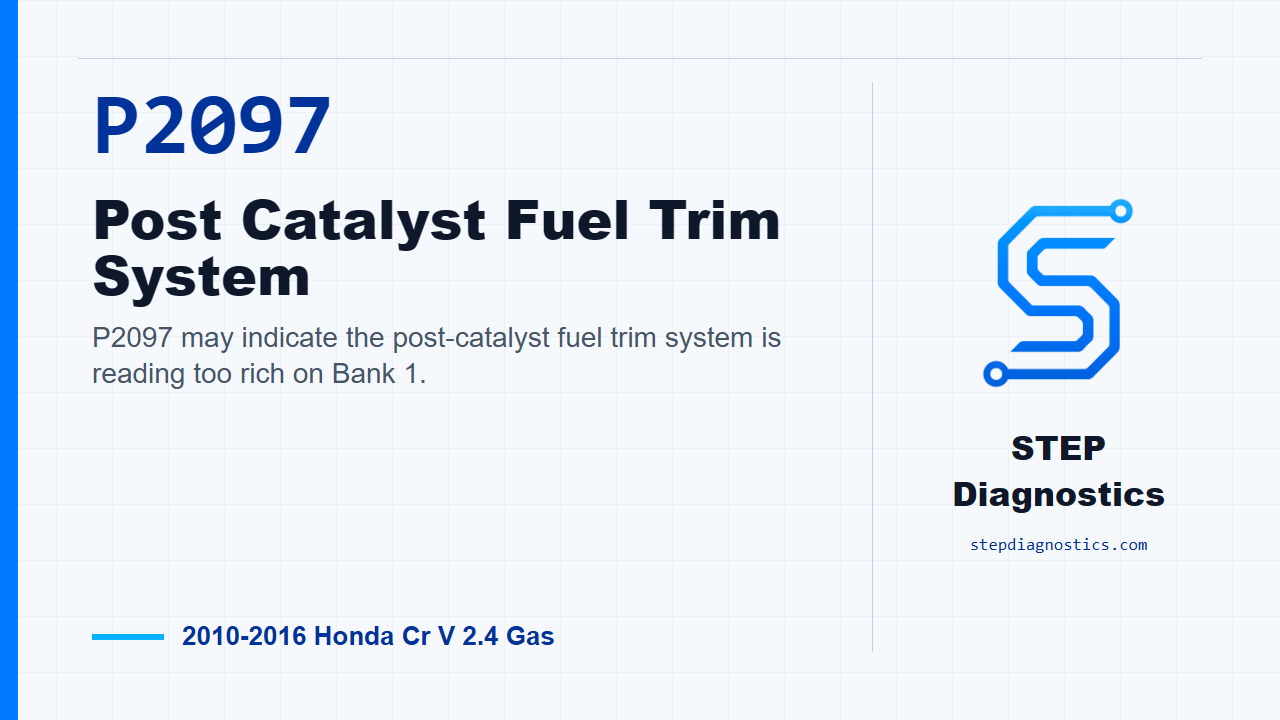
P2097 may indicate the post-catalyst fuel trim system is reading too rich on Bank 1.
What the vehicle may do
- The vehicle may illuminate the check engine light.
- The vehicle may run normally in some cases.
- Fuel trim-related drivability symptoms can be possible depending on the underlying issue.
Possible fault areas
- Exhaust leakage or restriction may be involved.
- Air fuel sensor feedback may be involved.
- Secondary oxygen sensor feedback may be involved.
- Connector or terminal issues may be involved.
- PCM-side signal concerns can be possible.
Diagnostic path
Opening context
On this 2010 to 2016 Honda CR-V with the 2.4 gas engine, P2097 is the post-catalyst fuel trim system reading too rich on Bank 1. In plain terms, the PCM may be seeing downstream oxygen sensor feedback that suggests a rich condition after the catalyst. The vehicle may have a check engine light, may run normally, or may show fuel-trim-related drivability symptoms depending on what else is going on. Broadly, this can involve exhaust leakage or restriction, sensor feedback from the air fuel sensor or downstream oxygen sensor, connector issues, or PCM-side signal concerns. Before getting deep into it, start with the basic system checks so you are not chasing this code with an obvious connection issue or another related fault still active.
Verify the fault first
Start by verifying the problem. Turn the vehicle to the ON mode, clear the DTC with the HDS, then start the engine. Warm it up by holding the engine at 3,000 rpm with no load, in P or N, until the radiator fan comes on, then let it idle. Now reproduce the operating conditions for the monitor: ECT SENSOR 1 above 158 °F (70 °C), transmission in D, engine speed below 4,000 rpm, and a steady drive between 15-75 mph (24-120 km/h) for 94 seconds or more. Watch the HDS OBD STATUS for the post-catalyst fuel trim monitor, focusing on P2097.
Interpret the verification result
If the HDS shows FAILED, the fault is duplicated and you move on to the exhaust check. If it shows PASSED, treat it as intermittent for now: the system is OK at this time, so check for poor connections or loose terminals at the A/F sensor, the secondary HO2S, and the PCM. If captured operating data is available, try to reproduce the failure under those same conditions. If the status is still EXECUTING, keep the same test conditions until the monitor gives a result. If it is OUT OF CONDITION, go back to the drive conditions and recheck instead of guessing.
Check the exhaust system
With the failure duplicated, turn the vehicle to OFF, LOCK mode. Check the exhaust system for leakage, clogging, or blockage. The key area for leakage is between the A/F sensor, Sensor 1, and the secondary HO2S, Sensor 2, but also look for any restriction in the exhaust system. If there is leakage in that section, or clogging or restriction in the exhaust, repair or replace the exhaust system as needed. If the exhaust check is clean, continue to the sensor substitution check.
Run the A/F sensor substitution check
Next, substitute a known-good A/F sensor, Sensor 1, and reconnect all connectors. Turn the vehicle to the ON mode, reset the PCM with the HDS, and do the PCM idle learn procedure. Start the engine, hold it at 3,000 rpm with no load in P or N until the radiator fan comes on, then let it idle. Drive it again under the same monitor gates: ECT SENSOR 1 above 158 °F (70 °C), transmission in D, engine speed below 4,000 rpm, and a steady speed between 15-75 mph (24-120 km/h) for 94 seconds or more. Then monitor the HDS OBD STATUS for P2097.
Use the substitution result
Now use the monitor result to separate the sensors. If the HDS shows PASSED with the known-good A/F sensor installed, replace the original A/F sensor, Sensor 1. If the HDS shows FAILED, replace the secondary HO2S, Sensor 2. If the status is EXECUTING, keep the test conditions until a result comes on. If it is OUT OF CONDITION, go back to the substitution test drive conditions and recheck. Pause, recheck the earlier diagnostic path, and avoid guessing if the monitor has not completed cleanly.
Final takeaway
The logic on P2097 is straightforward: prove the monitor failure, rule out exhaust leaks and restrictions first, then use the known-good A/F sensor check to decide whether the original A/F sensor or the secondary oxygen sensor is the problem. The confirmation point is the completed OBD STATUS result under the required drive conditions. For more diagnostic training, visit stepdiagnostics.com.
Final check
P2097 often needs the monitor failure reproduced first, then exhaust integrity and sensor feedback checked in order.
For more guided automotive diagnostics, visit STEP Diagnostics.