What this code means
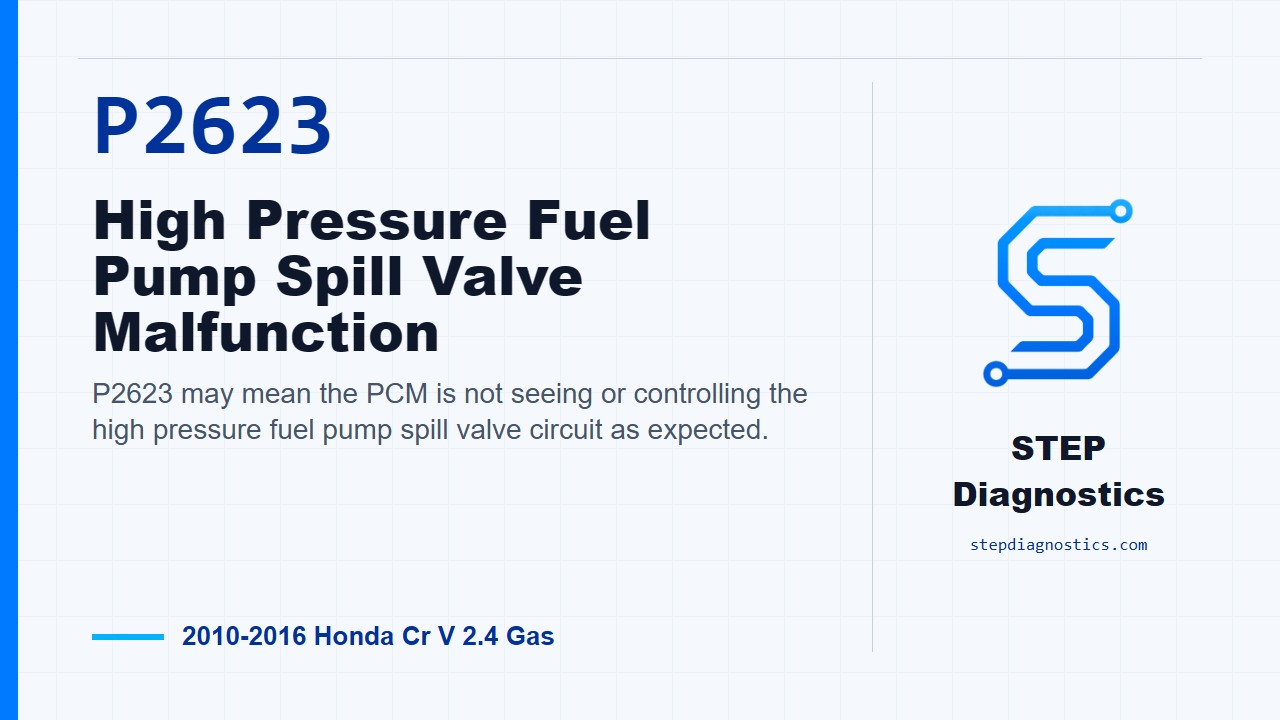
P2623 may mean the PCM is not seeing or controlling the high pressure fuel pump spill valve circuit as expected.
What the vehicle may do
- The vehicle may be hard to start or may not start.
- The engine may run poorly or feel low on power.
- The malfunction indicator may come on with fuel control related symptoms.
Possible fault areas
- Possible relay power supply or relay control issues.
- Possible wiring or connector problems between the PCM and high pressure fuel pump.
- Possible connection concerns at the high pressure fuel pump or PCM.
- Possible PCM software or control-related concerns.
Diagnostic path
Opening context
On this 2010-2016 Honda CR-V with the 2.4L engine, P2623 points to a high pressure fuel pump spill valve malfunction. In plain terms, the PCM may not be seeing or controlling the high pressure fuel pump spill valve circuit the way it expects. The vehicle may be hard to start, may not start, may run poorly, or may set the light with fuel control problems. The broad areas here are possible relay power supply issues, injector relay control or output faults, wiring problems on the high pressure fuel pump control lines, connection problems at the pump or PCM, and PCM software or control concerns. Before going deep, start with the basic system checks and follow a structured diagnostic approach so you do not chase the wrong side of the circuit.
Confirm the fault and choose the path
Start by turning the vehicle to the ON mode, clearing the code with the HDS, and starting the engine. If it will not start, crank it for 20 seconds. Then check Pending and Confirmed codes with the HDS. If P2623 is setting along with injector circuit codes, treat the failure as duplicated and move into the injector relay and feed checks. If P2623 is not paired with those injector circuit codes, the path can move toward the high pressure fuel pump circuit checks, but there is also an intermittent-fault outcome in this same decision point. If the system is OK at that moment, check for poor connections or loose terminals at the high pressure fuel pump and the PCM, and try to reproduce the captured conditions. If the return point is unclear, pause, recheck the earlier diagnostic path, and avoid guessing.
Injector relay and power feed checks
Next, turn the vehicle OFF, remove the injector relay from auxiliary under-hood relay holder A, and test the relay. If the relay is not OK, replace the injector relay. If it is OK, leave the relay disconnected, turn the vehicle ON, and check for battery voltage from injector relay 4P socket No. 7 to body ground. If battery voltage is not there, repair the open in the FI MAIN RLY OUT wire between PGM-FI main relay 1 and the injector relay. If that feed is good, turn the vehicle OFF and check for battery voltage from injector relay 4P socket No. 5 to body ground. If that is good, move on to the relay control side. If it is not good, check fuse No. A12 (20 A) in the under-hood fuse/relay box. If the fuse is OK, repair the open in the +B INJ wire between the No. A12 (20 A) fuse and the injector relay. If the fuse is not OK, repair the short in that same +B INJ wire and replace the No. A12 (20 A) fuse.
Injector relay control and output checks
For the relay control check, turn the vehicle ON and momentarily measure between injector relay 4P socket No. 7 and socket No. 8 with the relay disconnected. If battery voltage appears momentarily, move to the relay output check. If it does not, turn the vehicle OFF, jump the SCS line with the HDS, wait more than 1 minute, disconnect PCM connector A (51P), and check continuity between injector relay 4P socket No. 8 and PCM connector A (51P) No. 15. If there is no continuity, repair the open in the INJ RLY CL- wire between PCM A15 and the injector relay. If the wire is OK, update the PCM if it does not have the latest software, or substitute a known-good PCM, then recheck. For the relay output check, with the vehicle OFF, connect injector relay 4P socket No. 5 to socket No. 6 with a jumper wire. After jumping the SCS line and waiting more than 1 minute, disconnect PCM connector A (51P), then check for battery voltage at PCM connector A (51P) No. 6 and No. 7 to body ground. If battery voltage is missing, repair the open in the INJ RLY OUT wire between PCM A6, PCM A7, and the injector relay. If voltage is present, continue to the high pressure fuel pump circuit checks.
High pressure fuel pump open-circuit checks
Reinstall the injector relay, disconnect PCM connector C (51P), and check continuity between PCM connector C (51P) No. 13 and No. 14. If this check says the HPUMP H and HPUMP L wires are not open, continue to the individual line checks. If it does not, move to the short-to-power checks. One caution here: if you reached this point directly from the first decision, the connector state for PCM connector A is not fully clear in the procedure path, so pause, recheck the earlier setup, and do not assume the connector state. For the HPUMP H line, disconnect the high pressure fuel pump 2P connector and check continuity between high pressure fuel pump 2P connector No. 1 and PCM connector C (51P) No. 13. If there is no continuity, repair the open in the HPUMP H wire between PCM C13 and the high pressure fuel pump. For the HPUMP L line, check continuity between high pressure fuel pump 2P connector No. 2 and PCM connector C (51P) No. 14. If there is no continuity, repair the open in the HPUMP L wire between PCM C14 and the high pressure fuel pump. If both lines are OK, update the PCM if it does not have the latest software, or substitute a known-good PCM, then recheck. If P2623 goes away after a PCM update, the troubleshooting is complete. If P2623 goes away with a known-good PCM substituted, replace the original PCM.
High pressure fuel pump short checks
If the open-circuit path sends you into short checks, keep the high pressure fuel pump 2P connector disconnected. Turn the vehicle ON and measure voltage from PCM connector C (51P) No. 13 to body ground. If there is any voltage, repair a short to power in the HPUMP H wire between PCM C13 and the high pressure fuel pump. If there is no voltage, check PCM connector C (51P) No. 14 to body ground. Any voltage there means repair a short to power in the HPUMP L wire between PCM C14 and the high pressure fuel pump. If both power-short checks pass, turn the vehicle OFF and check continuity from PCM connector C (51P) No. 13 to body ground. Continuity means repair a short in the HPUMP H wire between PCM C13 and the high pressure fuel pump. If there is no continuity, the HPUMP H wire is OK. Then check continuity from PCM connector C (51P) No. 14 to body ground. Continuity means repair a short in the HPUMP L wire between PCM C14 and the high pressure fuel pump. If there is no continuity, the HPUMP L wire is OK, so update the PCM if needed, or substitute a known-good PCM, then recheck. If P2623 goes away after the update, the troubleshooting is complete. If it goes away with the known-good PCM installed, replace the original PCM.
Takeaway and CTA
The key on P2623 is to stay disciplined: verify whether it is tied to injector relay power and control first, then isolate the high pressure fuel pump H and L circuits for opens, shorts to power, and shorts to ground before blaming the PCM. Verify the repair by rechecking the path that led you there and confirming P2623 stays gone. For more diagnostic training, visit stepdiagnostics.com.
Final check
This diagnosis often comes down to proving the relay feeds and the high pressure fuel pump control circuits before considering PCM-related steps.
For more guided automotive diagnostics, visit STEP Diagnostics.