What this code means
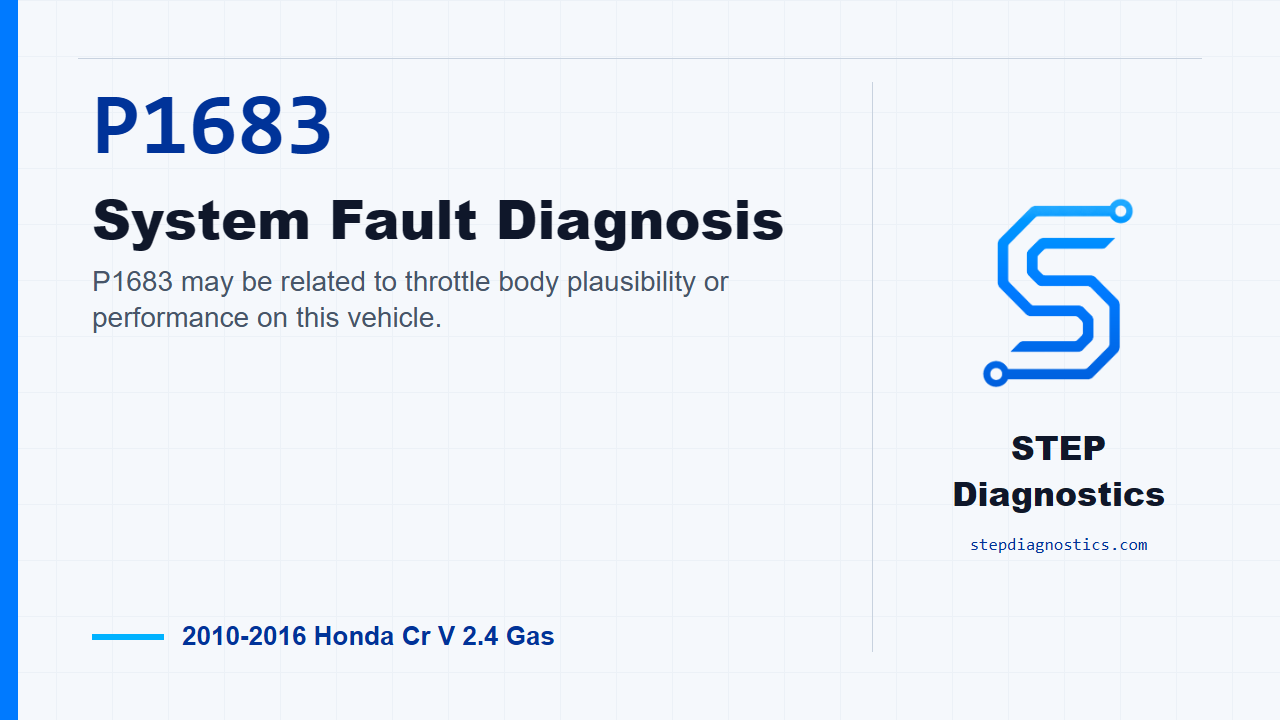
P1683 may be related to throttle body plausibility or performance on this vehicle.
What the vehicle may do
- The vehicle may set the code again during a controlled verification run.
- The condition can be intermittent, so the system may appear OK when the fault is not duplicated.
Possible fault areas
- Possible throttle valve return or default position concern.
- Possible throttle body condition concern.
- Possible poor connections or loose terminals at the throttle body or PCM.
Diagnostic path
Open: what P1683 is pointing us toward
On this 2010 to 2016 Honda CR-V with the 2.4 gas engine, P1683 may point to a throttle-body related plausibility or performance problem. The vehicle may run normally when the fault is intermittent, or it may set the code again when the throttle body behavior does not match what the ECM or PCM expects. The broad areas here are possible throttle valve return problems, throttle body condition, and possible poor connections or loose terminals at the throttle body or the PCM. Before putting hands near the throttle plate, remember this safety point: do not put your fingers into the installed throttle body when the vehicle is in ON mode. If the throttle valve is activated, it can seriously injure your fingers.
Start by duplicating the fault
Start with the problem verification. Turn the vehicle to ON mode, clear the DTC with the HDS, then start the engine. Hold the engine speed at 3,000 rpm with no load, in Park or Neutral, until the radiator fan comes on, then let it idle. After that, turn the vehicle to OFF, or LOCK mode, and wait 10 seconds. Turn it back to ON mode and check for Pending or Confirmed DTCs with the HDS. The first decision is simple: is P1683 indicated again or not?
If the code does not come back
If P1683 is not indicated during that check, treat it as an intermittent failure. The system is OK at this time. Do not guess at parts. Check for poor connections or loose terminals at the throttle body and at the PCM. If captured operating data is stored for this code, try to reproduce the failure under those same conditions.
If the code is duplicated, inspect throttle valve return
If P1683 is indicated again, the failure is duplicated, so move to the throttle body default position spring check. Turn the vehicle to OFF, or LOCK mode. Disconnect the intake air duct from the throttle body. With the vehicle off, push the throttle valve closed, then release it. Now watch the result: does the throttle valve return?
Make the decision from the return test
If the throttle valve does return, clean the throttle body. After cleaning, the decision point is whether P1683 is still indicated. If it is still indicated, the diagnostic path supports replacing the throttle body. If the throttle valve does not return during the spring check, the diagnostic path also supports replacing the throttle body.
Close
The takeaway is to duplicate P1683 first, handle a no-return result as a mechanical throttle body failure path, and avoid parts guessing when the code will not repeat. For more diagnostic training, visit stepdiagnostics.com.
Final check
Verify whether P1683 repeats first, then follow the throttle valve return check before making the repair decision.
For more guided automotive diagnostics, visit STEP Diagnostics.