What this code means
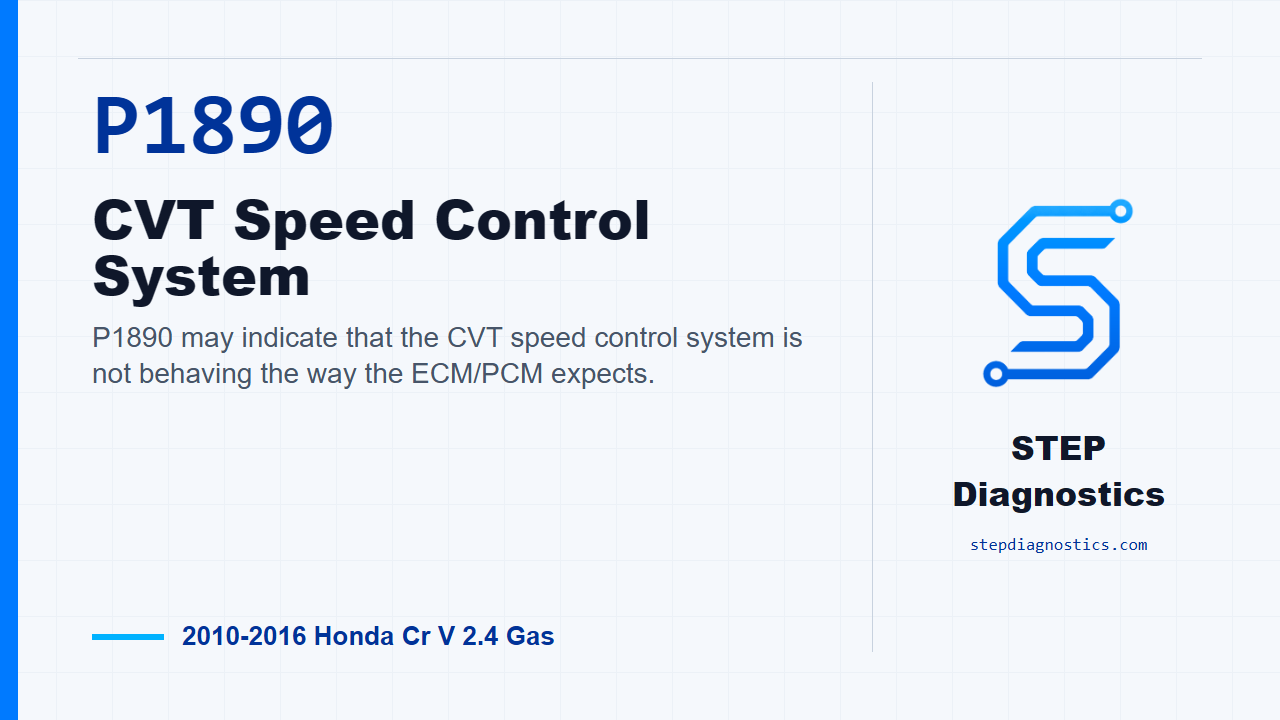
P1890 may indicate that the CVT speed control system is not behaving the way the ECM/PCM expects.
What the vehicle may do
- The vehicle may drive normally when the fault is not active.
- A transmission-related complaint may be intermittent.
- The code may need a specific warm-up and steady-speed drive condition before it shows as failed.
Possible fault areas
- CVT speed control system
- ECM/PCM control logic related to the CVT system
- Possible internal transmission condition
Diagnostic path
Opening context
On this 2010 to 2016 Honda CR-V with the 2.4 gas engine, P1890 points to the CVT speed control system. In plain language, the control side of the CVT may be seeing a speed-control problem. The vehicle may drive normally at times, or it may show an intermittent transmission-related complaint depending on when the fault is present. Broadly, the possible fault areas can include the CVT control system, the ECM/PCM side of the circuit logic, or an internal transmission condition. Before getting into the code path, start with the basic system checks so you are not chasing P1890 with a basic vehicle or scan-tool issue still in the way.
Check for other codes first
First, turn the vehicle to the ON mode and use the HDS to check for Pending or Confirmed DTCs. The first decision is whether anything besides P1890 is present. If other codes are present, check what they mean first and follow the diagnostic path for those codes before continuing with P1890. If P1890 is the only code, move on to duplicating the fault.
Try to duplicate P1890
For the verification drive, leave the vehicle in ON mode long enough to clear the DTC with the HDS. Then start the engine and warm it up to normal operating temperature. In this procedure, that means the radiator fan has come on twice. Test-drive the vehicle in D position or D mode on a flat road. Accelerate slowly until vehicle speed reaches 37 mph (60 km/h), then hold the vehicle at about 37 mph (60 km/h) for at least 60 seconds. While doing that, watch the OBD STATUS for P1890 in the DTCs menu with the HDS.
Interpret the result
Now make the call from the scan-tool result. If the HDS shows FAILED for P1890, the failure has been duplicated, and the directed repair is to replace the transmission. If the HDS does not show FAILED, treat it as an intermittent failure. The system is OK at this time. If captured operating data for this DTC is available, try to reproduce the failure under those same captured conditions instead of guessing.
Close
The key on P1890 is to avoid over-testing before you know whether the fault is repeatable. Check for other codes first, clear the code, run the specific warm-up and road-test conditions, and let the HDS status decide whether the failure is duplicated or intermittent. For more diagnostic training, visit stepdiagnostics.com.
Final check
This code path is mainly about confirming whether P1890 is repeatable under the specified operating conditions before deciding the next move.
For more guided automotive diagnostics, visit STEP Diagnostics.