What this code means
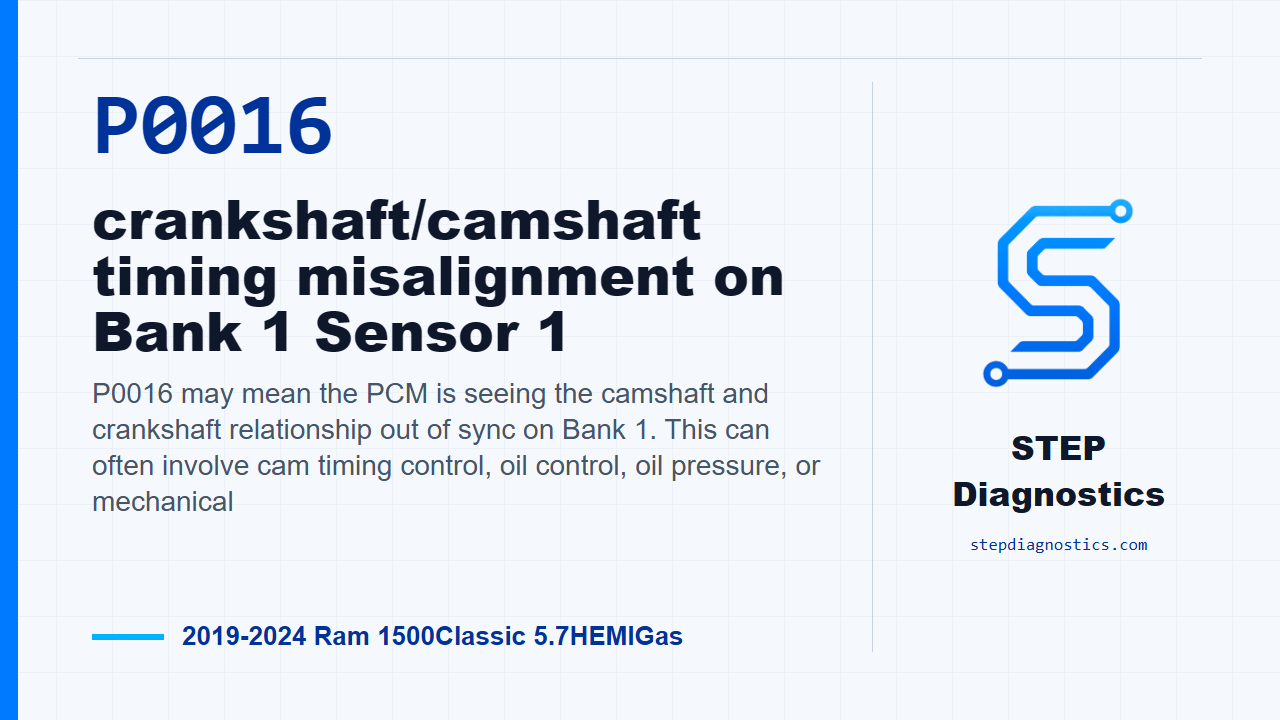
P0016 may mean the PCM is seeing the camshaft and crankshaft relationship out of sync on Bank 1. This can often involve cam timing control, oil control, oil pressure, or mechanical
What the vehicle may do
- The MIL may be on.
- Stop/start may be disabled when the fault is active on vehicles equipped with that feature.
- The engine may otherwise run normally, or it may show drivability symptoms depending on the condition.
Possible fault areas
- Possible oil level, oil condition, oil viscosity, or oil filter concerns.
- Possible oil pressure or mechanical oiling concerns.
- Possible camshaft oil control valve or cam phaser concern.
- Possible cam sensor target wheel, timing chain, sprocket, tensioner, or guide concern.
Diagnostic path
Opening context
On this 2019 to 2024 Ram 1500 Classic with the 5.7 Hemi, P0016 means the PCM may be seeing the Bank 1 exhaust camshaft position out of sync with the crankshaft position. In plain terms, the cam and crank relationship is not lining up the way the PCM expects. The truck may turn on the MIL, and if it has stop/start, that system can be disabled while the fault is active. Broadly, this can come from oil control problems, oil pressure or oil condition issues, a cam phaser or target wheel concern, or mechanical timing components like the chain, sprockets, tensioner, or guides.
Monitor gate and setting logic
Before chasing the fault, understand when the monitor is expected to run. The PCM is looking at this under operating conditions that include battery voltage above 11.0 volts, engine speed between approximately 500 - 5500 rpm, depending on PCM calibration, engine coolant temperature above 10°C (50°F), engine oil temperature above between 5°C (41°F) and 10°C (50°F), depending on PCM calibration, and engine oil pressure above approximately 220 kPa (31.9 psi). The code sets when the difference between the Bank 1 exhaust camshaft position and the crankshaft position is more than 10.0 degrees.
Start with the basic checks and confirm the code
Before going deeper, handle any applicable bulletins or known cases for this fault. Use caution around a running engine: stay out of line with the fan, keep hands away from pulleys, belts, and the fan, and do not wear loose clothing. Then turn the ignition on, read and record the DTCs, and save the captured operating data. Clear the codes, start the engine, and let it idle. If needed, road test it so cam phasing can occur and the fault has a chance to reset. Read codes again. If P0016 is not active or pending, treat it as an intermittent condition. If it is active or pending, the next move depends on whether the vehicle has variable cam timing. Without variable cam timing, move to the related-code check. With variable cam timing, try the phaser cleaning step first.
Use the phaser cleaning function when equipped
For a variable cam timing setup, use the scan tool to run the Exhaust Phaser 1 Cleaning function. After that, clear the codes, start the engine, and let it idle. Again, it may take a road test and cam phasing activity to reset the fault. Read the codes afterward. If P0016 does not return, the cleaning function corrected the fault condition, and you move to repair verification. If it does return, continue with the diagnostic path.
Check related code context, then oil level and condition
Next, look back at the codes you recorded. If camshaft oil control valve circuit faults or slow response faults are active or pending, diagnose those first because they can point directly at the control side of this system. If those are not present, move into the oil and mechanical checks. Check for engine mechanical tolerances out of specification, engine oil pressure out of specification, low oil level, an oil filter that does not meet OEM specifications, deteriorated or dirty oil, contaminated oil, incorrect oil viscosity, and aerated oil. Skipping these checks can lead to misdiagnosis, because oil quality, oil supply, and mechanical condition can all affect cam phaser control. If one of these conditions is found, correct that oiling or mechanical condition and then verify the repair. If none are found, continue to the oil pressure test.
Check oil pressure with a gauge
Shut the engine off and install an oil pressure gauge on the engine. Start it and let it idle, then watch the gauge reading. The decision here is whether the oil pressure is steady and above the engine specifications. If it is not steady and above specification, repair the oiling or mechanical problem before going any farther, then verify the repair. That could involve the same kind of oiling concerns already checked: oil level, oil viscosity, oil condition, oil drain-back, cylinder head screen restriction, sludge, oil pump, pick-up tube or seal, or the oil filter specification. If the oil pressure is steady and above specification, continue to the camshaft oil control valve step.
Replace the camshaft oil control valve and retest
At this point, turn the ignition off and replace the camshaft oil control valve. After repair or replacement work involving the CMP sensor, CKP sensor, flywheel, valvetrain, timing chain, or gears, the Cam/Crank Relearn must be performed. If that relearn is skipped, a misfire fault can set. Use the scan tool to perform the Cam/Crank Relearn procedure, connect the camshaft oil control valve harness connector, turn the ignition on, and clear the codes. Then operate the vehicle under the same captured conditions and monitor conditions that set the code, and read the DTCs again. If P0016 does not return, the camshaft oil control valve repair corrected the fault. If it does return, continue to the mechanical timing inspection.
Check timing alignment and mechanical components
Now check the engine timing alignment. Confirm proper timing chain and sprocket alignment, and inspect the cam sensor target wheel, timing chain tensioner, and guides for faulty or broken components. If you find a timing alignment or component problem, make the appropriate repair, perform the Cam/Crank Relearn, and verify the repair. If no timing alignment or component issue is found, the remaining path is a lack of oil pressure in the cylinder head or a faulty cam phaser assembly. Make the appropriate repair, perform the Cam/Crank Relearn, and verify the repair.
Verification and takeaway
Keep the verification separate from the testing. After the correction is made, clear the code, reproduce the captured operating conditions, and confirm P0016 stays gone. The key takeaway is not to jump straight to timing parts. Confirm the code, give the phaser cleaning function a chance where applicable, rule out related oil control faults, prove oil condition and pressure, then move from the oil control valve to the mechanical timing checks. For more diagnostic training, visit stepdiagnostics.com.
Final check
A clean diagnosis often starts with confirming whether P0016 is active, then works through oil control and oil pressure before moving into mechanical timing checks.
For more guided automotive diagnostics, visit STEP Diagnostics.