What this code means
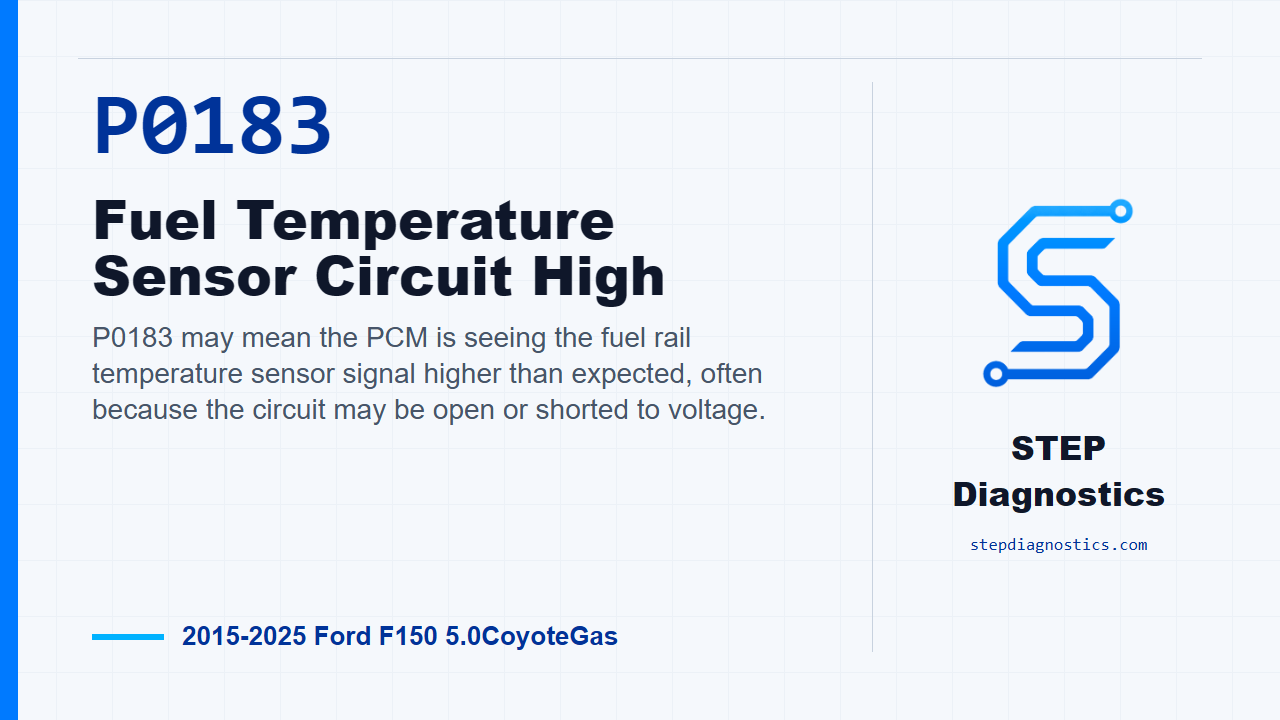
P0183 may mean the PCM is seeing the fuel rail temperature sensor signal higher than expected, often because the circuit may be open or shorted to voltage.
What the vehicle may do
- The vehicle may turn on the warning light.
- The engine may run normally in some cases.
- The vehicle can have possible drivability symptoms depending on how the PCM responds to the fuel temperature input.
Possible fault areas
- FRPT sensor wiring or connector concerns may be involved.
- The fuel rail temperature sensor portion of the FRPT sensor may be involved.
- Fuel supply-related issues may be possible in the broader diagnostic picture.
- PCM involvement may be possible after the circuit and sensor path has been checked.
Diagnostic path
Opening context
On this 2015 to 2025 F-150 with the 5.0L, P0183 is a fuel temperature sensor circuit high fault. In plain language, the PCM may be seeing the fuel rail temperature signal as open or shorted to voltage. The truck may run normally, or it can have a warning light and possible drivability symptoms depending on what the PCM is doing with that signal. The broad fault areas can include the FRPT sensor circuit, connector or harness issues, fuel supply-related concerns, the sensor itself, and less often the PCM. For this diagnosis, stay disciplined: prove the reference voltage, signal return, and FRT signal circuit before you make a call on the sensor.
Start with the code check
Start with the basic system checks and scan the vehicle. If P0183 is present, this path moves into the fuel rail temperature circuit checks. If other fuel temperature or fuel pressure related codes are present, check what they mean first so you do not chase the wrong branch. If P0183 is not present, do not force this test path; follow a symptom-based direction instead. One pressure-data note is worth keeping separate from the temperature-circuit fault: With the engine running, the FRP PID value may be 48-70 kPa (7-10 psi) higher than a fuel pressure reading taken with a mechanical gauge. That is pressure PID context, while P0183 still gets diagnosed through the FRT circuit high path.
Check VREF and signal return
Next, check the reference side of the sensor circuit. Turn the ignition OFF and disconnect the FRPT sensor connector. Then turn the ignition ON. On the 5.0L, measure voltage between C1257 Pin 1 and C1257 Pin 3. You are looking for 4.5 V - 5.5 V. If that voltage is in range, continue to the FRT signal circuit. If it is not in range, stop this branch and diagnose the reference voltage and signal return circuit before going any farther.
Check the FRT signal circuit for an open and short to ground
With the ignition OFF, disconnect the PCM connector and check the FRT signal circuit between C1257 Pin 4 and C1381E Pin 69. The decision point here is continuity: resistance needs to be less than 5 Ω. If it is not less than 5 Ω, repair the open circuit, clear the PCM DTCs, and repeat the self-test. If it passes, move on to the short-to-ground check. For the short-to-ground check, stay on the 5.0L FRT circuit at C1257 Pin 4 and verify the correct meter reference point at the vehicle before making the measurement. Do not guess at the reference point. The circuit should read greater than 10000 Ω. If it does not, repair the short circuit, clear the PCM DTCs, and repeat the self-test.
Check the FRT signal circuit for short to voltage
Now check the FRT circuit for a short to voltage. Turn the ignition ON and measure voltage at C1257 Pin 4 using the correct reference point for the test setup. Again, if that reference point is not clear at the vehicle, pause, recheck the earlier diagnostic path, and avoid guessing. If any voltage is present, repair the short circuit, clear the PCM DTCs, and repeat the self-test. If no voltage is present, continue to the intermittent concern check.
Check for an intermittent concern
For the intermittent check, turn the ignition OFF, reconnect the PCM connector, and reconnect the FRPT sensor connector. Turn the ignition ON, access the PCM, and monitor the FRT_V (V) PID. While watching the PID, tap on the sensor to simulate road shock. Wiggle the sensor connector. Then work from the sensor back toward the PCM, wiggling, shaking, and bending small sections of the harness. Also inspect the connector for damage or corrosion. If the concern shows up during that testing, repair as necessary, clear the PCM DTCs, and repeat the self-test. If the circuit checks pass and no intermittent concern shows up, this path supports installing a new Fuel Rail Pressure Temperature sensor, then clearing the PCM DTCs and repeating the self-test.
Fuel safety and verification
Before disconnecting fuel system components, relieve fuel system pressure. Fuel can remain under pressure even when the engine is not running, so use safety gloves and a face shield when disconnecting pressure lines. Keep smoking materials, open flame, and personal electronic devices away from fuel-related work. Be ready for fuel spillage, and clean fuel residue from the engine compartment before returning the engine to operation. Keep verification separate from the circuit testing. After an open, short, intermittent repair, or supported sensor replacement, clear the PCM DTCs and repeat the self-test to confirm P0183 stays gone.
Takeaway
The key on P0183 is not to jump straight to the sensor. Prove the reference voltage and signal return, prove the FRT signal circuit is not open, shorted to ground, or shorted to voltage, then load the circuit with a good intermittent check. For more diagnostic training, visit stepdiagnostics.com.
Final check
P0183 is often an electrical circuit diagnosis first: verify the reference, return, signal circuit integrity, and intermittent behavior before making the final repair decision.
For more guided automotive diagnostics, visit STEP Diagnostics.