What this code means
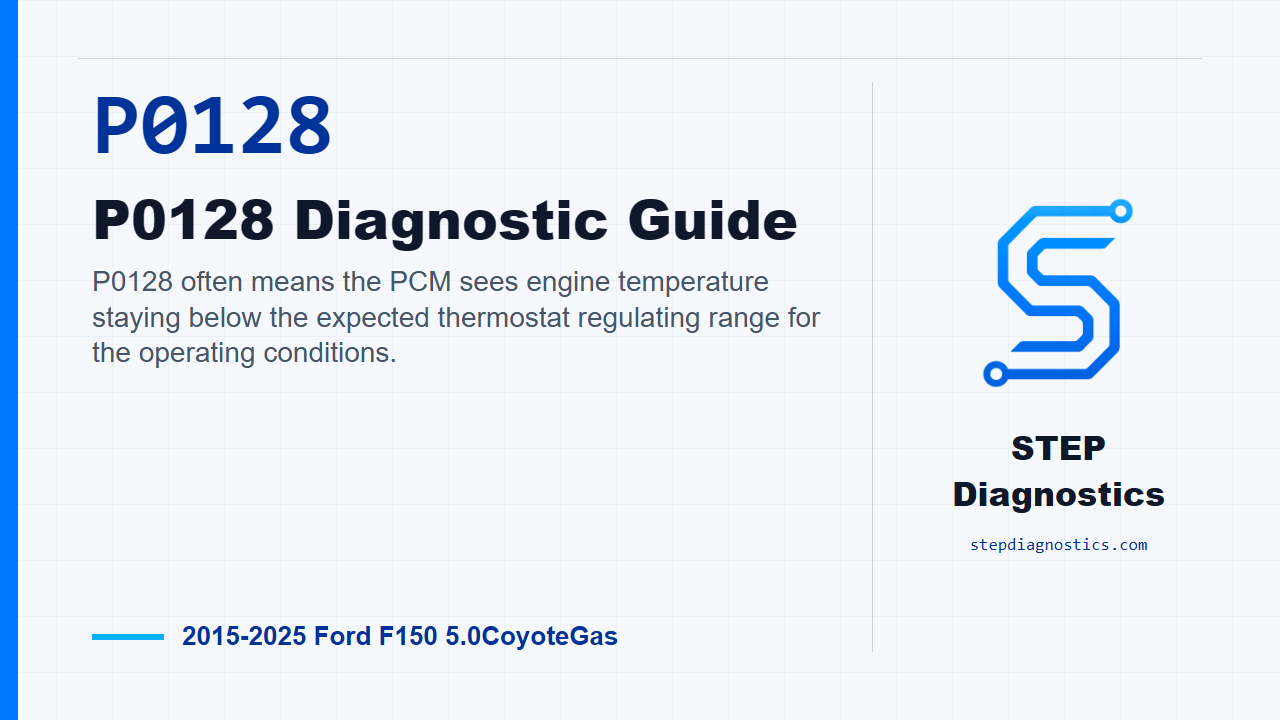
P0128 often means the PCM sees engine temperature staying below the expected thermostat regulating range for the operating conditions.
What the vehicle may do
- The engine may warm up slowly.
- The temperature gauge may stay lower than expected.
- Cabin heat may be reduced in some conditions.
- Fuel economy may be affected because the engine may stay in a colder operating strategy longer.
Possible fault areas
- Possible cooling system concern or low coolant condition.
- Possible thermostat or coolant bypass operation issue.
- Possible engine coolant temperature or cylinder head temperature sensor input concern.
- Possible wiring, connector, ambient air temperature input, or PCM input processing concern.
Diagnostic path
Opening context
On this 2015 through 2025 F-150 with the 5.0L Coyote gas engine, P0128 means the PCM is seeing the engine temperature come in below the thermostat regulating temperature. In plain terms, the engine may be warming up too slowly, may not reach normal operating temperature, or the temperature signal may not look believable for the way the engine is operating. Broadly, this can involve possible cooling system issues, coolant level, thermostat or bypass operation, temperature sensor inputs, related wiring, or PCM input processing. Treat it as a temperature performance and plausibility fault, not as an automatic thermostat replacement.
How the monitor is judged
For P0128, the thermostat monitor sets the code when the engine has not achieved the required operating temperature within a specified amount of time. Before leaning into parts, make sure the basic system checks and self-test conditions make sense. For the KOEO self-test, engine coolant temperature must be greater than -40°C-10°C (-40°F-50°F) to pass. For the KOER self-test, it must be greater than 65.5°C (149.9°F) to pass. Think of those as monitor gates, not the diagnosis by themselves.
Start the P0128 path
The diagnostic path for P0128 is the engine coolant temperature sensor pinpoint path. Start by checking for stored DTCs. If P0128 is the code you are working, follow the P0128 branch into the next check. If other temperature-related codes are present, do not turn this into a long code chase from memory. Check what those codes mean first and keep the diagnostic order clean.
Handle other DTCs before P0128
Next, check whether any other DTCs are present. If there are other codes, set the current P0128 diagnosis aside for the moment and diagnose the next code in the correct path. That keeps you from blaming the thermostat monitor when another fault may be driving the temperature information or engine operation. If no other DTCs are present, continue to the cooling system check.
Check the cooling system concern
With no other DTCs present, verify the engine cooling system is operating correctly. The two concerns called out here are an engine that overheats, or an engine that does not reach normal operating temperature. If either concern is present, correct the cooling system concern as necessary, clear the PCM DTCs, and repeat the self-test.
If the cooling system checks out
If the cooling system concern is not present, the path moves away from basic cooling system operation and into PCM input and output intermittent testing. At that point, do not guess at a thermostat, sensor, or module. Pause, recheck the earlier diagnostic path, confirm the conditions, and continue with intermittent testing in a structured way.
Verification and takeaway
Keep verification separate from testing. After a cooling system concern is corrected, clear the PCM DTCs and repeat the self-test to confirm P0128 stays gone. The takeaway is simple: for P0128, handle other codes first, verify the cooling system can reach and control normal temperature, and only then move into intermittent input and output testing if no cooling concern is found. For more diagnostic training, visit stepdiagnostics.com.
Final check
P0128 is a temperature performance fault, so the diagnostic logic is to confirm code priority, verify cooling system operation, and only then continue into intermittent input testing if the cooling系统ւ
For more guided automotive diagnostics, visit STEP Diagnostics.