What this code means
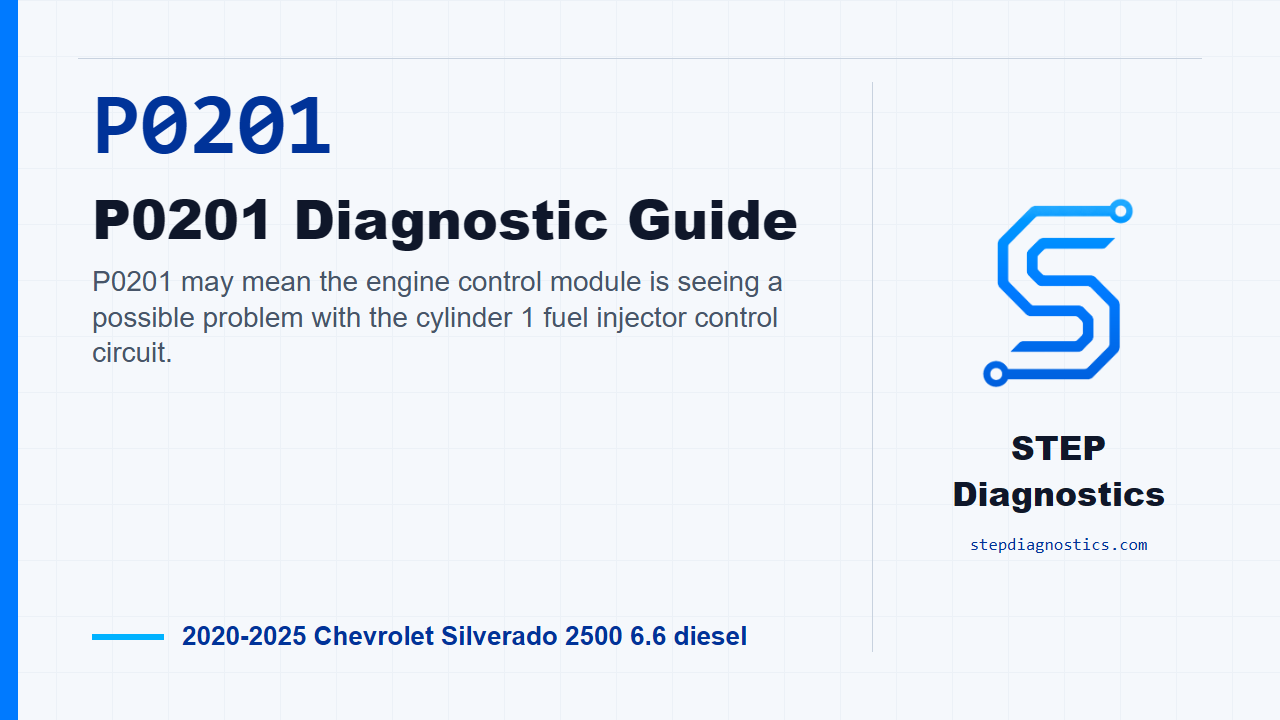
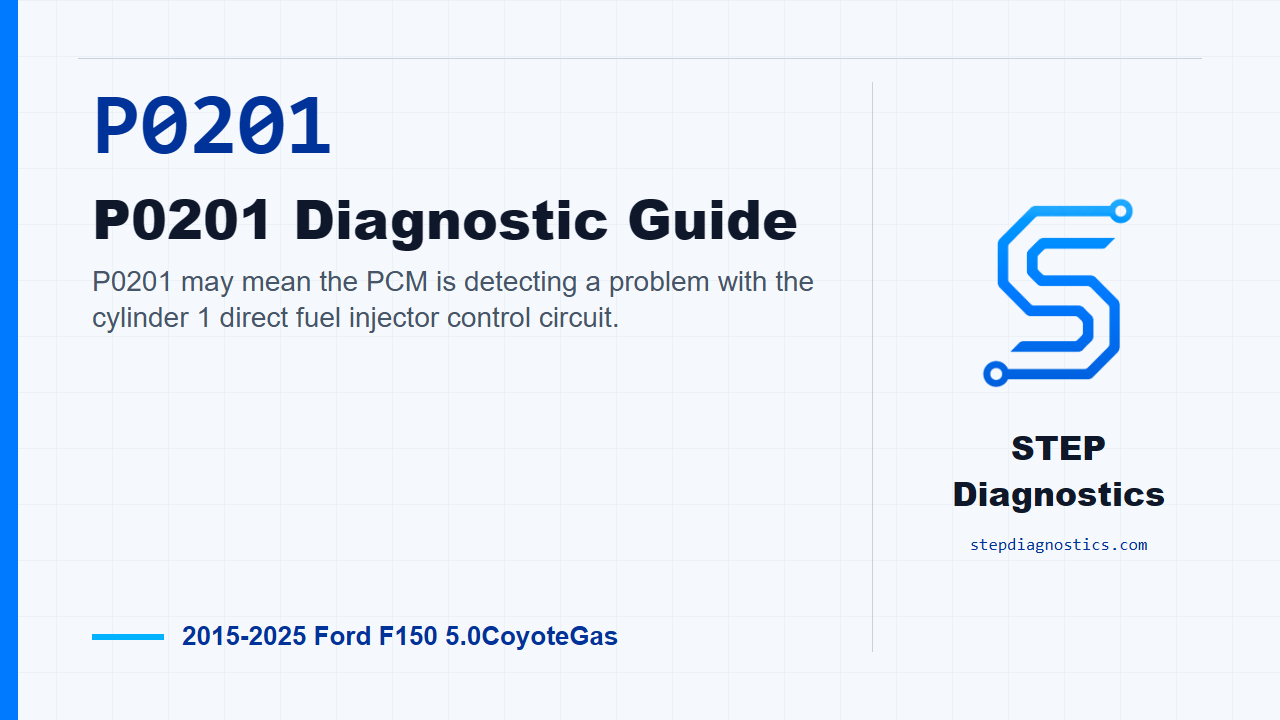
P0201 may mean the PCM is detecting a problem with the cylinder 1 direct fuel injector control circuit.
What the vehicle may do
- The engine may run rough or miss.
- Idle quality may be poor.
- A no-start type complaint can be possible in some cases.
Possible fault areas
- Fuel injector circuitry may be involved.
- The fuel injector itself can be a possible fault area.
- The PCM may be involved after circuit and connector checks are handled.
Diagnostic path
Open on P0201
On this 2015 through 2025 F-150 with the 5.0 Coyote, P0201 is a cylinder 1 direct fuel injector circuit code. In plain language, the PCM may be seeing the injector control circuit as inoperative, or it may be seeing the injector control output voltage outside its calibrated range. The truck may run rough, miss, idle poorly, or in some cases have a no-start type complaint. The broad areas in play are the injector wiring, the injector itself, and the PCM. Before putting power anywhere, remember this one: do not apply battery voltage across the fuel injector circuits. That can permanently damage the injector.
Start with the code and injector PIDs
Start with the basic system checks and confirm whether P0201, or another direct fuel injector code in the same family, is present. If one is present, continue into the injector circuit path. If none of those codes are present but the complaint is a no start, rough idle, or miss, stay in this path. For other complaints without one of these codes, move into symptom-based diagnosis instead. Next, key on and watch the PCM injector fault PIDs, including the individual injector fault PIDs and the overall INJ_F mode PID. If the overall injector fault PID indicates a concern, skip ahead to the harness wiggle test. If it does not show a concern, use the Power Balance Test step next.
Use power balance when the PID is not calling it out
If the injector fault PID is not flagging the concern, carry out the Power Balance Test. If that scan tool test is not available on the vehicle, move on to the next step. Also verify the low pressure fuel system path as directed by that diagnostic routine before leaning too hard on the injector circuit. If the Power Balance Test is satisfactory, the system is operating correctly at that time and the next move is symptom-based diagnosis. If the result is not satisfactory, continue to the harness wiggle test.
Wiggle test the injector harness
Now start the engine, bring it up to normal operating temperature, and monitor the same injector fault PIDs. Work from the suspected injector back toward the PCM, wiggling, shaking, and bending small sections of the harness. If the INJ_F PID indicates a concern while you are moving the harness, repair the wiring issue as necessary, clear the PCM DTCs, and repeat the self-test. If the wiggle test does not make the concern show up, continue into circuit testing.
Check the injector control circuits
From here, only measure the circuits that apply to P0201 and the injector being diagnosed. With the ignition off, disconnect the direct fuel injector connector and the PCM connector, then check the INJ and INJRTN circuits for an open. The resistance needs to be less than 5 Ω. If it is not less than 5 Ω, repair the open circuit, clear the PCM DTCs, and repeat the self-test. If it passes, check those circuits for a short to ground. The resistance needs to be greater than 10000 Ω. If it is not greater than 10000 Ω, repair the short circuit, clear the PCM DTCs, and repeat the self-test. Then key on and check for a short to voltage. If any voltage is present, repair the short circuit, clear the PCM DTCs, and repeat the self-test. If no voltage is present, key off and check for a short between the INJ and INJRTN circuits. That resistance also needs to be greater than 10000 Ω. If it is not greater than 10000 Ω, repair the short circuit, clear the PCM DTCs, and repeat the self-test. For the short-to-ground and short-to-voltage checks, the circuit pins are identified, but the return or reference side is not clear here. Pause, recheck the earlier diagnostic path and connector information, and do not guess on the meter hookup.
Check injector resistance, then PCM connections
If the wiring checks pass, measure the fuel injector resistance on the component side for the injector being diagnosed. The injector should measure between 1 Ω - 3 Ω. If it is between 1 Ω - 3 Ω and the Power Balance Test points to an injector concern, install a new fuel injector as necessary, reset KAM, clear the PCM DTCs, and repeat the self-test. If the resistance is not between 1 Ω - 3 Ω, install a new fuel injector, reset KAM, and repeat the self-test. If the injector resistance is between 1 Ω - 3 Ω and there is not that Power Balance Test result pointing at the injector, move to the PCM check. Disconnect all PCM connectors, inspect for pushed-out pins and corrosion, then reconnect them and make sure they seat correctly. If the concern is gone, the system is operating correctly at that time and the issue may have been a loose or corroded connector. If the concern is still present after that connector check, install a new PCM using the proper electronic engine controls process and generate RVC.
Verify the repair
Keep the repair verification separate from the testing. After a wiring repair, injector replacement, or PCM replacement path, clear the PCM DTCs and repeat the self-test. If KAM reset is part of the injector path, do that before final confirmation. The takeaway on P0201 is simple: prove the fault path in order, do not power the injector directly, and do not condemn the injector or PCM until the harness and connector checks have earned it. For more diagnostic training, visit stepdiagnostics.com.
Final check
P0201 is often best handled as an electrical circuit diagnosis first, with injector and PCM decisions made only after the circuit path is tested.
For more guided automotive diagnostics, visit STEP Diagnostics.