What this code means
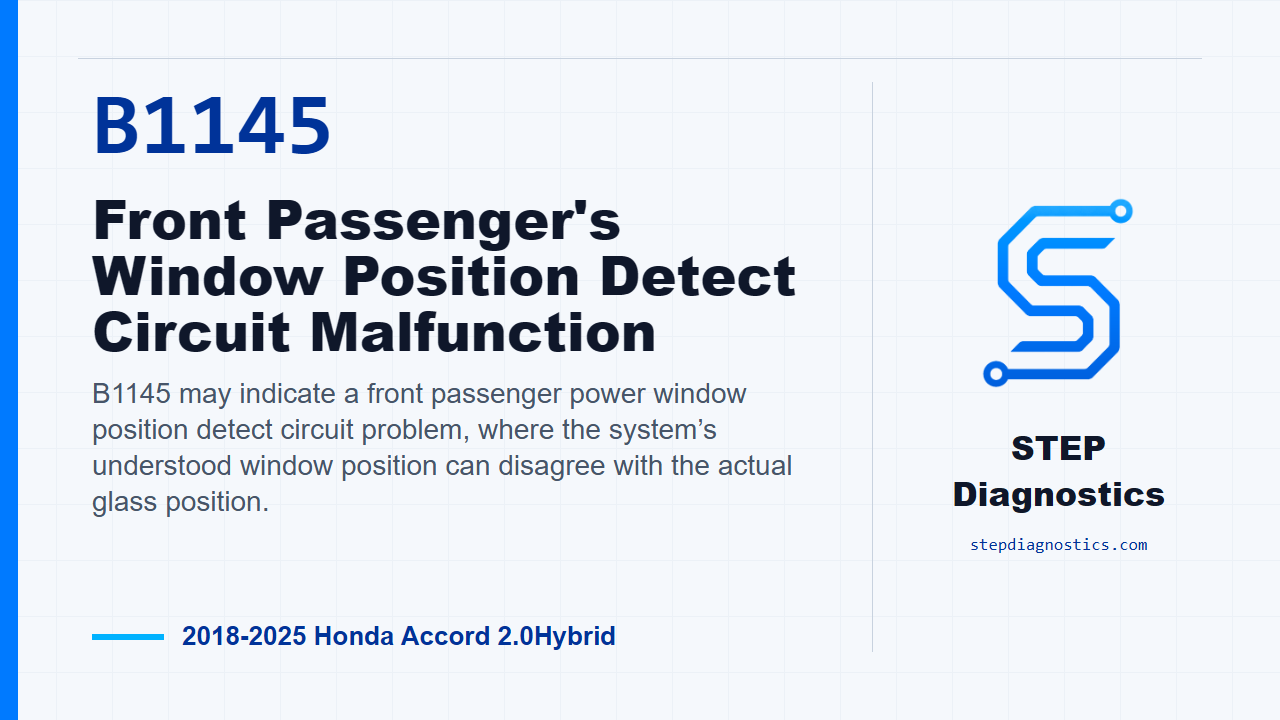
B1145 may indicate a front passenger power window position detect circuit problem, where the system’s understood window position can disagree with the actual glass position.
What the vehicle may do
- The front passenger window may move but not be tracked correctly by the control system.
- The power window system may store a fault when the expected and actual passenger window positions do not agree.
- The concern may be more about position recognition than simple window movement.
Possible fault areas
- Possible passenger power window switch input issue
- Possible power window master switch interpretation issue
- Possible position detect circuit issue
- Possible wiring or connector concern in the passenger window position signal path
Diagnostic path
Open on B1145
This episode is for B1145 on a 2018 to 2025 Honda Accord 2.0 Hybrid. In plain language, this code is tied to the front passenger window position detect circuit. The vehicle may have a passenger window that does not track position the way the control system expects, or the window may appear to operate while the recognized position does not match the actual glass position. Possible fault areas can include the passenger window switch input, the position detection signal path, connector or wiring issues, or the way the power window master switch is interpreting the passenger window position. Before getting too deep into the code, start with the basic system checks and follow a structured diagnostic approach.
Code-setting logic
The logic for B1145 is a plausibility check. The power window master switch is comparing what it believes the front passenger window position is against where the window actually is. If the recognized position and the actual position do not agree, the master switch judges that as an abnormal condition and stores the DTC. So the goal is not just to see whether the glass moves. The goal is to reproduce the window movement and watch for a mismatch between actual movement and the position the system thinks it has.
Multiple-code context
If other codes are present, do not treat B1145 in isolation. Check what the other codes mean first and use the body communication diagnostic path before chasing this one too far. Related codes are context for the system, but this episode stays focused on B1145.
Reproduce the operating condition
Turn the vehicle to the ON mode. Then use the front passenger power window switch itself and manually open and close the front passenger window. While doing that, pay attention to whether the window position being recognized by the system lines up with the actual window movement.
Testing focus
For this code, the important diagnostic question is whether the passenger window can be moved manually from the passenger switch while the master switch correctly recognizes where that window is. If the recognized position is different from the actual position, that is the fault logic for B1145. Avoid guessing at parts from the code alone; stay with the position-detection mismatch and the circuit or switch information that supports it.
Verification
Keep verification separate from the testing step. After the diagnostic path has been addressed, repeat the same operating condition: vehicle ON, then manually open and close the front passenger window from the passenger switch. The repair is verified only when the system recognizes the window position correctly and B1145 stays gone.
Closing takeaway
The takeaway for B1145 is simple: this is a passenger window position plausibility problem, so prove whether the actual glass position and the master switch’s recognized position agree before making any repair decision. For more diagnostic training, visit stepdiagnostics.com.
Final check
B1145 is best approached as a command-versus-position plausibility fault: reproduce the passenger window movement and determine whether the system’s recognized position matches the actual window.
For more guided automotive diagnostics, visit STEP Diagnostics.