What this code means
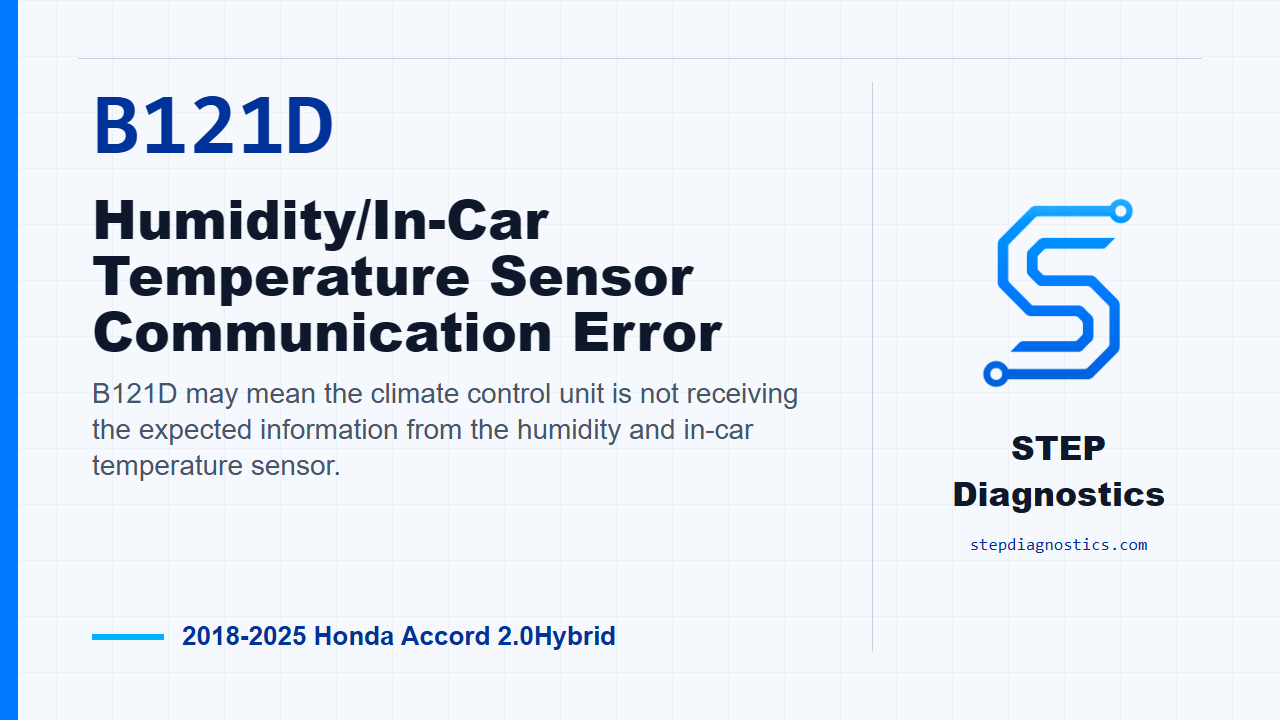
B121D may mean the climate control unit is not receiving the expected information from the humidity and in-car temperature sensor.
What the vehicle may do
- Automatic climate control may feel inaccurate or inconsistent.
- The HVAC system may store the code even when the driver notices little or no obvious symptom.
Possible fault areas
- Possible humidity and in-car temperature sensor concern.
- Possible wiring or connector concern in the sensor power, ground, data, or clock circuits.
- Possible related component concern.
- Possible climate control unit concern after the other checks are normal.
Diagnostic path
What B121D is telling you
On this Accord Hybrid, B121D is a body electrical HVAC code. In plain terms, the climate control unit may not be getting the data it expects from the humidity and in-car temperature sensor. The customer may notice automatic climate control that feels inaccurate or inconsistent, or there may be no obvious complaint beyond the code being stored. The possible fault areas are the sensor itself, the sensor power, ground, data, and clock circuits, connector condition, other related components, and, after the rest checks normal, the climate control unit. The logic is simple: if the climate control unit cannot receive the specified data from that sensor, it judges that as abnormal and stores B121D.
Start clean and confirm the code path
Before getting into pin checks, start with the basic system checks and follow a structured diagnostic approach. Make sure you are not chasing a setup issue or another obvious system problem first. Then run the confirmation step by turning the vehicle to the ON mode. That puts the system in the state needed to confirm the B121D fault path before you start disconnecting components.
Prepare for the circuit checks
Next, set up for the sensor circuit inspection. Disconnect the humidity and in-car temperature sensor connector, the 4P connector. Then disconnect climate control unit connector A, the 28P connector. With both sides isolated, you can check the S_5V, SENSOR_COM, HUM_DATA, and HUM_CLK circuits without backfeeding the modules.
Check opens and shorts in the sensor circuits
With the humidity and in-car temperature sensor 4P connector and climate control unit connector A 28P disconnected, keep IG Mode OFF for these checks. First check for opens. S_5V should be less than 1 Ω. SENSOR_COM should be less than 1 Ω. HUM_DATA should be less than 1 Ω. HUM_CLK should be less than 1 Ω. Then check HUM_DATA and HUM_CLK for a wire-to-wire short; normal is more than 1 MΩ. After that, use the normal open-or-shorted-wire inspection method for the short-to-ground checks. S_5V shorted to ground should read more than 1 MΩ. HUM_DATA shorted to ground should read more than 1 MΩ. HUM_CLK shorted to ground should read more than 1 MΩ. If any of these circuit checks are abnormal, treat it as a circuit problem and stay on the wiring and connector side of the diagnosis.
Use a known-good sensor when the wiring checks normal
If the circuit inspection does not point to a wiring fault, move to the humidity and in-car temperature sensor check. There is no direct test method given for this inspection item, so the diagnostic move is to install a known-good humidity and in-car temperature sensor and try to reproduce the failure. If the failure is reproduced, the problem is with other related components. If the symptom or DTC goes away with the known-good sensor installed, the original humidity and in-car temperature sensor is faulty.
When everything else checks normal
If the circuit checks are normal and the other inspection items indicate a normal condition, the remaining suspect is the climate control unit. Keep the logic in order: prove the circuits first, use the known-good sensor check next, and only then make the climate control unit call. After the indicated fault area has been corrected, verify the repair by putting the vehicle back through the confirmation conditions and making sure the symptom or B121D does not return. The takeaway is: B121D is a communication problem between the climate control unit and the humidity and in-car temperature sensor, so diagnose it as a sensor circuit first, then a sensor check, then the control unit only after the rest is normal. For more diagnostic training, visit stepdiagnostics.com.
Final check
This code is often approached by proving the sensor circuits first, then checking the sensor with a known-good unit, and only considering the climate control unit after the other inspection items are
For more guided automotive diagnostics, visit STEP Diagnostics.