What this code means
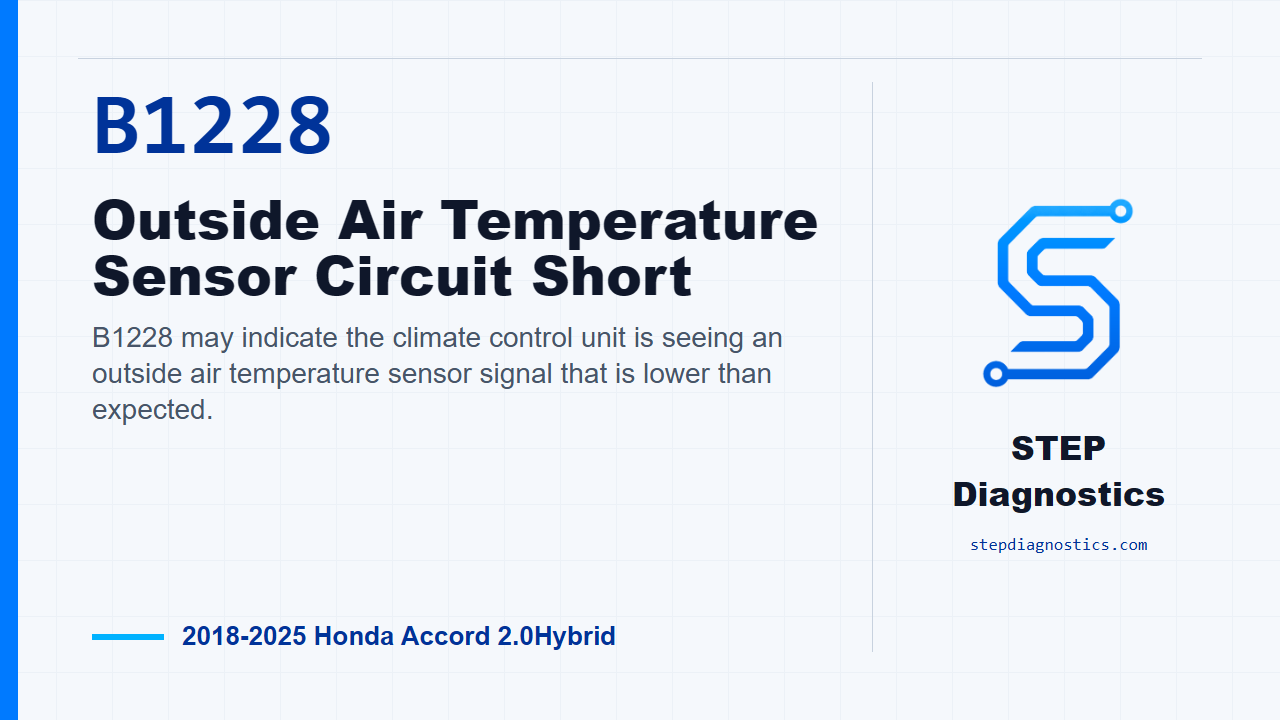
B1228 may indicate the climate control unit is seeing an outside air temperature sensor signal that is lower than expected.
What the vehicle may do
- The outside temperature display may be inaccurate.
- Automatic climate control behavior may not match actual outside conditions.
Possible fault areas
- Possible outside air temperature sensor issue.
- Possible signal or sensor ground circuit issue.
- Possible connector or terminal condition issue.
- Possible climate control unit involvement after circuit checks are normal.
Diagnostic path
Opening context
On this Accord Hybrid, B1228 points to the outside air temperature sensor circuit for the climate control system. In plain language, the climate control unit may be seeing an outside temperature sensor signal that is lower than it expects. The driver may notice an incorrect outside temperature display or climate control behavior that does not quite match conditions. Broadly, this can involve the outside air temperature sensor, its signal and sensor ground wiring, connector condition, or the climate control unit itself. Start with the basic system checks, and if other codes are present, understand those first before narrowing in on this circuit.
What sets the code
The logic behind this code is straightforward: if the input voltage from the outside air temperature sensor drops below the specified value, the climate control unit treats that as an abnormal signal and stores B1228. So the diagnostic path is aimed at proving whether the sensor circuit is shorted, grounded, or whether the remaining fault is inside the climate control unit after the circuit checks pass.
Begin the diagnostic path
Turn the vehicle to the ON mode. From there, run the outside air temperature sensor test. If you do not have the detailed sensor test procedure and the correct connector and terminal identification available, pause here. Do not guess at terminals or back-probe locations on this circuit.
Prepare for the shorted wire inspection
For the TAM and SENSOR_COM shorted wire inspection, disconnect the outside air temperature sensor 2P connector, and disconnect climate control unit connector A, the 28P connector. With both ends isolated, you can check the wiring without the components influencing the reading.
Check TAM to SENSOR_COM
Now perform the TAM and SENSOR_COM shorted wire inspection. With IG Mode OFF, inspect for a short wire-to-wire between TAM and SENSOR_COM. A normal result is more than 1 MΩ. If that check is abnormal, the problem is in the circuit, so stay with the wiring and connector side of the diagnosis.
Check TAM to ground
Next, use the proper open or short inspection method for the circuit, then inspect TAM for a short to ground with IG Mode OFF. A normal result is more than 1 MΩ. Again, if the reading is abnormal, treat it as a circuit problem and continue diagnosing the wiring and connection side of the fault.
Climate control unit decision point
Only after the other inspection items have been completed should you move to the climate control unit inspection. If the other inspection items all indicate a normal condition, then the remaining climate control unit is determined to be the cause. Keep that order straight: prove the sensor circuit first, then make the control unit call.
Verification and takeaway
After the fault area is handled, verify the repair and confirm B1228 stays gone under the appropriate operating conditions. The key takeaway is simple: this code is diagnosed by isolating the outside air temperature sensor circuit, checking TAM and SENSOR_COM for shorts, confirming both specified resistance checks are normal, and only then judging the climate control unit. For more diagnostic training, visit stepdiagnostics.com.
Final check
B1228 is often approached by checking the outside air temperature sensor circuit first, then considering the climate control unit only after the circuit inspections pass.
For more guided automotive diagnostics, visit STEP Diagnostics.