What this code means
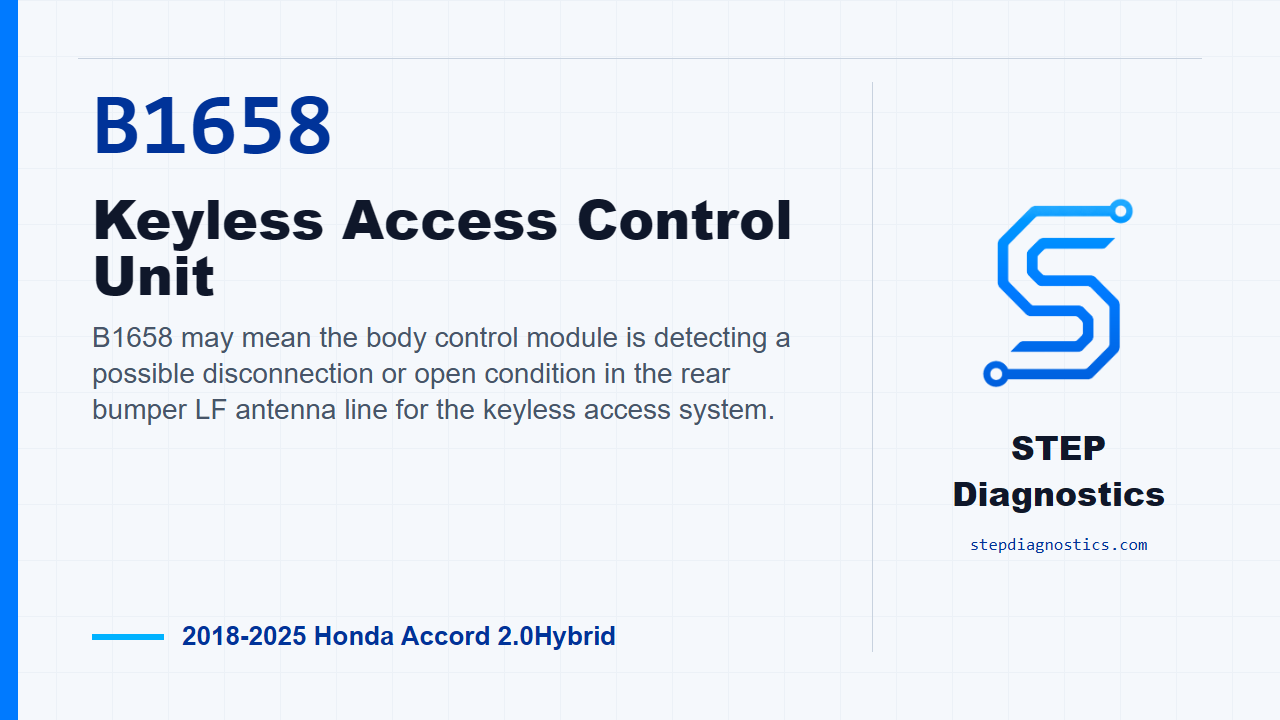
B1658 may mean the body control module is detecting a possible disconnection or open condition in the rear bumper LF antenna line for the keyless access system.
What the vehicle may do
- Keyless access operation around the rear of the vehicle may be inconsistent.
- The vehicle can store the fault when the antenna line is detected as abnormal.
Possible fault areas
- Rear bumper LF antenna circuit wiring
- Rear bumper LF antenna connector condition
- Body control module side of the circuit
- Rear bumper LF antenna
Diagnostic path
Opening context
On this Accord Hybrid, B1658 is a keyless access control unit fault. In plain language, the body control module may be seeing a disconnected or open line at the rear bumper LF antenna circuit. Depending on the failure, keyless access operation around the rear of the vehicle can be inconsistent. The broad possible fault areas are the rear bumper antenna circuit, connector condition, the body control module side of the circuit, or the rear bumper LF antenna itself.
Start with the checks that keep the diagnosis clean
Before getting into the pinpoint checks for B1658, start with the basic system checks and follow a structured diagnostic approach. If other codes are present, do not chase this one in isolation. Handle the network and system check path first so you are not diagnosing a symptom created by a larger communication or body electrical issue. After that, run the HDS Self Check and confirm what the vehicle is reporting now.
Check the rear bumper antenna circuit first
The first pinpoint area is the EXT_TR plus and EXT_TR minus wiring to the rear bumper LF antenna. Prepare for the open-wire inspection by disconnecting the rear bumper LF antenna 2P connector and body control module connector C, the 66P connector. Then perform the open-wire inspection on both sides of that antenna circuit. With the inspection OFF, both EXT_TR plus and EXT_TR minus should show less than 1 Ω. If either side is abnormal, stop there and treat it as a circuit problem before moving deeper into the diagnosis.
If the external circuit is normal, check the module side
If the outside circuit checks normal, move to the body control module inspection. For this part, the external circuit is already considered normal. Disconnect the rear bumper LF antenna 2P connector, then perform the module internal circuit inspection. The expected result is voltage. The note on this check says the vehicle mode can be ON or OFF, LOCK, because of the permanent power supply. If this inspection is abnormal, the fault area is the body control module.
Use the combined test result correctly
There is one important workflow point here: the combined inspection can be done before the other inspections because it covers all of these inspection items. But if that combined test fails, do not jump straight to a conclusion. Break the diagnosis back down and test each item individually so you know which part of the path actually failed.
Last remaining fault area
If the circuit inspection is normal and the body control module inspection is normal, the remaining fault area is the rear bumper LF antenna. At that point, the diagnosis identifies a problem with the rear bumper LF antenna rather than the wiring or the module side of the circuit.
Takeaway
The clean path for B1658 is simple: confirm the code with the HDS Self Check, check the rear bumper LF antenna wiring for an open, check the body control module side only after the external circuit is normal, and only then call the rear bumper LF antenna the remaining fault area. For more diagnostic training, visit stepdiagnostics.com.
Final check
This diagnosis separates the circuit, the body control module side, and the rear bumper LF antenna so the fault area is identified without guessing.
For more guided automotive diagnostics, visit STEP Diagnostics.