What this code means
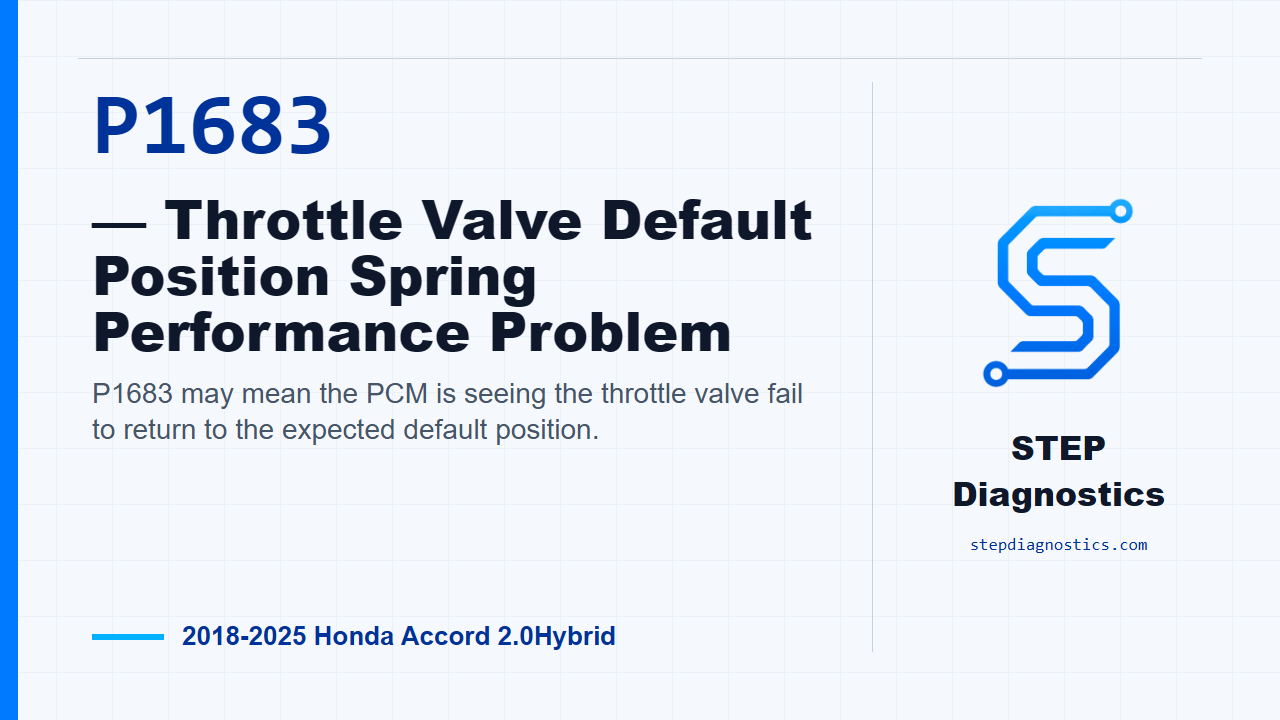
P1683 may mean the PCM is seeing the throttle valve fail to return to the expected default position.
What the vehicle may do
- The vehicle may set a warning light.
- The vehicle may idle differently than normal.
- Throttle response may be limited or feel abnormal if the fault is active.
Possible fault areas
- A possible sticking throttle valve.
- Possible contamination in the throttle body.
- A possible mechanical problem in the throttle body return behavior.
Diagnostic path
Opening context
On this 2018 to 2025 Honda Accord 2.0 hybrid, P1683 points to a throttle valve default position spring performance problem. In plain terms, the PCM may be seeing that the throttle valve is not getting back to the position it expects. The vehicle may idle oddly, may set a warning light, or may limit normal throttle behavior, depending on when the fault shows up. Broadly, this can involve a possible sticking throttle valve, contamination in the throttle body, or a throttle body mechanical issue. We’re going to keep the diagnosis focused on whether the valve returns correctly and whether cleaning changes the result.
How the code sets
The logic for this code is a commanded-versus-actual performance check. If the throttle valve does not reach the target position, the PCM judges that as an abnormal condition and stores P1683. So the test path is not about guessing at parts. It is about reproducing the condition, checking whether the throttle plate returns to its default position, and then confirming whether the code stays gone after the cleaning path.
Start with the basic checks
Before jumping into P1683, start with the basic system checks and follow a structured diagnostic approach. That keeps you from chasing the throttle body before you know the vehicle is ready for a clean confirmation test.
Reproduce the operating conditions
Enter maintenance mode, then start the engine. Hold engine speed at 3,000 rpm with no load, in P or N, until the radiator fan comes on, then let the engine idle. After that, turn the vehicle to OFF, LOCK mode, and wait 10 seconds. Then turn the vehicle back to ON mode. Be careful here: do not put your fingers into the installed throttle body when turning the vehicle ON, or while it is in ON mode. If the throttle valve is activated, it can seriously injure your fingers.
Check for a sticking throttle valve
Next, move into the throttle body inspection. Remove the throttle body inlet hose. Push the throttle valve closed for the stuck-valve check, then release it. The expected result is simple: the throttle valve should return to the default position. If that action is abnormal, the diagnostic path identifies a problem with the throttle body.
Cleaning path
If the stuck-valve inspection is normal, continue with throttle body cleaning. This cleaning step is only in the path after the throttle valve return check passes. After cleaning, run the same confirmation procedure again and check the result. The expected outcome is that P1683 is not indicated. If the result is still abnormal, the diagnostic path again points to a problem with the throttle body.
Final takeaway
The key on P1683 is to keep the diagnosis mechanical and performance-based: reproduce the condition, confirm the throttle valve returns to its default position, clean only when the return check is normal, and then verify that P1683 does not come back. For more diagnostic training, visit stepdiagnostics.com.
Final check
This code is often approached as a throttle valve performance check: confirm the operating conditions, inspect valve return, clean only when the path calls for it, and verify that the code stays gone.
For more guided automotive diagnostics, visit STEP Diagnostics.