What this code means
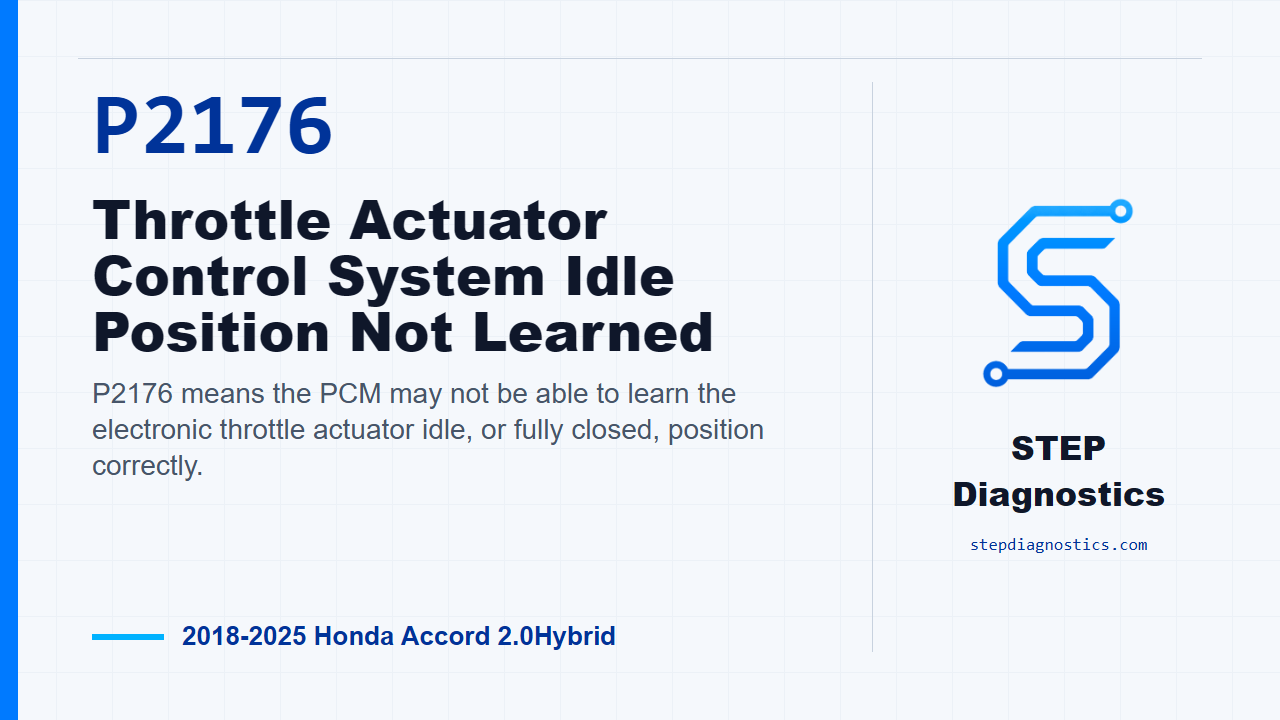
P2176 means the PCM may not be able to learn the electronic throttle actuator idle, or fully closed, position correctly.
What the vehicle may do
- The vehicle may have an unstable or rough idle.
- Throttle response may feel reduced or abnormal.
- A warning light may be present.
- The code may also be stored with few noticeable symptoms.
Possible fault areas
- Possible throttle valve sludge or carbon buildup.
- Possible throttle body fault.
- Possible throttle motor control circuit issue.
- Possible PCM concern after the earlier checks are normal.
Diagnostic path
Open on what P2176 means
P2176 on this Accord Hybrid means the PCM is not satisfied with the throttle actuator idle, or fully closed, position learning. In plain language, the electronic throttle system may not be learning where closed throttle is. The vehicle may have an unstable idle, reduced throttle response, a warning light, or it may only store the code. The possible fault areas can include throttle valve contamination, the throttle body itself, throttle motor control wiring, and only after the earlier checks pass, the PCM. Start with the basic system checks. If other throttle-related codes or indicated systems are present, handle those first so they do not steer this P2176 diagnosis the wrong way. Also, keep your fingers out of the installed throttle body any time the vehicle is in ON mode. If the throttle plate moves, it can seriously injure your fingers.
Confirm the condition and watch the data
For the confirmation routine, turn the vehicle to OFF, or LOCK mode, and wait 10 seconds. Then turn the vehicle to ON mode. Use the HDS PGM-FI Data List as supporting diagnostic information while you work through the fault. This code is about the PCM deciding that closed-position learning did not complete correctly, or that the learned closed position was outside the expected range.
Inspect the throttle valve first
Next, look at the throttle valve for sludge or carbon. The expected result is a clean throttle valve with no sludge or carbon present. If that inspection is abnormal, clean the throttle body before moving deeper into the diagnostic path.
Use a known-good throttle body for the direct check
If the visual inspection does not settle it, the next check uses a known-good throttle body because there is no direct test method for that inspection item. Install the known-good throttle body and try to reproduce the failure. If the failure is still reproduced, the problem is in other related components. If the symptom or the DTC goes away with the known-good throttle body, that points to a faulty throttle body.
Check the MTR1 and MTR2 circuits for an open
After that, move to the MTR1 and MTR2 open-wire inspection. Before disconnecting the PCM connector, jump the SCS line with the HDS and wait more than 1 minute. Then disconnect the throttle body 6P connector, and disconnect PCM connector B, the 101P connector. With IG Mode OFF, perform the open-wire inspection between the disconnected throttle body connector female terminals and the disconnected PCM connector B female terminals. MTR1 should measure less than 1 Ω, and MTR2 should also measure less than 1 Ω. If either check is abnormal, the problem is in the circuit. Do not guess terminal locations; if you cannot positively identify the terminals for this check, pause and confirm the connector information before measuring.
Final diagnostic conclusion
If the throttle body checks and the MTR1 and MTR2 circuit checks all indicate normal, the remaining diagnostic conclusion is a PCM problem. The key is not to jump there early: confirm the throttle condition, use the known-good throttle body check, verify the motor circuits, and only then make the PCM call. For more diagnostic training, visit stepdiagnostics.com.
Final check
Work the path in order: basic checks, related throttle faults first, confirmation, throttle inspection, known-good throttle body check, MTR1 and MTR2 circuit testing, then PCM conclusion only if the前ૢ
For more guided automotive diagnostics, visit STEP Diagnostics.