What this code means
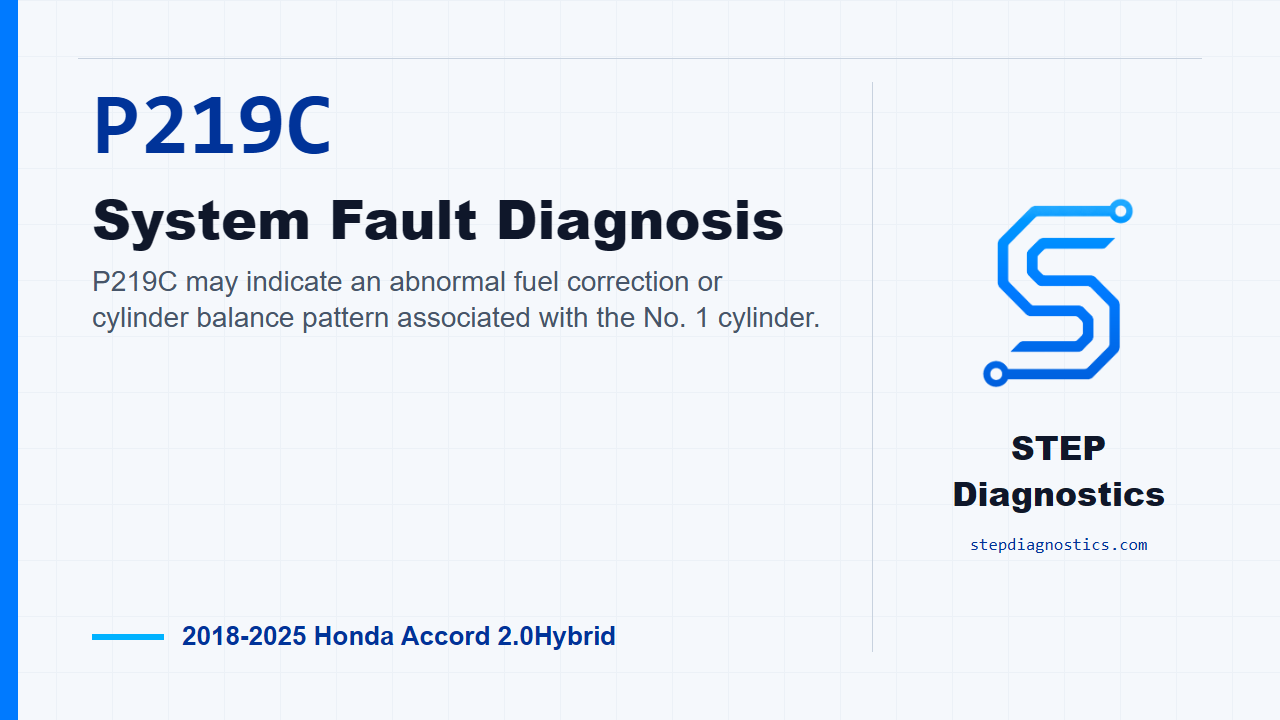
P219C may indicate an abnormal fuel correction or cylinder balance pattern associated with the No. 1 cylinder.
What the vehicle may do
- The vehicle may have a check engine light.
- It can sometimes idle rough or feel less smooth under light acceleration.
- It may also show little or no obvious drivability symptom.
Possible fault areas
- Possible air-fuel sensor or sensor heater influence.
- Possible injector or fuel delivery imbalance.
- Possible ignition or misfire-related influence.
- Possible engine mechanical condition issue.
- Possible intake or exhaust manifold condition issue.
Diagnostic path
Opening context
Today we’re focused on P219C on a 2018 through 2025 Honda Accord 2.0 Hybrid. In plain terms, this code may mean the PCM is seeing an abnormal fuel correction pattern tied to the No. 1 cylinder. The car may run normally, or it can show symptoms like a rough idle, hesitation, reduced smoothness, or a check engine light. The broad areas to keep in mind are air-fuel sensing, injector operation, cylinder misfire behavior, ignition, engine mechanical condition, and intake or exhaust leakage or restriction. Treat this as a plausibility diagnosis: prove the condition first, then work through the checks in order.
Start with the basic checks
Before chasing P219C directly, start with the basic system checks and follow a structured diagnostic approach. If other codes are present in the air-fuel sensor, air-fuel sensor heater, injector, misfire, or ignition coil areas, diagnose those first. Those faults can affect the same fuel balance logic and can send you down the wrong path if they are ignored.
Duplicate the condition
Next, duplicate the condition. Enter maintenance mode and start the engine. Hold engine speed at 3,000 rpm with no load, in Park or Neutral, until the radiator fan comes on, then let the engine idle. After that, drive at a steady engine speed between 1,000 - 1,200 rpm, then accelerate up to 3,400 rpm over about 10 - 15 seconds. Repeat that drive pattern 3 times or more if needed.
Use the P219C fuel factor value
For P219C, watch the HDS fuel factor study value for the No. 1 cylinder. The PCM sets this type of code when the fuel coefficient for a cylinder is outside its specified range. In this path, if the Fuel factor study value of No1 cylinder is out of 0.83 - 1.18, the failure is duplicated. If that value is not out of range during the confirmation run, pause and recheck the earlier diagnostic path instead of guessing.
Mechanical and manifold checks
Once the condition is duplicated, move into the inspection items in order. First, do the engine compression inspection. Then do the intake manifold and exhaust manifold visual inspection. For that visual check, the intake manifold is removed, and you visually check for carbon build-up in the intake and exhaust manifolds. Normal condition is no carbon build-up. If that inspection is abnormal, the path points toward a problem with the intake or exhaust manifold, including oil leakage.
Injector swap and cylinder air-fuel test
If the earlier checks do not resolve the direction, continue with the injector inspection. Exchange the injector from the problem cylinder with one from another cylinder. For P219C, the problem cylinder is No. 1. Then enter maintenance mode again and start the engine. Hold engine speed at 3,000 rpm with no load, in Park or Neutral, until the radiator fan comes on, then let it idle. Run the HDS CYLINDER AF TEST three times with the A/C off and all electrical loads off. The normal condition given for this check is that the injector failure cylinder is not changed. If the injector inspection is abnormal, the path identifies a problem with the injector.
Close and takeaway
The key with P219C is to confirm the No. 1 cylinder fuel factor first, then work the checks in order: related system faults, compression, manifold condition, and injector behavior. Don’t jump to a part until the test path points there. For more diagnostic training, visit stepdiagnostics.com.
Final check
P219C is best approached as a confirmation-first cylinder fuel balance diagnosis, not as an automatic parts call.
For more guided automotive diagnostics, visit STEP Diagnostics.