What this code means
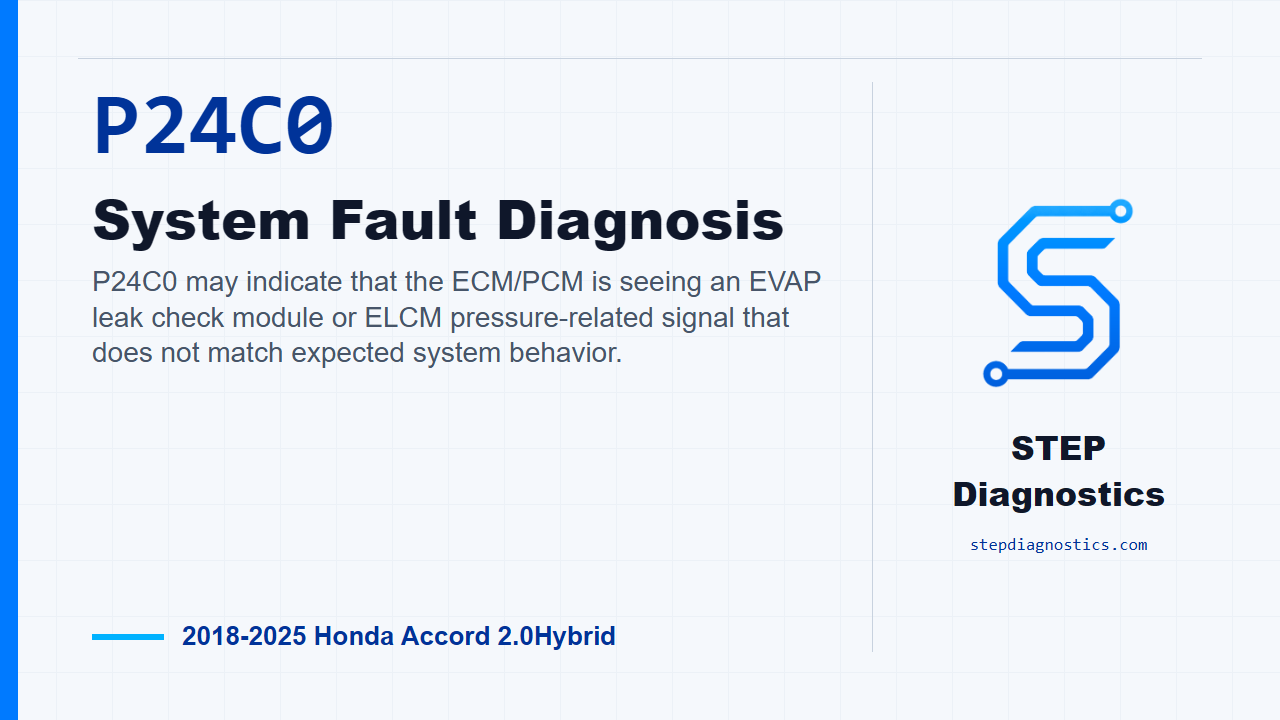
P24C0 may indicate that the ECM/PCM is seeing an EVAP leak check module or ELCM pressure-related signal that does not match expected system behavior.
What the vehicle may do
- The check engine light may be on.
- The vehicle may often drive normally.
- Emissions monitor readiness can be affected.
Possible fault areas
- A possible EVAP leak check module concern.
- A possible ELCM system concern.
- Possible drain tube, hose, or connection issues.
- Possible pressure-sensing or control-side behavior in the EVAP leak check system.
Diagnostic path
Opening context
On this Accord Hybrid, P24C0 is tied to the ECM/PCM watching the ELCM and EVAP leak check module side of the system. In plain language, the computer may be seeing an EVAP leak check pressure signal that does not line up with what it expects. The vehicle may still drive normally, but the check engine light can be on and emissions readiness may be affected. The broad areas to keep in mind are the EVAP leak check module, the drain and hose path, the ELCM system, and the pressure-sensing side of that circuit. Start with the basic system checks and follow a structured diagnostic approach before jumping into the pinpoint test.
Reproduce the operating conditions
To get the fault to show itself, enter maintenance mode, then start the engine. Hold engine speed at 3,000 rpm with no load, in P or N, until the radiator fan comes on, then let it idle. Next, watch the HDS EVAP PC Duty while holding the engine at 3,000 rpm, with EVAP PC Duty at 20 % or more. Then watch the HDS OBD STATUS for P24C0. Treat this part as the monitor gate: you are trying to run the system under the conditions where the code can be evaluated.
Set up the pressure check
If the code path is active, move to the EVAP leak check module test. Disconnect the drain tube from the EVAP leak check module. Then connect a hose to that drain tube, and connect a vacuum pump/gauge, 0-30 inHg, to the hose. Make sure the drain tube, hose, and gauge hookup are positively identified before applying pressure; if the setup is not clear, pause and recheck the earlier diagnostic path instead of guessing.
Run the check and interpret it
Apply pressure to the hose and watch the gauge. The normal condition is that pressure is not held. If the result is abnormal, the fault is in the ELCM system. If the result is normal, the fault is in the EVAP leak check module. Do not turn that into an automatic parts call; use the result to keep the diagnosis pointed at the correct side of the system.
Verification and takeaway
Keep verification separate from the pressure test. After the fault is addressed, rerun the same confirmation conditions and make sure P24C0 does not return. The key on this one is simple: confirm the monitor conditions first, then use the drain-side pressure check to split the fault between the ELCM system and the EVAP leak check module. For more diagnostic training, visit stepdiagnostics.com.
Final check
Confirm the operating conditions first, then use the pressure check result to separate an ELCM system problem from an EVAP leak check module problem.
For more guided automotive diagnostics, visit STEP Diagnostics.