What this code means
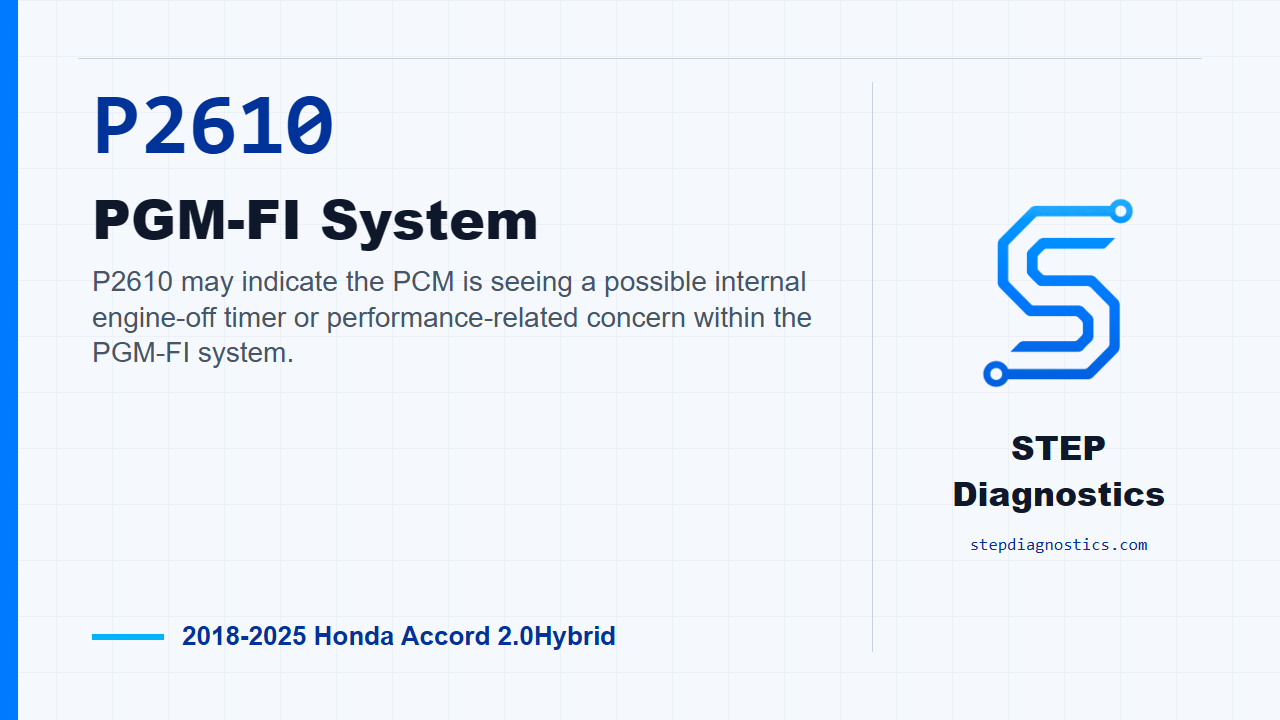
P2610 may indicate the PCM is seeing a possible internal engine-off timer or performance-related concern within the PGM-FI system.
What the vehicle may do
- The vehicle may turn on a warning light.
- The vehicle can sometimes appear to run normally.
- Symptoms may be intermittent depending on when the PCM detects the concern.
Possible fault areas
- Possible PCM internal logic or timing concern
- Possible power, ground, or connector condition affecting module operation
- Possible control-module state or communication-related concern
Diagnostic path
Code overview and starting point
On this Accord Hybrid, P2610 may point to a possible PCM internal timing or performance concern in the PGM-FI system. The driver may only notice a warning light, and the vehicle can sometimes appear to run normally. Broadly, keep the fault areas in perspective: possible PCM logic, power or ground stability, connector condition, or control-module state issues. Before going after the code, start with the basic system checks and follow a structured diagnostic approach. The key idea here is simple: if the PCM sees an abnormality in itself, it can store this DTC.
Set up the vehicle state
Begin by turning the vehicle to the ON mode. This puts the system in the correct state to begin working through the PGM-FI diagnostic path. At this stage, do not jump to parts or assumptions. Get the vehicle powered up correctly first, then continue only with confirmed diagnostic information.
Takeaway
For P2610, treat this as a plausibility and performance-style fault around what the PCM is seeing internally. Start clean, power the vehicle to ON mode, and avoid guessing beyond the confirmed diagnostic path. For more diagnostic training, visit stepdiagnostics.com.
Final check
This code should be handled methodically as a PCM plausibility or performance concern, without assuming a failed part before the diagnostic path supports it.
For more guided automotive diagnostics, visit STEP Diagnostics.