What this code means
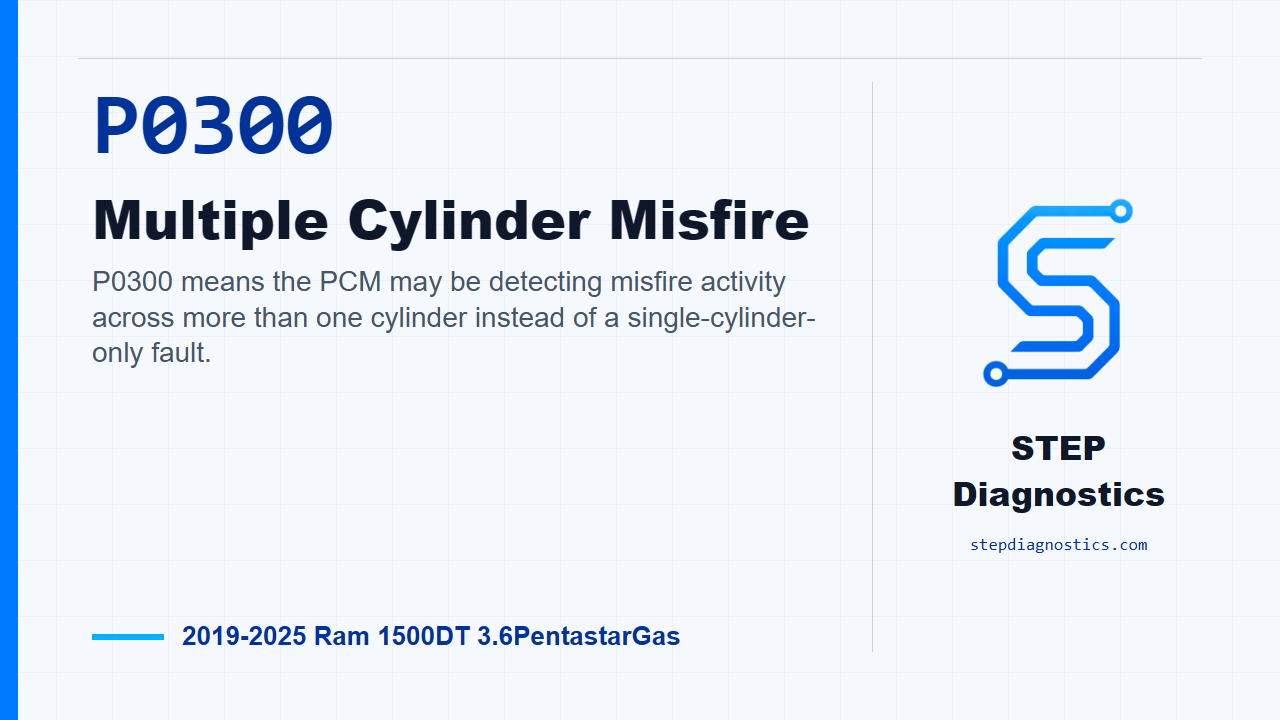
P0300 means the PCM may be detecting misfire activity across more than one cylinder instead of a single-cylinder-only fault.
What the vehicle may do
- The vehicle may idle rough or shake.
- It may hesitate, stumble, or feel weak under load.
- The check engine light may illuminate or flash depending on misfire severity.
- Stop/start may be disabled while the code is active on equipped vehicles.
Possible fault areas
- Air intake or vacuum leak concerns may be involved.
- Fuel quality, fuel delivery, or injector operation may be involved.
- Ignition coil, spark plug, or coil circuit concerns may be involved.
- Engine oiling, cam phaser control, or valve lift operation may be involved.
- Compression, valvetrain, combustion chamber, EGR, or carbon buildup concerns may be involved.
- Wiring, connector, power, ground, or PCM control concerns may be involved.
Diagnostic path
Open: what P0300 is telling us
On this 2019 to 2025 Ram 1500DT with the 3.6 Pentastar, P0300 means the PCM is seeing a multiple-cylinder misfire. The truck may idle rough, stumble under load, or set a check engine light that may illuminate or flash depending on how severe the misfire is. If equipped with stop/start, that system may be disabled while the code is active. Broadly, this can come from air, fuel, ignition, engine mechanical issues, oiling and cam control, valve lift operation if equipped, EGR leakage, wiring, or a control-side problem. The PCM is watching crankshaft speed variation between cylinders, so the job here is to prove which system is actually disturbing combustion.
Start by proving the misfire is active
Start with the basic system checks. Then turn the ignition on, use the scan tool to record all codes and the captured operating data, and road-test the truck under the same captured conditions. During the drive, pay attention to when the misfire shows up, watch the downstream oxygen sensor readings while it is happening, and use the misfire monitor to see which cylinders are involved. Treat the monitor requirements as gates: fuel level above 12%, battery voltage above 10.9 volts, ambient temperature above -23°C (-9.4°F), coolant temperature at engine start above -7°C (19.4°F), or if start engine temperature is below threshold, enable monitor when engine temperature reaches 21°C (69.8°F), and engine speed between approximately 400 rpm and 6200 rpm. The misfire monitor is disabled during decel fuel shutoff, so do not mistake a monitor that is not running for a clean result. If the excessive misfire is not happening now, handle it as an intermittent instead of forcing the rest of this path. If it is happening now, check what other active or pending codes mean first. Fuel, ignition, air handling, variable valve timing, or valve lift codes can lead you directly to the system that is causing P0300, so chase those before continuing this misfire flow.
General inspection, oil condition, and oil pressure
Next, do a broad inspection before getting buried in one system. Look for accessory drive problems, sensor mounting issues, poor connector or terminal fit at the crank, cam, MAP, throttle body, injector, coil, and related components, corroded PCM power or grounds, vacuum leaks, intake or exhaust restriction, internal engine problems, moisture on ignition parts, fuel concerns, and load-related issues. Repair anything obvious and then verify the repair and confirm the code stays gone. If nothing shows up, shut the ignition off and check the oil side. Low oil, aerated oil, dirty or contaminated oil, the wrong filter, or the wrong viscosity can all matter here because oil control affects cam phaser movement. If an oiling or mechanical issue is found, repair that first. If the oil condition checks out, measure oil pressure with the proper adapter and gauge at the oil filter cap, or monitor it with the scan tool if the adapter is not available. Let the engine idle and make sure the reading is stable and above 14.0 psi. Oil pressure below 14.0 psi, or pressure that is oscillating excessively, can delay cam phaser movement enough to create a misfire during any operating condition.
Check cam phaser response when the misfire is bank-related
If the multiple-cylinder misfire is concentrated on one bank and variable valve timing is suspect, compare desired and actual intake and exhaust camshaft positions on that bank. Watch them at idle and at several engine speeds. Raise engine speed quickly and hold it steady for up to 30 seconds, then bring it back down and hold it above idle for up to 30 seconds. Repeat that while watching whether actual cam position follows desired position and whether the cam returns to the lock pin at idle. For the standard 3.6L application, lock pin position for the Intake Camshaft is 127.0 degrees, and lock pin position for the Exhaust Camshaft is 117.0 degrees. For the 3.6L Upgrade application, lock pin position for the Intake Camshaft is 146.0 degrees, and lock pin position for the Exhaust Camshaft is 123.0 degrees. If actual and desired differ by more than 6.0 degrees at idle, treat that as a cam not returning to the lock pin. If actual position lags behind or overshoots desired position during speed changes, treat that as a binding or sticking VVT concern. Diagnose and repair the VVT system before moving on.
Airflow, exhaust, fuel quality, and fuel delivery
If cam control does not explain it, move to breathing and fuel. Inspect the intake plumbing for restriction, check the air filter for excessive debris, and check engine components and vacuum hoses for leaks. If the intake side is clean, inspect the exhaust for physical damage that could restrict flow or create excessive backflow, then idle the engine and check flow at the tailpipe. After that, check the fuel itself: water in the fuel, wrong fuel type, old or contaminated fuel, and low fuel all need to be ruled out, along with the ethanol content check. If the fuel is the problem, replace the fuel and flush or clean the fuel system if needed. If fuel quality checks out, run the fuel delivery test. Any problem found in those areas gets repaired first, followed by verification that P0300 stays gone.
Compare injector pressure drop on misfiring cylinders
For the injector check, turn the ignition on and allow fuel pressure to build to maximum. Use the scan tool to actuate the injectors on the cylinders that showed misfire, and watch the fuel pressure gauge. Restore rail pressure and repeat the same check on two or three known good cylinders. The point is comparison: the misfiring cylinder should have a fuel pressure drop equal to the known good injectors. If the drop is too little, check for debris in the fuel rail or injector and repair as needed. If the drop is too large, suspect a faulty or fouled injector. After each injector actuation, start the engine to clear fuel from the cylinder; skipping that can cause engine damage.
Valve lift check if equipped
If this truck is equipped with the variable valve lift system, run the scan tool VVL System Diagnostic and follow the on-screen directions. Do not erase the code before running that routine. If the vehicle does not have VVL, skip this test. A rocker arm stuck in low lift can cause a misfire at higher engine speeds, above approximately 4000 rpm. If the VVL routine says the misfire is being caused by that system, follow the result path carefully. When the path calls for checking actual oil pressure to the VVL solenoid, remove the solenoid identified by the scan tool, install Kit, VVL Adapters 2027300090, start the engine, and let it idle long enough for the dual oil pump to switch to low pump mode. Compare cylinder head oil pressure to main engine oil pressure. Cylinder head oil pressure should be within 5.0 psi of main engine oil pressure. If it is within that range, inspect the VVL solenoid screen for debris and the seals for damage or poor installation. If there is no debris and the seals are good, replace the VVL solenoid. If cylinder head oil pressure is not within that range, diagnose and repair the lack of oil pressure to the solenoid.
Spark, plug condition, compression, EGR, carbon, and valvetrain
Now move into ignition and mechanical checks. Remove the ignition coil from the cylinders that are misfiring, reconnect the coil connector, disconnect the injector connector for the cylinder being tested, install a spark tester, crank the engine, and look for good spark. If spark is good, inspect the spark plug. Oil or coolant signs, cracks, carbon tracking, fouling, incorrect gap, or a loose or broken electrode all point you to the plug or to a cylinder problem that has to be corrected. If the plug inspection is clean, run compression on all cylinders and compare the misfiring cylinders against known good cylinders. If compression is not within specification, use a leak down test to separate valvetrain from combustion chamber causes. If compression is acceptable, swap the suspect spark plug with a known good cylinder, or replace the plugs if access makes swapping impractical, then watch the misfire monitor. If the misfire follows the plug or goes away after replacement, replace the spark plugs. If it does not, check for an EGR valve leaking at idle. A tube that heats quickly after a cold start can indicate exhaust leaking past the valve; if access requires it, block the EGR opening and see whether the idle misfire or rough running is gone. If the EGR valve is the issue, replace it. If EGR checks out, clean carbon from the valves and combustion chambers with Mopar Combustion cleaner, drive the vehicle to clear the cleaner, erase codes, and retest under the captured conditions. If the misfire does not return, the carbon cleaning repaired the fault. If it does return, visually inspect the camshaft lobes, rocker arms, and springs for excessive wear or broken parts, and repair what is found.
No-spark path: power feed and coil control
If the spark test failed, go after the coil circuits. Turn the ignition off, disconnect the ignition coil connector, turn the ignition on, and use the scan tool to actuate the ASD relay. With a 12-volt test light connected to ground, probe the ASD relay output circuit at the coil connector. The light should illuminate brightly. If it does not, repair the open or short to ground between the PDC and the ignition coil connector, then stop all actuations and verify the repair. If the power feed is good, check the coil driver. Use a 12-volt test light connected to a 12 volt source, probe the coil control circuit at the coil connector, and crank the engine for 5.0 seconds. A brightly blinking light means the driver is operating, so replace the ignition coil. If the light stays on constantly, check the coil control circuit for a short to ground. Turn the ignition off, disconnect the PCM C2 connector, install the GPEC Diagnostic 10436 adapter, and check continuity between ground and the coil control circuit. If continuity is present, repair the short to ground. If the light stays off constantly during the driver test, check the coil control circuit for an open by measuring resistance between the coil connector and the GPEC adapter. Resistance should be below 3.0 Ohms. If it is not, repair the open or high resistance. Keep clear of the fan, pulleys, and belts while the engine is operating, and do not wear loose clothing. Also, do not probe the PCM harness connectors; use the adapter so the terminals are not damaged.
Final connection check and verification
If the path gets all the way to the end without finding the fault, perform any applicable bulletins, then disconnect the PCM connectors, any related in-line connectors, and the related component connectors. Inspect connector installation, locks, corrosion, water intrusion, weather seals, bent or pushed-back terminals, spread terminals, overheating from poor contact, and terminal tension. Repair anything found, reconnect everything fully, erase the code, and operate or drive the truck under the same monitored conditions. If P0300 does not return, the wiring or poor connection problem has been repaired. If it does return after those checks, replace and program the PCM, then verify the repair and confirm the code stays gone. Takeaway: P0300 is not a parts code. Work it in order: prove the active misfire, handle supporting codes first, rule out oiling and cam control, air and fuel, VVL if equipped, ignition, compression, EGR, carbon, valvetrain, and finally wiring or control. For more diagnostic training, visit stepdiagnostics.com.
Final check
P0300 often requires a system-by-system diagnosis rather than guessing at one part.
For more guided automotive diagnostics, visit STEP Diagnostics.