What this code means
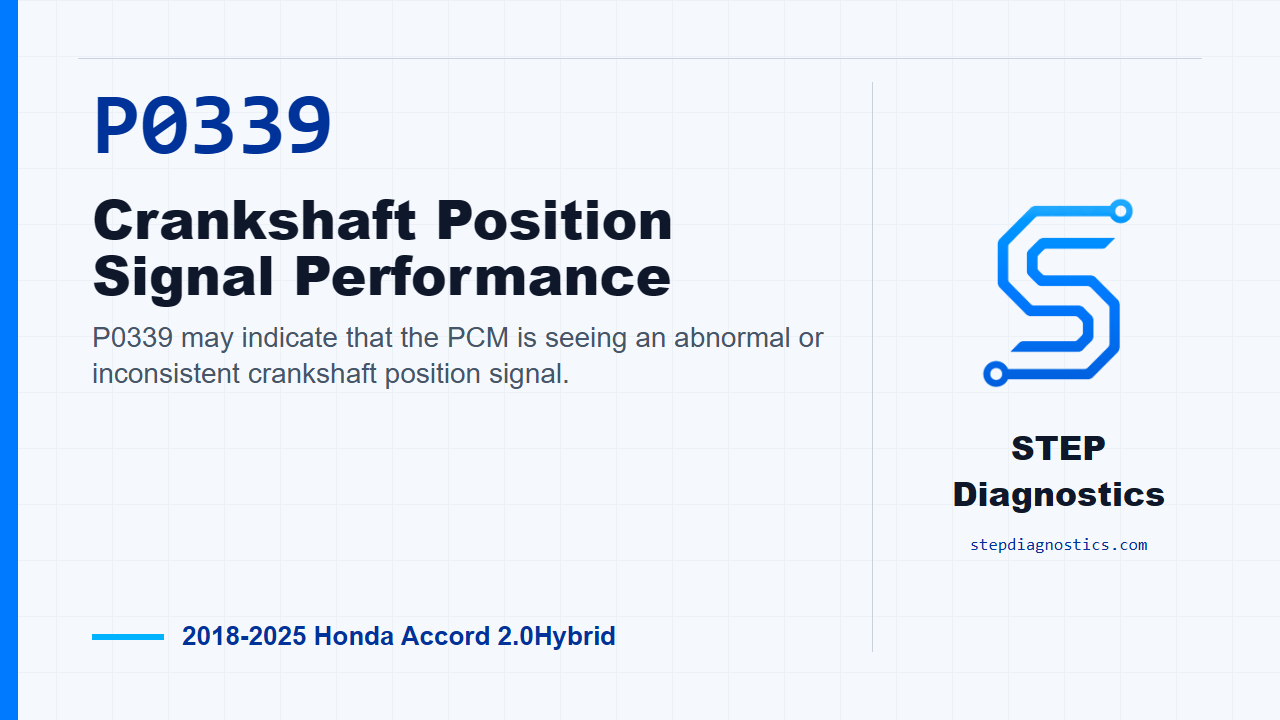
P0339 may indicate that the PCM is seeing an abnormal or inconsistent crankshaft position signal.
What the vehicle may do
- The vehicle may have starting difficulty.
- The engine may stall or run rough.
- The concern can be intermittent.
Possible fault areas
- Possible CKP sensor circuit connection or terminal issues.
- Possible engine or body ground connection issues.
- Possible CKP pulse plate looseness or damage.
- Possible CKP sensor fault after other checks are normal.
Diagnostic path
Opening context
This one is for P0339 on the Honda Accord Hybrid. In plain language, the PCM may be seeing a crankshaft position signal that does not line up the way it expects. The vehicle may have starting, stalling, rough-running, or intermittent drivability complaints, but treat those as possible symptoms, not proof. Broadly, this diagnostic can involve the CKP sensor circuit, connector and terminal condition, engine and body ground connections, the CKP pulse plate, or the CKP sensor itself.
Diagnostic setup and code logic
Before testing, make sure you are working from the basic troubleshooting approach for the vehicle instead of jumping straight to a part. The logic behind this code is a crank signal plausibility check. If the pulses between the reference pulses are not at the specified value, the PCM decides the crank signal is abnormal and stores P0339. So the job here is to duplicate the failure under the right conditions, then work through the crank sensor circuit and mechanical target checks in order.
Confirmation path
Start by trying to confirm the fault. Enter maintenance mode, start the engine, and let it idle for 10 seconds or more. While it is idling, monitor the HDS OBD status for P0339. If the failure duplicates there, that part of the confirmation is complete. If it does not, test-drive the vehicle for several minutes in the same range as the recorded on-board snapshot for engine speed and vehicle speed, then monitor the HDS OBD status again for P0339.
Connector and terminal checks
Once you are into the fault path, check the CKP sensor and PCM connectors for secure fit and loose terminals. The expected result is that the connections and terminals are OK. If that inspection is abnormal, the problem is in the connections or terminals. Next, check the engine ground and body ground connectors the same way, again looking for a secure connection and loose terminals. If that is abnormal, stay with the connection or terminal problem instead of moving on.
Pulse plate inspection
If the connector and ground checks are normal, remove the CKP sensor so the CKP pulse plate can be inspected. Visually inspect the pulse plate for looseness or damage. The expected condition is no looseness and no damage. If that inspection is abnormal, the problem is with the CKP pulse plate.
CKP sensor conclusion
If the earlier inspection items all show normal condition, the remaining CKP sensor is determined to be the cause. That is the diagnostic conclusion from this path: the circuit connections, grounds, and pulse plate have been checked first, and the remaining fault area is the CKP sensor.
Verification and takeaway
Keep verification separate from the inspection work. After correcting the fault found in the diagnostic path, use the confirmation routine again and make sure P0339 does not return under the idle check and the matching drive conditions. The takeaway is simple: confirm the code first, inspect the CKP circuit connections and grounds, check the pulse plate, and only then make the CKP sensor call if everything else checks normal. For more diagnostic training, visit stepdiagnostics.com.
Final check
P0339 is often approached by confirming the fault first, then checking the CKP circuit, grounds, pulse plate condition, and finally the sensor if the earlier inspections are normal.
For more guided automotive diagnostics, visit STEP Diagnostics.