What this code means
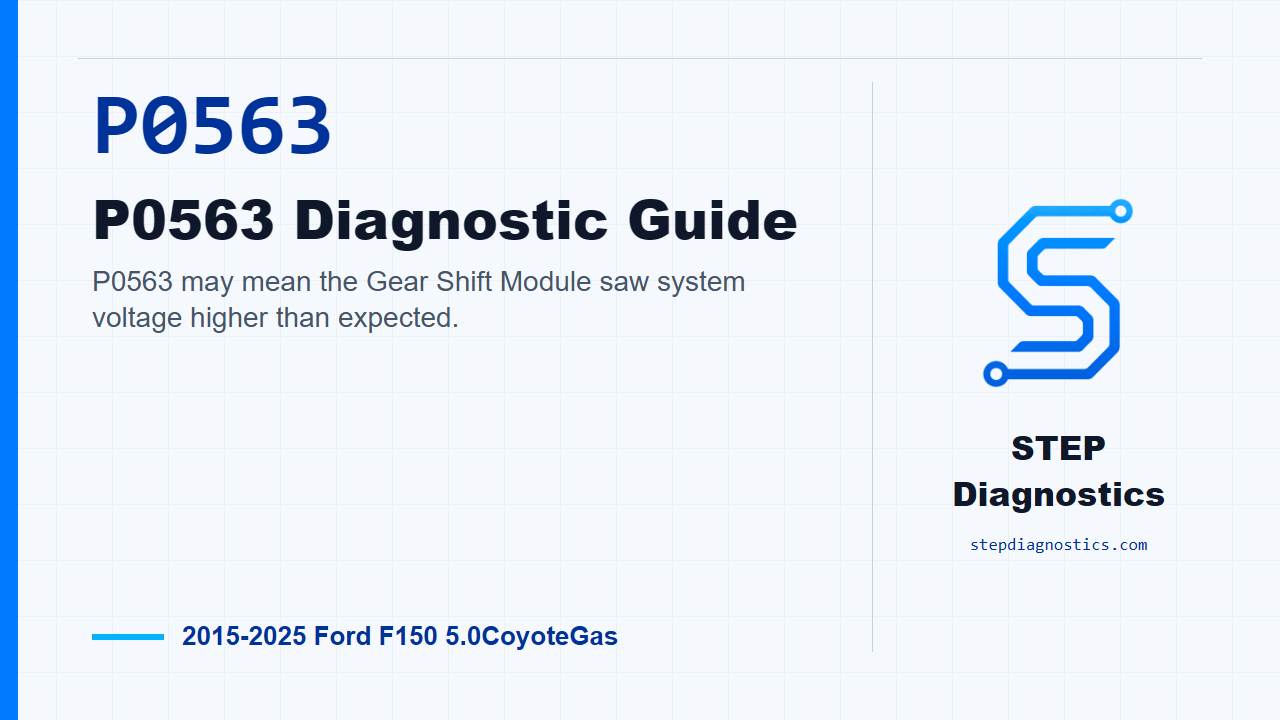
P0563 may mean the Gear Shift Module saw system voltage higher than expected.
What the vehicle may do
- The vehicle may have shift-control symptoms, or it may operate normally by the time it is inspected.
- The code can be stored after a charging or jump-start event.
Possible fault areas
- Possible charging-system overvoltage
- Possible prior battery charging or jump-start event
- Possible GSM power feed, ground, connector, or module concern
Diagnostic path
Opening context
Today we’re diagnosing P0563 on a 2015 to 2025 F-150 with the 5.0 Coyote and 10R80 column-shift setup. In plain language, this code means the Gear Shift Module may have seen system voltage higher than expected. The truck may act normally by the time it gets to you, or the customer may report shift-control concerns depending on when the voltage event happened. Think in broad areas first: a possible charging-system overvoltage, a battery charging or jump-start event, the GSM power and ground path, or a connector issue at the module.
Start with the basic checks
Start by verifying the customer concern. Operate the vehicle and try to duplicate the condition before you get deep into testing. Then do a visual inspection for obvious mechanical or electrical damage. If you find an obvious cause, correct it if possible before moving on. If nothing stands out, retrieve all GSM codes and use the code information to choose the correct diagnostic path. If there are no codes, stay with symptom-based diagnosis instead of forcing a code-based test.
Understand what P0563 is looking at
For this fault, the GSM is fed through a fused circuit from the BCM and it has a single ground circuit. The GSM needs operating voltage between 9 and 16 volts. P0563 sets when the voltage supplied to the GSM rose above 16 volts. An overcharging condition can cause this, and the code may also be stored after battery charging or jump starting. Once P0563 is the target code, follow the high-voltage GSM test path and have the correct schematic and connector information available.
Check whether the high voltage is vehicle-wide
The first real split is whether this is only a GSM complaint or part of a larger vehicle charging concern. With the scan tool, pull continuous memory codes from all modules. If other modules also have high-voltage codes, diagnose the vehicle charging concern first. If no high-voltage codes are present in other modules, continue with the GSM path.
Check charging voltage under the specified condition
Next, clear all GSM codes. Turn off the interior lights, exterior lights, and accessories. Start the engine and run it at approximately 1,500 RPM for 3 minutes while watching battery voltage. Do not let engine speed go above 2,000 RPM during this step. If it does go above 2,000 RPM, shut the engine off and restart it before doing the check again. You’re looking for battery voltage to stay between 13 and 15.2 volts. If it stays in that range, keep going. If it does not stay in that range, diagnose the overcharging condition before blaming the GSM.
Recheck P0563 after the voltage check
Now cycle the ignition off, then back on, and run the GSM self-test with the scan tool. If P0563 comes right back, continue to the module connector and operation check. If P0563 does not return, the system is operating properly at this time. In that case, the code may have been set earlier during battery charging or while jump starting the vehicle.
Inspect the GSM connector and confirm operation
If P0563 is still present, turn the ignition off and disconnect the GSM connector. Inspect the connector carefully. If there is corrosion, correct it by installing a new connector or terminals and cleaning the module pins. If pins are damaged or bent, install new terminals or pins as needed. If pins are pushed out, install new pins as necessary. Then reconnect the GSM connector and make sure it fully seats and latches. Operate the system again and see whether the concern is still present.
Final decision and takeaway
If the concern is still present after the connector check, check for any applicable service communication that addresses this concern. If one applies, stop this test path and follow that direction. If none address the concern, install a new GSM. If the concern is gone, the system is operating correctly at this time, and the likely issue was a loose or corroded connector. Address the root cause of any connector or pin problem so it does not come back. The takeaway is simple: prove whether P0563 is part of an overcharging issue first, then confirm whether the GSM code returns, and only move toward the module after the connector and charging checks are clean. For more diagnostic training, visit stepdiagnostics.com.
Final check
P0563 is often approached by separating a vehicle-wide charging concern from a GSM-specific power or connector concern.
For more guided automotive diagnostics, visit STEP Diagnostics.